
24-Year-Old Chinese-Born Founder Raises $64 Million for AI Math Startup Axiom
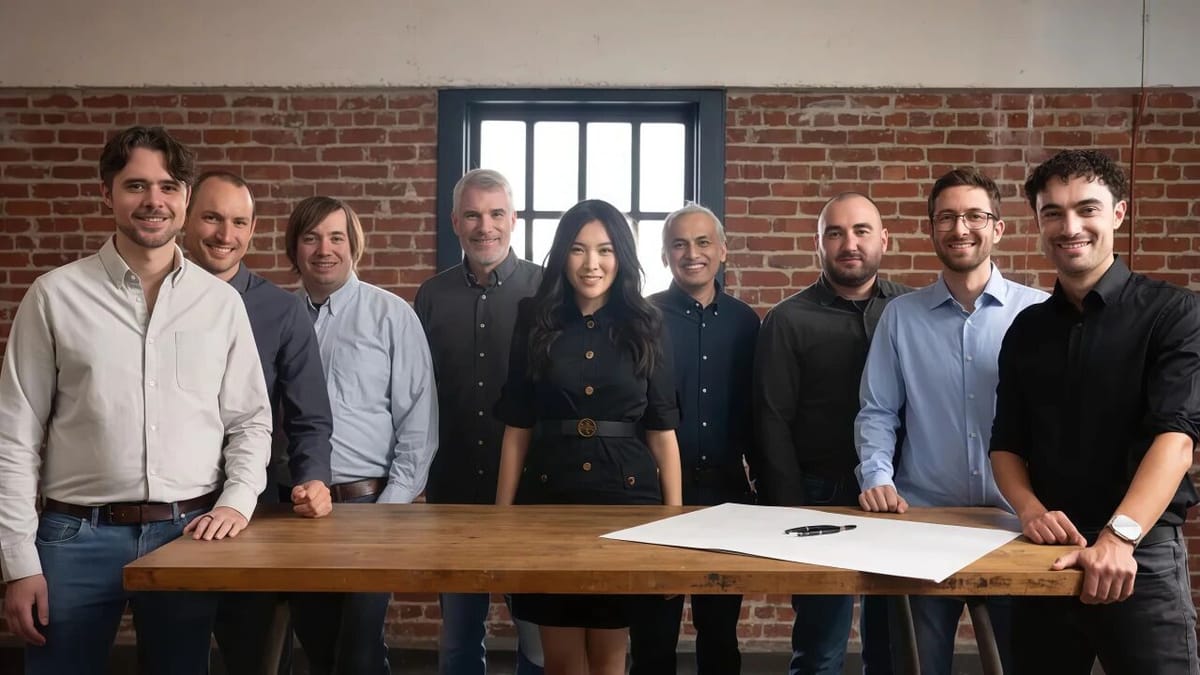
Carina Hong, a 24-year-old mathematician born in Guangzhou, has raised $64 million (approximately 460 million yuan) in Series A funding for her AI startup Axiom Math, which aims to build "super-intelligent reasoning systems" capable of solving complex mathematical problems and generating new mathematical conjectures.
The round was led by B Capital, with participation from Greycroft, Madrona and Menlo Ventures, valuing the company at $300 million (approximately 2 billion yuan). Hong represents a growing cohort of Gen Z entrepreneurs making their mark in the AI sector, bringing fresh perspectives to tackle problems that have challenged traditional large language models.
Axiom's approach addresses a critical gap in current AI capabilities. While some large language models can achieve 96% accuracy on American Mathematics Invitational exams, their performance drops to just 5% when required to show proof processes, according to Hong. Her company converts mathematical content from textbooks, papers and journals into programmatic knowledge that AI can use to solve problems with verifiable reasoning.
The funding comes as investors increasingly back young AI entrepreneurs who entered the field without preconceived notions about technological limitations, potentially giving them advantages in developing breakthrough solutions.
From Academic Excellence to AI Innovation
Hong's journey to entrepreneurship began with exceptional academic achievements across multiple institutions. After graduating from South China Normal University High School, where she was one of only four female members of the provincial Mathematical Olympiad team, she earned dual degrees in mathematics and physics from MIT in 2022.
Her undergraduate work included research on L-functions of modular elliptic curves and K3 surfaces, moonshine conjectures, and pop-stack sorting algorithms. She received both the Schafer Prize for Excellence in Mathematics, awarded annually to one undergraduate woman, and the Morgan Prize, the highest honor for undergraduate mathematics students in North America.
Following her MIT graduation, Hong became one of only four Chinese recipients of the Rhodes Scholarship in 2022, pursuing a master's degree in neuroscience at Oxford University. She later enrolled at Stanford University for dual doctoral degrees in mathematics and law before leaving to found Axiom in 2024.
The company's origins trace to a weekend coffee shop conversation between Hong and Shubho Sengupta, then at Meta, where they discussed the intersection of their research and the potential for AI to solve challenging mathematical problems.
Building AI Mathematical Reasoning Capabilities
Axiom's 10-person team includes several former Meta AI researchers with deep expertise in mathematical reasoning and distributed systems. Chief Technology Officer Shubho Sengupta previously led Meta's FAIR team and developed OpenGo and CrypTen, while also contributing to Google's distributed training systems and early CUDA technology development.
François Charton, who led large language model research in mathematics and theoretical physics at Meta, began exploring Transformer applications to complex mathematical problems in 2019. Hugh Leather, another Meta alumnus, developed some of the first large language models for compiler and GPU code generation.
The company's technology converts English mathematical content into programmatic knowledge, enabling AI systems to solve mathematical problems with detailed, verifiable reasoning processes. Future applications could extend to financial modeling, chip architecture design, and quantitative trading, with Hong envisioning the model potentially proposing new mathematical conjectures and generating novel knowledge.
B Capital partners noted that solving complex mathematical problems underlies many human inventions, making tools capable of proposing and verifying new quantitative hypotheses highly valuable for decision-making across industries.
Gen Z Entrepreneurs Drive AI Innovation Wave
Hong joins a growing roster of Gen Z founders securing significant funding for AI ventures. Recent examples include Sola Solutions, founded by 22-year-old Jessica Wu and 23-year-old Neil Deshmukh from MIT, which raised $21 million (approximately 150 million yuan) across seed and Series A rounds led by Conviction and Andreessen Horowitz respectively.
Anysphere, the AI coding startup behind Cursor, raised 900million (approximately 6.5 billion yuan) in Mayata 9 billion valuation. The company was founded by four MIT graduates in 2022, led by Michael Truell, who dropped out to focus on revolutionizing programming workflows.
In China, similar patterns emerge with companies like Zero Times, founded by three Tsinghua University students who completed over 100 million yuan in angel funding rounds, backed by investors including Riverside Capital and Tongchuang Weiye.
Industry observers suggest Gen Z entrepreneurs may have advantages in AI innovation due to their fresh perspectives and lack of preconceptions about technological constraints. As one venture capitalist noted, when established experience becomes less applicable to emerging technologies, younger founders' willingness to challenge assumptions can drive breakthrough innovations.