
Alibaba and Tencent Pour RMB 120B in a Single Quarter Into AI as China's Infrastructure Race Escalates
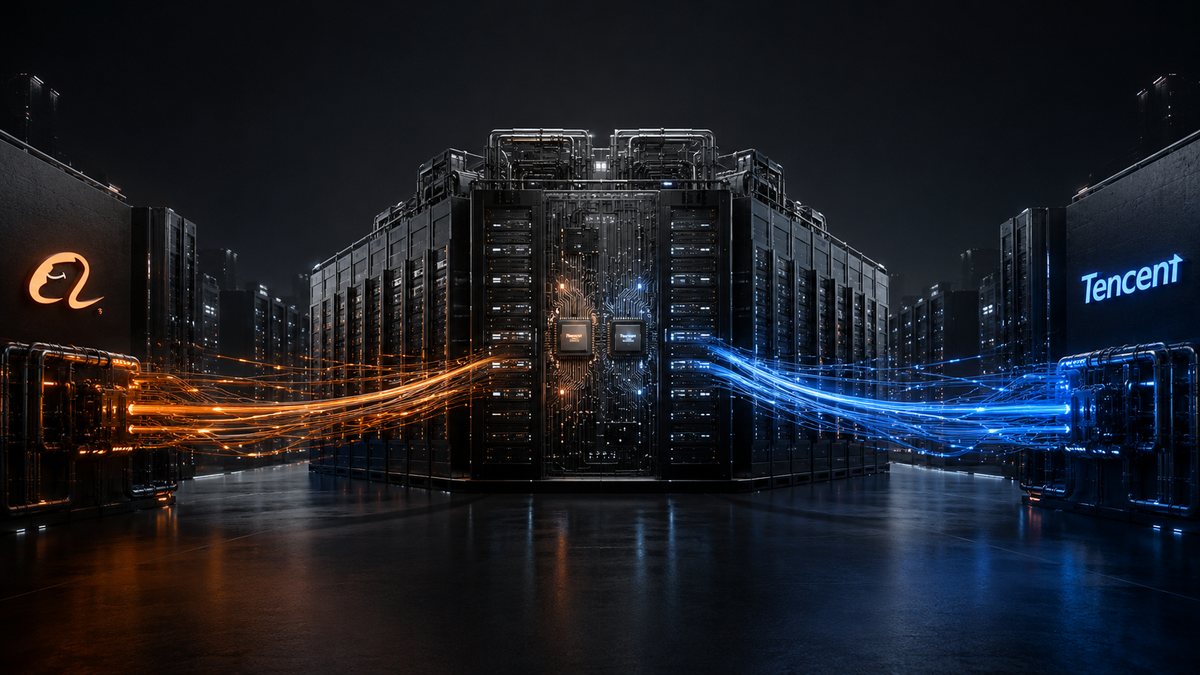
Combined capital expenditure of China's two largest internet groups surpasses RMB 120 billion (US$16.7 billion) in a single quarter, with free cash flow turning deeply negative — signaling a structural shift in how Big Tech allocates capital and rewards shareholders.
The numbers from China's latest earnings season are unambiguous: the AI infrastructure race has entered a stage that most competitors simply cannot afford to enter. Alibaba reported capital expenditure of RMB 67.66 billion (US$9.4 billion) for the quarter ended June 2026, a 75% year-on-year surge that dwarfed every rival. Tencent, which had itself set what appeared to be a record just days earlier with RMB 52.78 billion (US$7.3 billion) in capex — the highest single-quarter figure ever recorded among China's internet majors — was immediately overshadowed. Together, the two companies deployed RMB 120.44 billion (US$16.7 billion) in a single quarter, with analysts estimating at least 80% directly attributable to AI infrastructure, including data center construction, server procurement, and chip acquisition.
The market's initial reaction to these figures, however, is more nuanced than a simple "spend more, win more" narrative. A consensus that had held for years — that aggressive capital deployment automatically justified higher price targets — is visibly fraying. Investors are increasingly scrutinizing free cash flow, and both Alibaba and Tencent are now generating deeply negative numbers on that metric: Alibaba's free cash flow stood at negative RMB 44.67 billion (US$6.2 billion) for the quarter, while Tencent's came in at negative RMB 13.8 billion (US$1.9 billion). For platforms long celebrated as cash-generation machines, this represents a genuine inflection point.
Alibaba's Cloud Growth Steepens, Reclaiming Global Tier-One Status
The revenue case for Alibaba's spending is, at least for now, holding up. The company's AI Cloud and Computing Power Services segment posted revenue of RMB 48.44 billion (US$6.7 billion) for the quarter, with Alibaba Cloud's external commercialization revenue growing 45% year-on-year — a 22-quarter high and a sequential acceleration from 38% and 40% in the preceding two quarters. That growth rate now exceeds both Microsoft Azure and Amazon Web Services on a comparable basis, placing Alibaba Cloud back in the global high-growth tier alongside Google Cloud.
Alibaba Group CEO Wu Yongming told analysts on the earnings call that the acceleration reflects simultaneous demand across compute, storage, Model-as-a-Service (MaaS), and AI applications. The pricing environment is also supportive: a Citigroup report dated August 8, 2026 documented a 15.2% rise in Blackwell instance rental prices over three months, with new capacity being absorbed almost immediately by training and inference workloads. When compute is scarce, pricing power concentrates at the infrastructure layer — a structural advantage for full-stack cloud providers over pure-play model companies.
AI Revenue ARR Hits RMB 49.5 Billion, Establishing a Trackable Monetization Benchmark
Beyond headline cloud growth, Alibaba has introduced a metric that sets it apart from every other Chinese technology company: a disclosed annualized run-rate (ARR) for AI-related products. This quarter, AI-related product ARR reached RMB 49.5 billion (US$6.9 billion), with AI revenue as a share of external commercialization revenue rising from 30% last quarter to 35%. Quarterly AI-related product revenue reached RMB 12.38 billion (US$1.7 billion).
Wu Yongming indicated that AI-related revenue is on track to exceed 50% of external cloud commercialization revenue within one year. For context, Amazon Web Services — the only US hyperscaler to disclose a comparable AI revenue ARR — reported a figure exceeding US$25 billion, representing roughly 15% of AWS revenue. Alibaba's willingness to publish a quarterly-trackable AI ARR figure creates a disclosure standard that no other Chinese cloud provider currently matches, and directly addresses investor demand for evidence that AI spending is translating into recurring commercial returns.
Proprietary Chip Deployment Drives Margin Expansion Toward 20% Target
The more strategically significant development this quarter may be on the margin line. The AI Cloud and Computing Power Services segment reported adjusted EBITA of RMB 5.63 billion (US$782 million), up 133% year-on-year, with the adjusted EBITA margin expanding from 9.1% last quarter to 11.6%. Revenue growth and margin improvement are now occurring simultaneously — a combination that was not present in Alibaba's prior cloud growth cycle between 2019 and 2021, which was driven by enterprise digitization and conventional application migration.
The margin improvement pathway runs directly through Alibaba's in-house chip program. The T-Head Zhenwu M890 chip — the company's latest generation, based on a domestic GPU architecture — has been commercially launched on Alibaba Cloud in a "super-node" configuration since August 2026, making it one of only two domestically produced chips in China available at scale in super-node form. The T-Head chip portfolio now serves more than 650 external customers across 20-plus industries, covering training, fine-tuning, and inference workloads.
Morgan Stanley, in an August 18, 2026 research note, modeled two IaaS capacity expansion scenarios for Alibaba. Under the self-build GPU IaaS model, operating margin is estimated at approximately 43.5%, with a return on invested capital of 13.2% and a cash payback period of roughly 3.1 years. The MaaS layer is more lucrative still: the bank's base-case operating margin for MaaS is 53%, with a cash payback period of approximately 2.5 years. Morgan Stanley projects a clear path for Alibaba Cloud's overall margin to expand from the current 11%–12% range toward a long-term target above 20%, with Wu Yongming himself expressing confidence in achieving the company's stated goal of US$100 billion in external cloud commercialization revenue before 2030.
A Three-Tier Market Crystallizes: Alibaba, Tencent, ByteDance — Then Everyone Else
The quarterly data now makes explicit what was previously a matter of inference: China's AI infrastructure competition has bifurcated into two distinct leagues. Alibaba, Tencent, and privately held ByteDance — which does not report financials but is estimated by analysts to be deploying capex at a scale comparable to Tencent's — constitute the only three companies still competing across the full AI value chain, from public cloud and foundational models to video generation, enterprise software, and consumer applications.
By contrast, Baidu and Kuaishou, along with other second-tier internet groups, are reporting quarterly capex in the range of RMB 6–8 billion (US$833 million–US$1.1 billion) — roughly one-tenth the scale of the top tier. This is not necessarily a market-negative signal for those companies; capital markets have recently shown greater appreciation for free cash flow discipline. But it does mean that the ambition of "full-stack AI" positioning is effectively off the table for anyone outside the top three.
The combined AI-related capex of Alibaba, Tencent, and ByteDance for the quarter is estimated at approaching RMB 150 billion (US$20.8 billion). The structural logic is self-reinforcing: whichever of the three pulls back first cedes ground in cloud, model capability, and application ecosystems simultaneously.
Shareholder Returns Compress as Free Cash Flow Turns Negative
The capex surge carries a direct cost for shareholders in the near term. Tencent, historically one of the most aggressive buyback operators among Chinese technology companies, repurchased only RMB 24.4 billion (US$3.4 billion) worth of shares in the first half of 2026 — a one-third decline year-on-year. Alibaba repurchased just US$160 million in shares last quarter, a fraction of its historical pace.
Both companies retain low leverage ratios and balance sheet flexibility, which analysts believe will allow them to fund incremental AI investment primarily through debt issuance in the near term rather than equity dilution. The parallel with US hyperscalers is instructive but imperfect: Alphabet, long regarded as one of the most cash-rich companies in global technology, has recently conducted equity financing to support its own AI infrastructure buildout. Alibaba and Tencent are not at that threshold yet, but the direction of travel is clear.
The Monetization Clock Is Running: Agentic AI Demand Must Sustain the Investment Case
The critical open question is duration. The current wave of AI revenue growth is heavily concentrated in Agentic Coding and Workflow automation, with a secondary contribution from multimodal applications, particularly video. Entering July 2026, there are early signs that penetration rates for "vibe coding" tools may be approaching a plateau, though enterprise AI-driven collaborative workflow adoption is argued by some analysts to still be in early innings.
If global AI application revenue growth sustains through the second half of 2026 and into 2027, the capital allocation decisions made by Alibaba, Tencent, and their US counterparts will be validated. If growth decelerates materially before the infrastructure investment cycle matures, capex plans across the industry will face revision. The supply chain beneficiaries — compute and storage hardware vendors — are insulated from this uncertainty in the near term; demand from the top-tier platforms ensures that most capacity will find buyers regardless of which application layer ultimately drives end-user revenue. The platform investors bear the duration risk.
For now, Alibaba's combination of 45% cloud growth, a disclosed and expanding AI ARR, accelerating margin improvement, and a proprietary chip program advancing toward commercial scale represents the most complete publicly verifiable AI monetization story among Chinese technology companies. The growth curve is steepening. The question is how long the slope holds.
Related Coverage:
Tencent's RMB 52.8B AI Bet Signals a New Phase of China's Compute Race
Alibaba Trades Profit for AI Dominance as Cloud Growth Hits 22-Quarter High