
Alibaba Bets $20GW Data Center Empire on 'Machine Intelligence' Supercycle
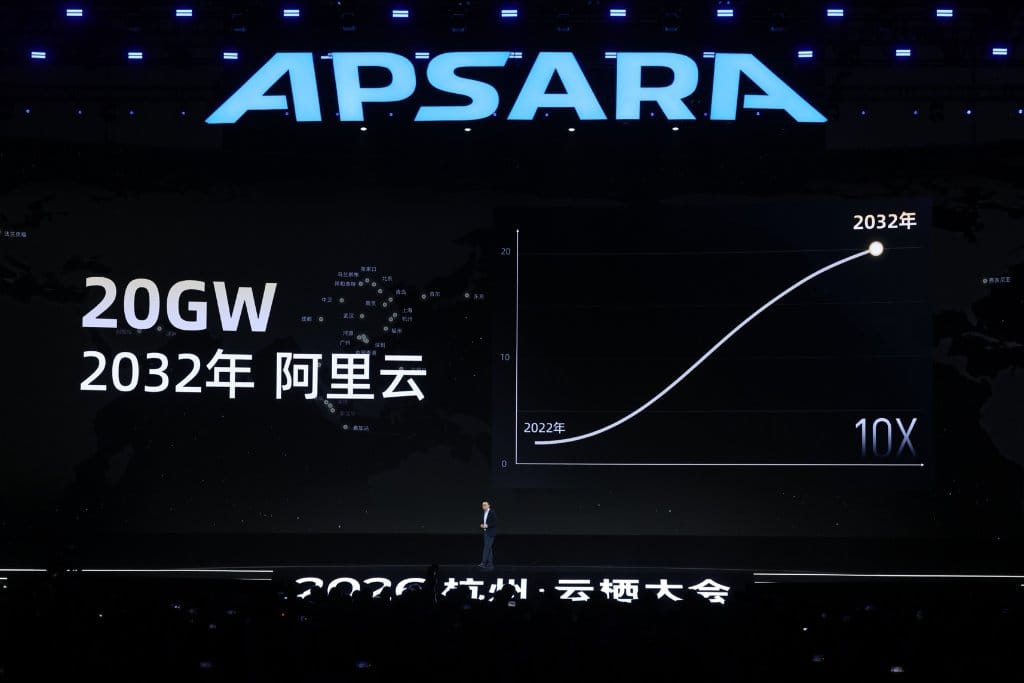
Alibaba Group is staking its next decade on a single conviction: that the global supply of machine-generated intelligence will eventually dwarf human cognitive output by a factor of 1,000, and that whoever builds the infrastructure first will capture the commanding heights of that market.
Speaking at the 2026 Hangzhou Yunqi (Cloud Computing) Conference on Monday, Alibaba Group CEO Eddie Wu unveiled the most explicit and quantified AI infrastructure roadmap the company has ever disclosed publicly. Within minutes of the announcement, Alibaba's Hong Kong-listed shares climbed more than 4%, touching a one-month intraday high — a market signal that investors are beginning to price in the company's transition from a diversified internet conglomerate to a vertically integrated AI infrastructure play.
The timing is deliberate. With U.S. export controls continuing to constrain Chinese companies' access to Nvidia's most advanced GPUs, Alibaba's dual announcement — a homegrown chip and a six-year capacity target — positions the company as both a demand aggregator and a supply-side sovereign in the global AI compute race.
Supply Crunch Drives 20GW Capacity Mandate
Wu's central argument is not aspirational; it is supply-chain arithmetic. He stated bluntly that current mid-to-long-term AI demand "far exceeds" Alibaba's ability to supply, and that global supply-chain bottlenecks for AI data center components are directly constraining Alibaba Cloud's compute growth rate — even as cloud revenue continues to accelerate.
"We are racking AI compute at full speed to meet customer demand," Wu said, adding that client appetite remains "extremely strong."
The 20GW target for Alibaba Cloud-operated global data centers by 2032 is the company's direct operational response to that gap. For context, 20GW of data center capacity would represent a scale comparable to the combined current AI infrastructure ambitions of several major hyperscalers — a benchmark that underscores how aggressively Alibaba is recalibrating its capital allocation priorities. The company did not disclose total capital expenditure figures associated with the buildout, but the scale implies multi-year spending commitments running into the hundreds of billions of renminbi.
Wu framed the infrastructure imperative through a historical analogy that is likely to resonate with investors familiar with the early electrification era: "No matter how many new inventions come later, the first step is always to build enough power stations and lay enough grid lines." He noted that total global electricity generation circa 1900 — when household appliances were already proliferating — would power today's world for only two hours, a data point he used to illustrate how severely current AI infrastructure lags behind eventual demand.
Zhen Wu V900 Challenges Nvidia's Ecosystem Lock-In
The hardware centerpiece of Monday's event is the Zhen Wu V900, the latest AI accelerator from Alibaba's chip unit T-Head Semiconductor. Wu described it as currently the highest-performance domestically produced AI chip in China, delivering three times the compute throughput of its predecessor, the Zhen Wu M890.
The V900's cluster scalability is the more strategically significant figure: a single cluster built on the chip can scale to 500,000 cards — a configuration capable of training and running inference on frontier-scale models. That number matters because cluster scalability, not raw chip performance, is the primary bottleneck for training models at the parameter counts that define competitive frontier AI.
T-Head has now completed a full data center chip stack: the Zhen Wu GPU series, the Yitian CPU series, the Panmai intelligent network interface cards, and ICN interconnect chips. Alibaba says it is conducting joint optimization across chips, servers, supernodes, networking, models, and inference systems to maximize token throughput across the entire cluster — a systems-level integration strategy that mirrors, at least in ambition, Nvidia's CUDA ecosystem approach.
The M890-based AI supernode is already running at scale on Alibaba Cloud, supporting inference on models exceeding 2 trillion parameters. Alibaba said it will add new service nodes in Q4 2026 to expand supernode supply. The company projected that T-Head's annual AI chip shipment volume will "increase substantially" as the product line matures and customer adoption broadens, though it stopped short of providing unit or revenue guidance.
5–10 Trillion Parameter Models Signal ASI Ambitions
On the software side, Alibaba's Qwen team is pursuing a technical pathway it calls Recursive Self-Improvement (RSI) — a training paradigm in which models identify their own weaknesses through real-world task feedback, design their own experiments, construct training data, and iteratively refine their own architecture. Wu described this as the clearest technical route the AI research community has mapped toward Artificial Superintelligence (ASI).
Alibaba disclosed that it plans to train a new model at 5 to 10 trillion parameters — a scale that would place it among the largest language models ever attempted globally. The stated objective is handling "more complex, longer-horizon tasks," a capability profile aligned with agentic AI workflows rather than single-turn query-response interactions.
The multimodal dimension is equally prominent. Alibaba is developing unified understanding-and-generation multimodal models, positioning them as the interface layer through which users will eventually interact with machine intelligence without navigating complex UI frameworks.
Qwen Intelligence Enters Mobile via Honor Partnership
Alibaba is not waiting for ASI to monetize its model stack. Wu announced the formal launch of Qwen Intelligence, a mobile AI solution platform for hardware partners. The first commercial deployment comes through a partnership with Honor, whose Magic9 series — scheduled to launch September 28 — will be the first devices to ship with Qwen Intelligence natively integrated. Honor's Robot Phone will also support the platform at launch.
The joint solution, developed on Qwen Intelligence and Honor's MagicOS, achieves a composite task accuracy rate of 91.8%, a GUI operation speed of 3.6 seconds, supports over 100-step operations for complex long-horizon tasks, and delivers an end-to-end service completion rate exceeding 90%. These metrics position the Alibaba-Honor stack as a direct competitor to Apple Intelligence and Google's Gemini Nano deployments in the premium Android segment.
On the desktop side, Alibaba's open-source Qwen2-7B model remains, by the company's account, the most widely adopted model among global developers. Wu said Alibaba will continue optimizing lightweight open-source models to support on-premise deployment by enterprises and independent developers.
Reframing AI's Economic Logic
Wu's most consequential assertion may be the one least amenable to near-term verification: that today's AI applications — coding assistants, report generation, workflow automation — represent only the "primary stage" of machine intelligence, analogous to the electric light bulb in 1882. The transformative products of the machine intelligence era, he argued, have not yet been invented.
The investment implication is direct. If Wu's framework is correct, the companies that build infrastructure now — before the killer applications emerge — will occupy the same structural position that early electricity grid operators held relative to the appliance manufacturers who came later. Alibaba is explicitly betting that it can be the grid, not just another appliance.
The 1,000x cognitive output ratio Wu cited is not a near-term projection but a long-run equilibrium argument: just as machines now perform an estimated 99.9% of physical work, Wu projects that machine cognition will eventually dominate human cognitive output by a comparable margin. Current machine thinking, he estimated, accounts for roughly 3% of human cognitive volume — implying, by his arithmetic, tens of thousands of times of remaining growth headroom.
For investors, the key variable is not whether Wu's vision is correct, but whether Alibaba can execute the infrastructure buildout fast enough, and at sufficient cost efficiency, to remain competitive against both U.S. hyperscalers and domestic rivals including Huawei , ByteDance , and Tencent — all of whom are pursuing parallel infrastructure strategies under the same supply-constrained conditions.
Related Coverage:
Alibaba’s 4B Qwen-Drive Tests a More Efficient Path to Autonomous Driving
Alibaba's Qwen3.8-Max Seizes Front-End AI Crown at One-Fifth the Price of Top Rivals
Alibaba's Qwen3.8-Flash Rewrites the AI Cost Curve, Previews Qwen4 Architecture