
Alibaba Unveils High-End AI Chip ‘Zhenwu 810E’ to Rival Nvidia’s H20, Cementing Full-Stack Strategy
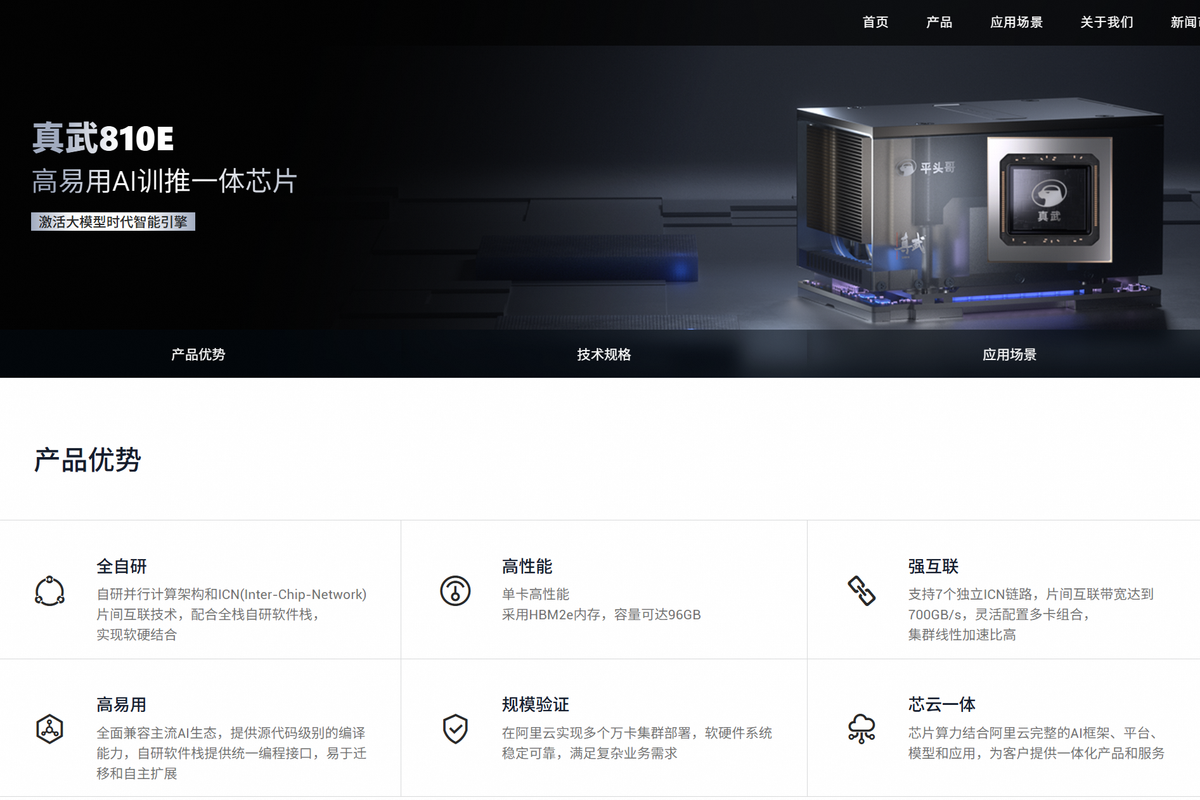
Alibaba has officially released the "Zhenwu 810E," a new generation artificial intelligence chip designed for high-performance model training and inference. The launch marks a critical step in the technology giant's strategy to secure semiconductor self-sufficiency, with the processor already deployed at scale within Alibaba Cloud infrastructure.
Developed by the company’s chip division, T-Head, the Zhenwu 810E is reportedly operating in clusters exceeding 10,000 units. Industry sources indicate that the chip’s overall performance metrics surpass Nvidia Corp.’s A800 and mainstream domestic GPUs, placing it on par with Nvidia’s H20. Reports from foreign media further suggest that an upgraded version of the processor may outperform the Nvidia A100, signaling strong demand and a competitive cost-performance ratio in a supply-constrained market.
The commercial rollout of the Zhenwu 810E has already secured adoption from over 400 enterprise clients, including XPeng and the State Grid Corporation of China. This widespread deployment underscores Alibaba's transition into a select tier of global technology firms—alongside Alphabet Inc.’s Google—capable of controlling a full-stack AI ecosystem comprising proprietary large models, cloud infrastructure, and custom silicon.
The release comes amidst recent market speculation regarding a potential spinoff and initial public offering of the T-Head unit. By demonstrating the viability of its high-end silicon in demanding scenarios ranging from autonomous driving to multi-modal content generation, Alibaba is effectively validating the technological maturity and market value of its chip manufacturing arm.
Hardware Architecture and Interconnect Capabilities
The Zhenwu 810E is engineered to address the bottlenecks of large model training through advanced memory and interconnect specifications. According to official product details updated on T-Head’s website, the chip utilizes HBM2e high-bandwidth memory, offering a single-card memory capacity of up to 96GB. It connects to host systems via PCIe 5.0 x16 interface.
A key feature of the architecture is the inclusion of seven independent Inter-Chip-Network (ICN) ports, a proprietary technology developed by T-Head. These ports deliver a chip-to-chip interconnect bandwidth of up to 700GB/s, facilitating low-latency communication essential for multi-card collaborative computing. This architecture is designed to maintain high linear acceleration efficiency as cluster sizes expand, directly supporting the massive computational requirements of modern AI workloads.
On the software side, the chip is paired with a self-developed AI software stack that provides a unified programming interface. T-Head claims this stack is compatible with mainstream AI frameworks, allowing users to migrate applications without modifying code. The system also supports source-code-level compilation, enabling autonomous extension and secondary development by customers.
Strategic Integration and Performance Benchmarks
The launch of the Zhenwu 810E completes what Alibaba terms its "Golden Triangle" of AI: the "Tongyi" (Qwen) large models, Alibaba Cloud, and T-Head chips. The company aims to function as an integrated AI supercomputer, coordinating innovation across chip architecture, cloud platforms, and model structures to maximize efficiency.
The chip has been extensively used for the training and inference of Alibaba’s own Tongyi Qianwen large models. By optimizing the hardware specifically for its software stack, Alibaba seeks to offer an integrated product service that rivals third-party solutions.
Industry feedback highlights the chip's stability and performance. While officially positioned as comparable to the Nvidia H20, the Zhenwu 810E is described by practitioners as having superior cost-effectiveness. The chip’s ability to handle large-scale parameter training and multi-modal fusion is supported by its custom interconnect technology, which alleviates communication bottlenecks often found in massive training clusters.
Commercial Adoption and Diverse Use Cases
The Zhenwu 810E targets distinct high-demand sectors, including autonomous driving, internet services, and consumer electronics. In the automotive sector, the chip supports the full computational lifecycle from data generation and model training to cloud-based simulation. It is compatible with over 50 common autonomous driving models and possesses strong generalization capabilities, allowing for deployment without specialized adaptation.
For multi-modal applications, the processor combines AI computing power with hardware-level video decoding capabilities. It has successfully passed verification tests for text-to-video, image-to-video, and image-text generation scenarios, supporting models such as Tongyi Wanxiang.
Currently, the chip is available to external customers via Alibaba Cloud, providing AI training and inference computing services. The successful deployment across hundreds of clients, including major entities like State Grid and XPeng, validates the system's operational stability in real-world business environments.