
BYD Launches 4nm Self-Developed Smart Driving Chip, Commits to L3/L4 Safety Liability
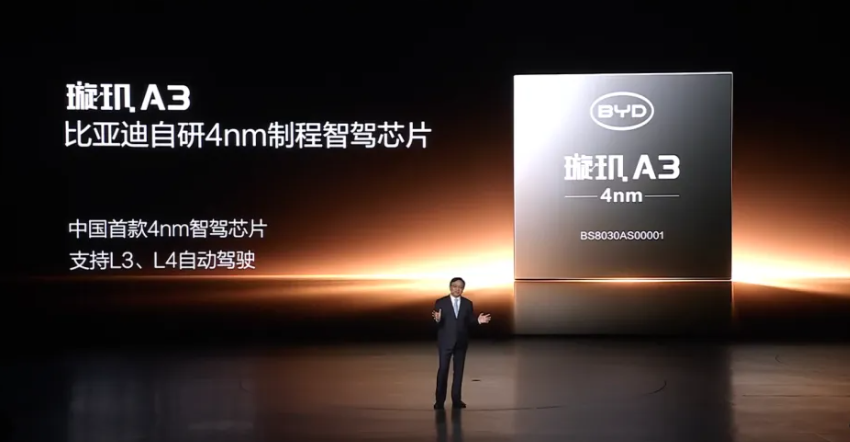
BYD deepened its vertical integration strategy on May 28, unveiling the Xuanji A3—China's first domestically developed 4nm automotive-grade smart driving chip—while committing to shoulder L3 and L4 safety responsibilities during L2-stage deployment, a move that signals both technical confidence and a calculated bet on regulatory positioning ahead of autonomous driving commercialization.
The announcement marks a structural shift in China's smart mobility supply chain. By delivering a 4nm chip matching specifications typically associated with L3/L4 systems, BYD Chairman Wang Chuanfu positioned the automaker as the only global carmaker controlling the full semiconductor value chain—from product definition through wafer fabrication to testing. The three-chip architecture delivers combined computing power exceeding 2,100 TOPS, with power consumption per unit of computing power 20% lower than competing products, according to company disclosures.
Wang framed the technological leap in stark terms: "A 4nm automotive-grade chip equals a 2nm consumer-grade chip in difficulty." The assertion underscores process node challenges in automotive applications, where temperature ranges, reliability standards, and longevity requirements far exceed consumer electronics.
Liability Assumption Expands From Parking to Highway-Speed Navigation
BYD's second major reveal—a one-year safety underwriting commitment for urban navigation functions—extends liability coverage from parking scenarios, where the company introduced similar guarantees in July 2025, to highway-speed and urban arterial driving. The automaker now assumes full financial responsibility for repair costs, third-party property damage, and personal injury claims arising from qualified users' operation of its Tianshen Eye A and B systems in city navigation mode.
The guarantee applies immediately to new buyers and, following over-the-air updates to Tianshen Eye 5.0, to existing owners. Crucially, BYD confirmed claims will not affect users' commercial insurance premiums in subsequent years—a detail likely aimed at removing behavioral friction in feature adoption.
Data disclosed at the event suggests the parking liability program drove measurable engagement: usage rates jumped from 21% to 93%, with "near-zero accident rates." Whether similar adoption dynamics materialize for higher-speed functions remains an empirical question, but the financial commitment itself redistributes risk between manufacturer and end-user in a manner uncommon among Chinese automakers still relying on boilerplate disclaimers.
Chip Autonomy Reflects Broader Hedging Against Supply Chain Volatility
BYD's chip announcement carries geopolitical undertones. The company disclosed it operates four chip R&D centers and five wafer fabrication plants, including what it describes as "China's largest 12-inch wafer fab dedicated to automotive-grade production" in Chengdu. Total chip development spending has exceeded RMB 100 billion (US$13.9 billion), with a team of over 7,000 engineers.
The vertical integration spans seven stages: product definition, architecture design, circuit design, layout design, wafer manufacturing, packaging, and testing. No other automaker globally claims end-to-end control over this stack, according to BYD. The strategic rationale is transparent—reducing dependence on external chip suppliers mitigates exposure to supply disruptions, export controls, or pricing volatility that have roiled automotive production since 2021.
The 4nm node itself represents a generational leap for Chinese automotive semiconductors. While consumer electronics have pushed into 3nm territory, automotive-grade processes lag due to qualification timelines and safety validation requirements. BYD's claim of 100% improvement in computing power utilization—achieved through co-optimization of proprietary algorithms and silicon architecture—suggests the chip was purpose-built for its perception and planning software, rather than adapted from off-the-shelf designs.
Data Scale Underpins Algorithmic Confidence
BYD's safety commitments rest on accumulating real-world mileage. As of March 31, 2026, the company reported 2.85 million vehicles equipped with advanced driver assistance systems (ADAS)—including both Tianshen Eye and Huawei-sourced Qiankun systems—generating over 180 million kilometers of data daily. In March 2026 alone, BYD sold 129,610 ADAS-equipped vehicles.
This data velocity positions BYD alongside Tesla and Xpeng as one of the few automakers operating fleets large enough to train perception models at scale. The company's willingness to underwrite liability suggests internal validation metrics meet thresholds for commercial risk assumption, though no benchmarking data against competitors was disclosed.
Charging Network Expansion Tied to Delivery Compensation
BYD introduced a delivery delay compensation mechanism: buyers of "flash-charging" models who experience order-to-delivery timelines exceeding 30 days will receive one day of free charging credits for each additional day of delay. The move addresses near-term production bottlenecks while creating a switching cost for buyers considering cancellation.
The automaker operates over 6,100 fast-charging stations—the largest self-built network among Chinese OEMs. Under its "Flash Charging China" initiative launched in March 2026 alongside second-generation Blade batteries, BYD targets 20,000 stations by year-end 2026. The compensation program effectively converts delivery friction into charging network engagement, reinforcing the vertically integrated ecosystem strategy evident in chip and battery investments.
Three-Pillar Vision Frames Long-Term Positioning
Wang outlined three strategic objectives for BYD's "intelligent second half": achieving zero traffic accidents, enabling "Super Driver" autonomous capabilities, and delivering a "Super Secretary" AI assistant. He tied these goals to advances in perception hardware, AI algorithms, and data accumulation, framing them as inevitable rather than aspirational.
The company simultaneously launched "DiDiXia," an AI assistant supporting whole-vehicle memory, cross-domain interaction, edge-cloud collaboration, and dual-speed reasoning functions. While technical specifications remain sparse, the branding signals intent to compete in the emerging vehicle-as-platform arena where software services generate recurring revenue beyond hardware sales.
Market Implications
BYD's dual announcements—chip autonomy and liability assumption—compress timelines for autonomous feature deployment while hedging technical and legal risks. The 4nm chip entering mass production in 2026 positions BYD to iterate smart driving functions without external chip roadmap dependencies, while the safety guarantee shifts responsibility upstream in a manner that could pressure rivals to match commitments or risk perception gaps.
For investors, the RMB 100 billion chip investment and 7,000-person engineering team represent capital intensity levels typically associated with dedicated semiconductor firms, not vertically integrated automakers. Whether this spending yields defensible competitive moats—or merely raises baseline R&D thresholds for all players—will determine returns on a bet that collapses traditional automotive and tech industry boundaries.
The charging delay compensation and safety liability programs carry near-term P&L impacts, but also function as customer acquisition tools in a market where delivery predictability and post-sale risk mitigation influence purchase decisions. BYD's ability to self-insure these commitments, backed by 2.85 million ADAS-equipped vehicles and 180 million daily data kilometers, suggests confidence in actuarial models competitors may lack the data scale to replicate.
Related Coverage:
China's Semiconductor Strategy Pivots as Xiaomi and NIO Drive Private Silicon Development