
BYD's Ultra-Fast Charging Battery Puts Nio's Swap Model Under Pressure in 2026
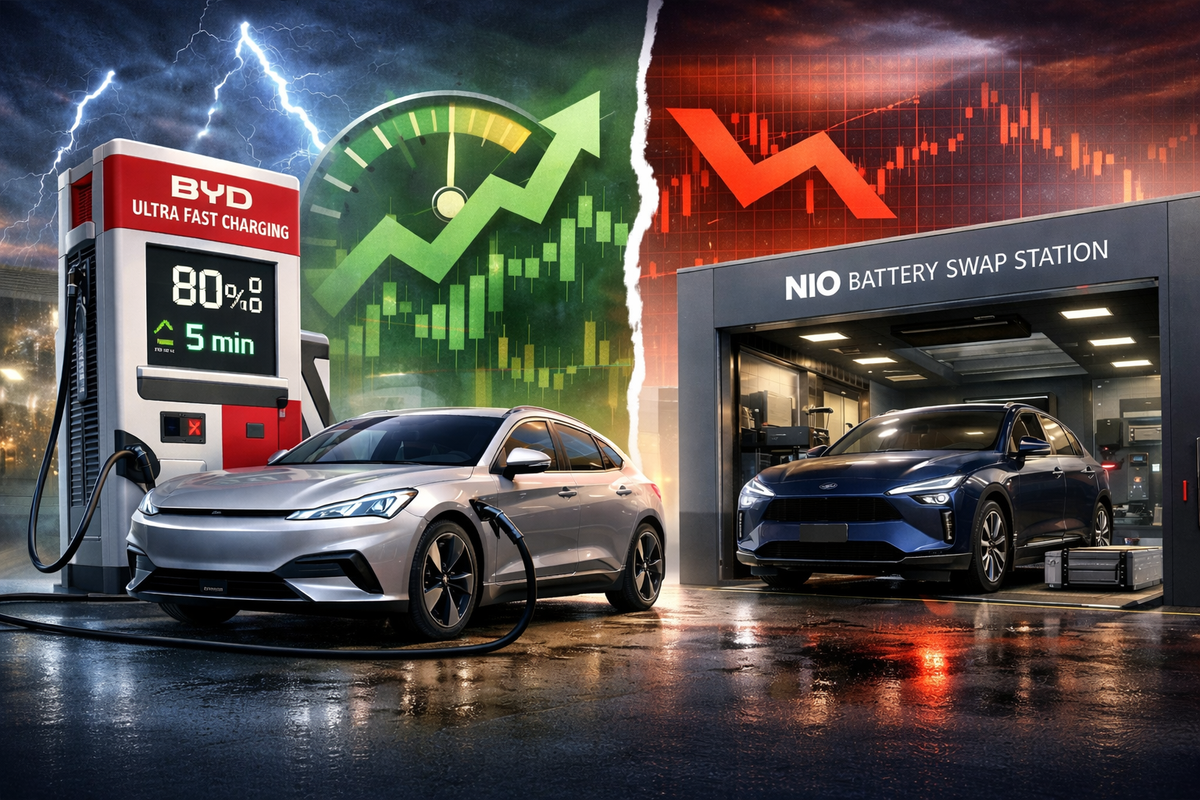
BYD has unveiled a new battery technology capable of ultra-fast charging, posing a direct and formidable challenge to the core business model of its rival Nio . The development escalates the intense competition in China’s electric vehicle market, pitting BYD’s technology-centric approach against Nio’s service-oriented battery-swapping network and setting the stage for a critical battle over the future of EV refueling in 2026.
At a launch event on March 5 in Shenzhen, BYD Chairman Wang Chuanfu announced the second-generation Blade Battery, capable of charging from 10% to 70% in just five minutes and to 97% in nine minutes. Crucially, the battery demonstrates strong performance in extreme cold, charging from 20% to 97% in 12 minutes at minus 30 degrees Celsius. "Let the history of EVs struggling to cross the Shanhai Pass be over forever," Wang declared, targeting a key pain point for EV owners in China's frigid northern regions.
This technological leap strikes at the heart of Nio's value proposition. For years, Nio has championed its three-minute battery swap service as the only solution offering a refueling experience comparable to gasoline cars, a key differentiator that has justified its premium branding and heavy infrastructure investment. With BYD’s charging times now approaching the speed of Nio’s swaps, the latter’s primary competitive advantage is facing its most significant threat to date.
The announcement represents a clash of two distinct philosophies for solving EV range anxiety. BYD is pursuing a path of technological iteration, aiming to make batteries so efficient that swapping becomes redundant. Nio, meanwhile, has invested heavily in a service-based ecosystem, building a network of automated swap stations. The market’s response to BYD’s new technology in 2026 will be a crucial test for the long-term viability of Nio’s capital-intensive strategy.
A Direct Strike on Nio's Moat
BYD's challenge is not just the battery itself but the comprehensive ecosystem it plans to build. The company has already constructed 4,239 of its high-powered "Flash Charging" stations, with single piles capable of a 1,500kW peak, and aims to expand the network to 20,000 stations by the end of 2026. This rapid build-out is designed to create a dense and convenient network that rivals Nio's.
Nio’s battery-swapping network, built at an accumulated cost of over RMB 18 billion yuan (approx. US$2.5 billion), consists of 3,729 stations as of February 2026. While it has performed over 100 million swaps, the system faces a new competitive reality. When customers can find a nearby fast-charging station that replenishes their battery in under 10 minutes, the appeal of driving to a specific swap station—which may have limited battery availability and queues—is significantly diminished.
Nio's Defense: Chips and Premium Service
Nio is not without a counter-strategy. The company is attempting to widen its competitive moat beyond battery swapping, focusing on in-house technology and user experience. Just a week before BYD’s announcement, Nio’s chip subsidiary, Sj'enji Technology, completed an independent funding round of RMB 2.257 billion (US$318 million), led by state-affiliated investors from Hefei.
The unit’s core product is the NX9031, a 5nm automotive-grade chip for autonomous driving, which Nio claims is four times as powerful as Nvidia's Orin-X. The self-developed chip, already deployed in its flagship ET9 model, is projected to reduce per-vehicle costs by approximately 10,000 yuan. However, an internal Nio discussion acknowledged the limitations of this strategy, with one executive reportedly stating, "Chips can help us save money, but they can't help us attract new users. When buying a car, new users still ask about range and charging first."
Profitability Milestone Clouded by Margin Pressures
Nio achieved a significant milestone in the fourth quarter of 2025, reporting its first-ever adjusted operating profit. The company attributed this to sales growth, an optimized product mix, and cost-efficiency measures. Notably, the battery-swapping business, which remains a cost center, was not cited as a driver of profitability. The company's February 2026 deliveries were strong at 20,797 units, a 57.6% year-on-year increase, led by its popular ES8 SUV.
However, this growth has come at a cost. To boost volume, Nio has pursued a multi-brand strategy, introducing the lower-priced Onvo and Firefly brands. This has pushed the company into more competitive, lower-margin segments and diluted its premium image. The average selling price of its vehicles fell from 270,000 yuan in the same period of 2024 to 220,500 yuan in 2025, a price-for-volume trade-off that is squeezing its margins.
Battle of Philosophies: Open Tech vs. Closed Ecosystem
The competition between BYD and Nio highlights a fundamental strategic divergence in the EV industry. BYD's model is to develop core technologies, such as its Blade Battery, that can be sold to other automakers, allowing it to profit from the entire industry's growth. Its technology breakthroughs create a ripple effect across the supply chain.
In contrast, Nio has built a closed ecosystem. Its swapping network primarily services its own brands—Nio, Onvo, and Firefly. The company confirmed in November 2025 that even its entry-level Firefly brand would use Nio's proprietary swap stations and not integrate with partners like CATL, citing technical incompatibilities. This reinforces its commitment to its walled-garden approach, tying vehicle sales directly to its infrastructure.
2026 as a Make-or-Break Year for Battery Swapping
The year 2026 is shaping up to be pivotal for Nio. The company has two primary goals: achieve full-year non-GAAP profitability and, more critically, transform its battery-swapping network from a cost center into a profit center. The latter goal remains a steep climb. Despite reaching 100,000 swaps per day, the average station services only about 27 cars daily—far below the estimated 60-80 swaps required to break even.
The technological landscape is shifting beneath Nio’s feet. With 900V ultra-fast charging technology becoming increasingly standard across the industry—pursued by competitors and even Nio itself—the fundamental time advantage of swapping is eroding. If charging for 10 minutes to gain 500 kilometers of range becomes the norm, Nio’s vast and expensive network of swap stations risks becoming a stranded asset, weighing heavily on its balance sheet. While Nio fortifies its defenses with investments in next-generation chips and service, BYD's latest innovation has directly questioned the very foundation on which Nio's empire was built.