
BYD's Yangwang U9X Breaks Global Speed Record at 496 km/h, Limited to 30 Units
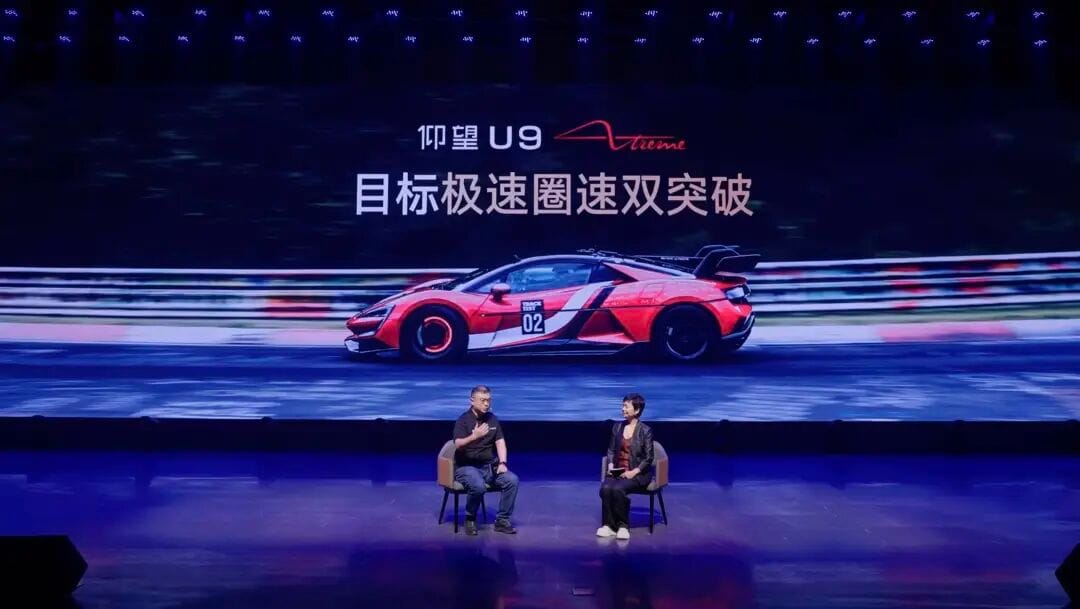
BYD has unveiled the Yangwang U9X, a track-focused version of its electric supercar that achieved a global automotive speed record of 496.22 km/h, surpassing all previous benchmarks for production vehicles. The announcement marks a significant milestone for Chinese electric vehicle technology in the ultra-high-performance segment.
The vehicle also set a new Nürburgring Nordschleife lap record of 6 minutes 59.157 seconds, demonstrating capabilities that extend beyond straight-line speed. Yangwang General Manager Hu Xiaoqing emphasized the engineering achievement required 3,000 horsepower, with each wheel delivering power equivalent to a complete traditional supercar rated at 750 horsepower.
The U9X will be available globally in a limited production run of 30 units, with pre-orders now open. Pricing details were not disclosed at the launch event held at Zhengzhou Racing Circuit on September 20.
Revolutionary Powertrain Architecture
The extreme performance targets necessitated breakthrough engineering solutions, starting with the world's first mass-production 1200V ultra-high-voltage platform. BYD's vertical integration capabilities enabled engineers to select premium silicon carbide chips from internal production to meet the U9X's demanding power requirements.
Contrary to industry expectations, the vehicle utilizes lithium iron phosphate battery technology rather than higher energy-density ternary lithium cells. Yangwang justified this choice citing superior high-temperature resistance, low-charge discharge capabilities, and enhanced safety characteristics crucial for track applications. The track-grade blade battery system allows full-day track operation without battery replacement, earning what the company calls "Nürburgring workhorse" status.
Advanced Control Systems Drive Performance
The U9X integrates Yangwang's Yisifang (e⁴) four-motor independent drive system with Yunlian-X suspension technology to manage the massive power output. The four-motor configuration delivers torque control response speeds 10 to 20 times faster than traditional mechanical systems, enabling real-time precision torque distribution to each wheel.
During Nürburgring testing across 177 corners, over 60% of braking energy was recovered through motor regeneration, significantly reducing traditional brake system loads. The system demonstrated its stability capabilities when a high-speed tire failure at nearly 300 km/h was controlled through instantaneous Yisifang system adjustments.
The Yunlian-X system introduces vertical control technology to the supercar segment, actively managing four-corner suspension geometry to optimize load transfer and maximize tire grip. This represents a functional evolution beyond the "dancing" demonstration capabilities of earlier versions.
Lightweight Engineering Compensates for System Complexity
To offset weight increases from the advanced control systems, Yangwang implemented aerospace-grade metal 3D printing technology throughout the vehicle structure. Both front and rear compartments utilize 3D-printed aluminum alloy components, while brake calipers employ 3D-printed titanium alloy construction.
These measures reduced overall vehicle weight by 100 kilograms compared to the standard U9 model. The lightweighting coefficient improved from 0.95 to 0.83, with lower values indicating superior efficiency ratios.
Market Positioning and Future Vision
Addressing questions about practical applications given highway speed limits, Hu Xiaoqing drew parallels to high-speed rail development, noting that trains traveled at just 60 km/h twenty years ago before today's 350 km/h service became standard. She positioned the U9X as future-oriented development, stating "someone must build cars for the future."
The limited production vehicles will feature unique customization options for each of the 30 units. The test vehicle livery incorporated names of initial U9 owners, which Yangwang described as recognition of customer support enabling the record-breaking achievement.