
China Auto Market Falls 20% in H1 2026 as EVs Hit 60% Penetration
China's passenger car market shed roughly 2.2 million units in the first half of 2026, with retail insurance registrations falling 20.2% year-on-year to 8.726 million vehicles — a structural reset that is reshaping the competitive hierarchy between domestic and foreign automakers at an accelerating pace.
The contraction is not a demand shock in isolation. The 2025 baseline was artificially elevated by two concurrent policy tailwinds: government trade-in subsidies and a purchase-tax phase-down deadline for new-energy vehicles (NEVs) ahead of the next scheduled 5-percentage-point reduction in 2027. With both catalysts exhausted, full-year 2026 retail volume is tracking toward approximately 20 million units — down from a peak cycle — and the second half is expected to recover only modestly to around 11.3 million units. Meanwhile, the industry launched nearly 600 new models in the first six months, yet vehicle-level profit margins continued to erode, underscoring the paradox of product proliferation without pricing power.
The most structurally significant data point: pure battery-electric vehicles (BEVs) recorded a penetration rate of 60.7% in June on a monthly NEV basis, crossing a threshold that analysts have long viewed as the point of irreversibility for the technology transition.
BEV Holds While Plug-In Hybrids Collapse Under Regulatory Cost Pressure
Within the NEV segment, the divergence between powertrain types is striking. June BEV registrations reached 691,000 units, up 2.2% year-on-year — the only sub-segment to post growth. Plug-in hybrids (PHEVs) dropped 25.6% to 239,000 units, extended-range EVs (EREVs) fell 15.4% to 98,000 units, and conventional hybrid (HEV) registrations declined 23.3% to 73,000 units.
The PHEV decline has a specific regulatory explanation. Updated purchase-tax qualification thresholds raised the minimum all-electric range requirement from 50 km to 100 km, while manufacturers are commercially deploying systems with 200 km or more of electric range to remain competitive — a cost escalation that compressed margins and suppressed consumer demand simultaneously. For EREVs, the entry-level battery pack has migrated to 50 kWh, with flagship configurations now requiring 60–80 kWh, effectively cannibalizing the segment's original cost-efficiency proposition.
For the full first half, NEV registrations totaled approximately 4.55 million units, achieving a 52% penetration rate. BEVs accounted for 3.05 million units (down only 6.1%), while PHEVs fell 27.4% to 1.08 million and EREVs dropped 20.6% to 426,000 units.
Conventional internal combustion engine (ICE) vehicles registered 3.71 million units in H1 2026, a decline of 24.9%, leaving them with just 42% market share. In June alone, ICE registrations collapsed 36.7% to 589,000 units — the segment's sharpest single-month contraction on record in this cycle.
Domestic Brands Widen Lead Over Foreign Rivals as Gap Hits 11.7 Points
The market-share split now reads: traditional domestic OEMs at 47.8% (4.175 million units), foreign brands including joint ventures and imports at 36.1% (3.15 million units), and new-energy startups at 12.9% (1.125 million units). Domestic brands outpace foreign rivals by 11.7 percentage points — a gap that has widened materially from prior years.
BYD remains the volume leader but absorbed the most severe absolute decline among top-tier domestics: 982,000 units in H1 2026, down 37.2% year-on-year, narrowing its lead over second-place Geely to just 22,000 units from a gap of several hundred thousand units in H1 2025. BYD's top-selling models — the Haiseal 06 (86,000 units), Yuan UP (83,000), Song Pro (76,000), and Qin PLUS (71,000) — sustained the core brand. Sub-brands Denza delivered 52,000 units with continued growth, and Fangchengbao posted 123,000 units, up 25% sequentially.
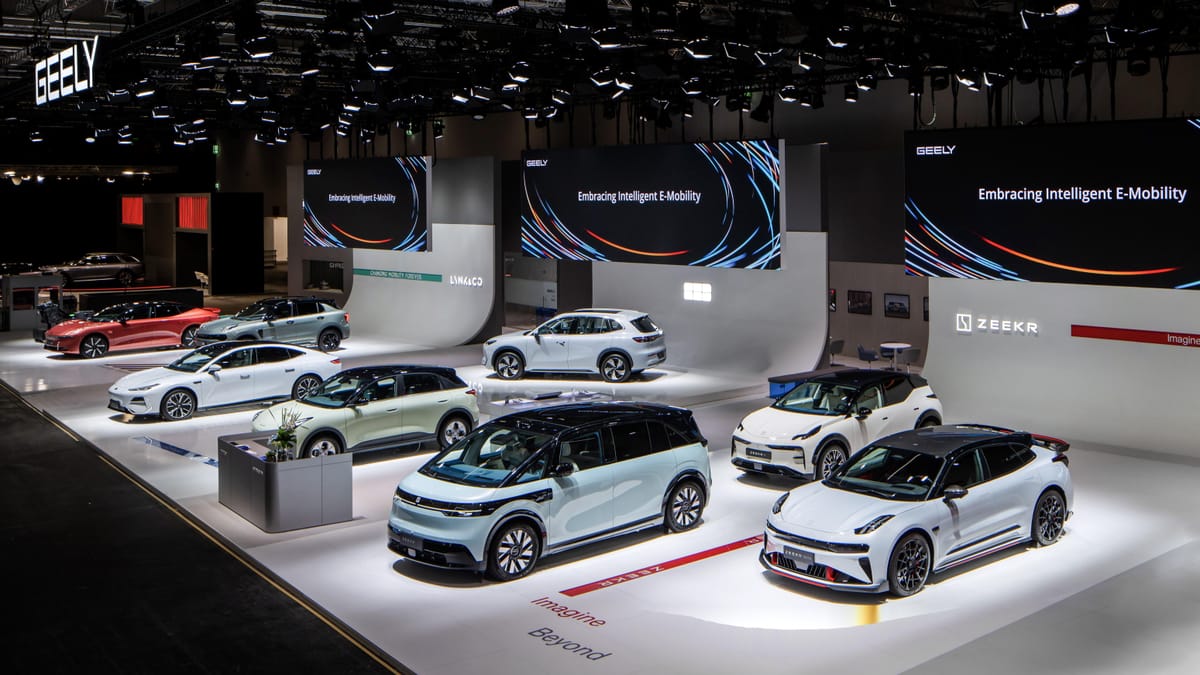
Geely at 960,000 units (down 10.9%) was the most resilient among top domestic OEMs. Its Galaxy sub-brand alone contributed 338,000 units — 35% of group volume — while premium EV arm Zeekr defended the high end and the legacy ICE portfolio remained intact.
Changan Automobile registered 503,000 units (down 20.0%), and Chery Automobile delivered 440,000 units domestically (down 29.1%), with the latter's strong export pipeline partially offsetting the domestic shortfall. Great Wall Motor posted 265,000 units (down 14.4%), and SAIC-GM-Wuling fell 32.8% to 262,000 units as the micro-EV segment that powered its earlier growth — led by the Hongguang MINI — continued its structural retreat.
EV Startups Split: Leapmotor and NIO Surge While Xpeng Retreats
Among new-energy pure-plays, performance bifurcated sharply.
Leapmotor led the cohort with 259,000 units, up 45.1% — the fastest growth rate among all new-energy brands tracked. NIO delivered 196,000 units, up 67.8%, driven decisively by its three-row SUV lineup. Xiaomi Auto registered 186,000 units (up 17.9%) on the strength of the refreshed SU7, while AITO, backed by Huawei, reached 159,000 units (up 8.6%) on a broadened model portfolio.
Li Auto slipped 8.0% to 191,000 units as its product mix pivoted toward pure battery-electric from its EREV origins. Xpeng fell 25.6% to 134,000 units, with the MONA series providing a volume floor but insufficient to offset broader weakness.
German JVs Lead Foreign Declines; Toyota's Hybrid Moat Proves Durable
The foreign brand segment is under systemic pressure, with limited competitive EV portfolios leaving most joint ventures exposed to the ICE market's structural retreat.
FAW-Volkswagen posted 554,000 units (down 23.1%) and SAIC Volkswagen 385,000 units (down 27.9%) — both declines exceeding 20% despite maintaining top-10 volume positions. Tesla China registered 239,000 units, down 9.7%, which by joint-venture standards represents relative resilience given its pure-EV positioning.
Toyota's hybrid technology advantage is the clearest differentiator in the foreign camp. GAC Toyota fell only 7.5% to 328,000 units, and FAW Toyota declined 10.6% to 327,000 units — both holding declines to approximately one-tenth, the tightest performance in the joint-venture universe. Toyota's low-fuel-consumption hybrid systems retain persuasive consumer appeal in a volatile fuel-price environment.
Dongfeng Nissan at 203,000 units (down just 5.0%) is the other outlier, sustained by steady demand for the Sylphy and Teana nameplates.
The Honda joint ventures tell a contrasting story: GAC Honda plunged 44.0% to 93,000 units — nearly halving its volume in six months — while Dongfeng Honda fell 25.9% to 113,000 units. BMW Brilliance registered 212,000 units (down 17.8%), Beijing Benz 176,000 units (down 25.9%), and Lexus 71,000 units (down 22.7%).
Exports Emerge as the Pressure Valve for Domestic Overcapacity
With approximately 2.2 million units of annualized domestic demand having evaporated, Chinese OEMs are redirecting capacity toward export markets at scale. Chery's domestic registration decline relative to its overall production output illustrates the dynamic most clearly. The industry's near-600 new-model launch cadence in H1 2026 — against a contracting home market — points to a structural overcapacity condition that exports alone may not fully absorb.
The 2026 competitive landscape has effectively entered an elimination round. As total addressable volume stabilizes at a lower equilibrium — with national passenger vehicle stock at 366 million units as of end-2025 against 525 million licensed drivers — incremental domestic share gains are zero-sum. The survivors will be those who can leverage Chinese manufacturing cost bases for both domestic margin defense and international volume growth.
Related Coverage:
China's Auto Market Faces Historic Shift as EV Penetration Breaches 60% Amid Fuel Vehicle Collapse