
China Cuts NEV Export Rebates to 9%, Shifting Focus to Quality
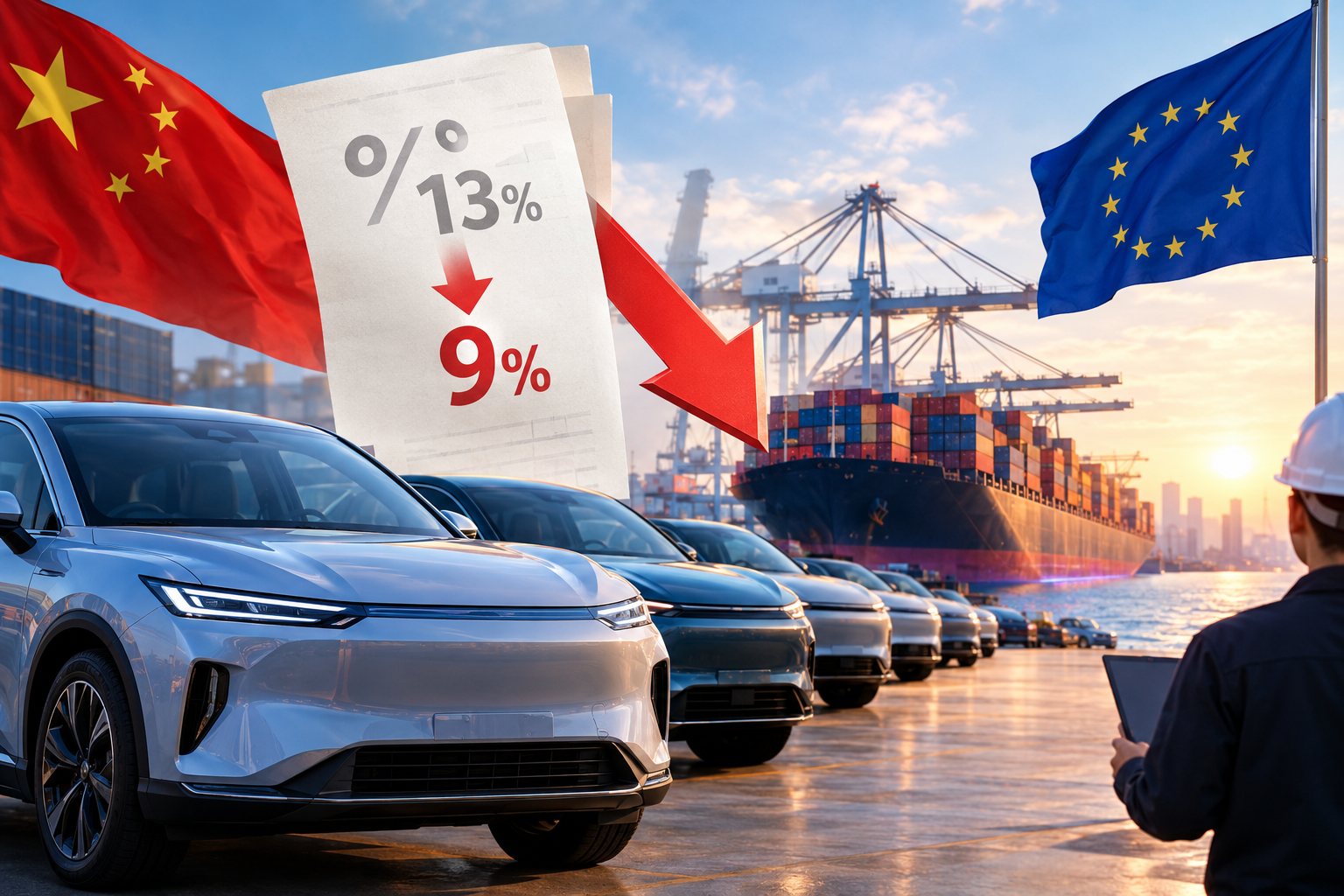
Beijing's decision to cut the value-added tax rebate on new energy vehicle exports by four percentage points signals the end of subsidy-driven overseas expansion and accelerates a structural shakeout among Chinese automakers competing globally.
China's Ministry of Finance and State Taxation Administration announced on October 12, 2026 that the VAT export rebate rate for new energy vehicles (NEVs) will be reduced from 13% to 9% effective April 1, 2027—the first targeted adjustment to NEV-specific export tax policy since a sector-wide VAT overhaul in April 2019. The six-month transition window is deliberate, giving manufacturers time to reprice, renegotiate contracts, and restructure overseas cost models before the new standard takes effect.
The market's initial read is bifurcated. High-margin, brand-established exporters with pricing power in overseas markets—think BYD and SAIC Motor premium tiers—are seen as better positioned to absorb or pass on the incremental cost. Lower-margin volume players, many of whom have been routing export profitability through rebate arbitrage, face a direct compression of unit economics that cannot easily be offset without losing order flow.
Explosive Export Data Reframes the Policy's Timing
The backdrop against which Beijing is pulling back support is, paradoxically, one of remarkable strength. According to data from the China Passenger Car Association, NEV passenger car exports reached 558,000 units in September 2026, up 163.5% year-on-year, accounting for 60.8% of total passenger vehicle exports of 917,000 units—themselves up 73.7% year-on-year.
Drilling into the September NEV mix: battery-electric vehicles (BEVs) contributed 338,000 units (+140.8% YoY); plug-in hybrids (PHEVs) 191,000 units (+187.2% YoY); and extended-range electric vehicles (EREVs) 30,000 units, surging 478.0% YoY. Through the first three quarters of 2026, cumulative NEV passenger car exports reached 3.887 million units, up 138.8% year-on-year.
These numbers reframe the policy logic entirely. When export volumes are growing at triple-digit percentages and NEVs now constitute the majority of China's vehicle export mix, maintaining a 13% rebate no longer functions as industrial stimulus—it functions as a structural price subsidy that distorts global market pricing and invites trade retaliation. Beijing's move is less a brake on growth and more a recalibration of the mechanism that has been enabling that growth.
Four Percentage Points Compress Margins, Exposing Low-Cost Dependents
The arithmetic is unambiguous. A four-percentage-point reduction in VAT rebate translates directly into higher per-unit costs for exporters. On a vehicle priced at RMB 150,000 (approximately US$20,833), the loss of rebate value amounts to roughly RMB 6,000 (US$833) per unit—a figure that is manageable for premium or high-volume models with sufficient gross margin, but potentially fatal for thin-margin commodity EVs that have been pricing against the rebate.
Cui Dongshu, Secretary-General of the China Passenger Car Association, told Yicai that the policy impact is structurally asymmetric: "The four-percentage-point cost increase hits low-end, thin-margin models hardest. High-end models have greater capacity to absorb the pressure." He characterized the cut as a policy normalization consistent with the phased subsidy withdrawal seen in China's solar and lithium battery sectors—both of which are also classified under the "new export trio" alongside NEVs.
Li Yanwei, an analyst at the China Automobile Dealers Association, reinforced this view, noting that firms with mature overseas service networks, established brand equity, and differentiated product lines retain the pricing leverage to pass costs downstream. Those relying on low-price volume strategies lack that buffer—any price increase risks order cancellation, leaving the cost burden entirely on the manufacturer's balance sheet.
Anti-Dumping Calculus Drives Strategic Policy Alignment
The rebate cut does not exist in a vacuum. It is the fiscal policy complement to a broader regulatory architecture Beijing has been constructing around overseas competitive behavior.
On August 24, 2026, the Ministry of Commerce, the Ministry of Industry and Information Technology, and the State Administration for Market Regulation jointly issued the Guidelines for Overseas Competition Conduct and Compliance in the Automotive Sector, formally effective September 1, 2026. The guidelines explicitly require automakers to adopt cost-based pricing strategies oriented to international market supply and demand, prohibit pricing behavior that distorts market order for competitive gain, and mandate against frequent or large-scale retail price fluctuations in overseas markets.
Read alongside the rebate reduction, the signal is coordinated and unmistakable: Beijing is preemptively defusing the subsidy narrative before it triggers further multilateral trade action. The European Union has already imposed additional tariffs on Chinese BEV imports since October 2024. PHEVs currently remain subject only to the baseline 10% EU tariff, though reports indicate Brussels is considering trade safeguard measures that could halve Chinese hybrid vehicle imports from their current baseline of 302,000 units set in 2025.
On October 12, 2026, China's Ministry of Commerce confirmed that bilateral consultations between China and the EU had produced an upward arrangement from the 302,000-unit PHEV baseline, securing export space and stable growth for Chinese manufacturers. Reducing the rebate removes one of the primary justifications that trading partners have cited when characterizing Chinese NEV exports as subsidized dumping.
As Li Yanwei noted, "Overseas markets readily classify export tax rebates as industrial subsidies. An orderly adjustment to rebate policy also helps defuse external trade friction."
EU Market Exposure Amplifies Structural Stakes
The European Union's growing importance as a destination market amplifies the stakes of this policy pivot. In the first seven months of 2026, Chinese independent-brand automakers exported 777,000 units to the EU—a 106% year-on-year increase that surpassed both Latin America (594,000 units) and Russia and Central Asia (491,000 units) to become the top regional export destination for domestic Chinese brands.
That market concentration in a jurisdiction already applying BEV surcharges and scrutinizing PHEV imports creates a risk-concentration problem for Chinese automakers. Any perception that export prices are artificially suppressed by fiscal policy mechanisms—including rebates—creates justification for additional EU trade action. Normalizing the rebate rate preemptively narrows that political surface area.
Industry Shakeout Accelerates, But Export Growth Trajectory Holds
The industry consensus, shared by both Cui and Li, is that the rebate reduction will not reverse China's NEV export growth trajectory—but it will accelerate the divergence between competitive survivors and structurally weak exporters.
Cui argued that the foundation of China's NEV export growth is supply chain system advantage, not tax policy: "Short-term, only low-end volume models will contract. Leading brands and high-value-added models, combined with the release of overseas localized production capacity, will sustain overall export growth."
The six-month runway to April 2027 is not incidental. Ocean freight lead times for automotive exports typically run approximately two months, meaning the policy effectively provides manufacturers with roughly four months of operational transition time post-logistics adjustment. Automakers must use this window to recalculate full-chain export costs, reprice overseas distributor agreements, and reposition product mix toward higher-margin models that can sustain profitability under the new rebate structure.
The broader transition that the rebate cut enforces—from price-led market penetration toward brand, technology, and localization-led competition—mirrors the structural evolution that solar panel and lithium battery manufacturers underwent as their own subsidy frameworks were wound down. For NEV exporters, the message from Beijing is equally clear: the era of rebate-subsidized volume accumulation is over; the era of genuine global competitiveness has begun.
Related Coverage:
BYD Exports Japan-Exclusive Micro EV to Global RHD Markets
The EV Juggernaut: How China Built a Car Empire to Challenge the World