
China Secures 6G Spectrum as US Spectrum Bottleneck Deepens Global Race
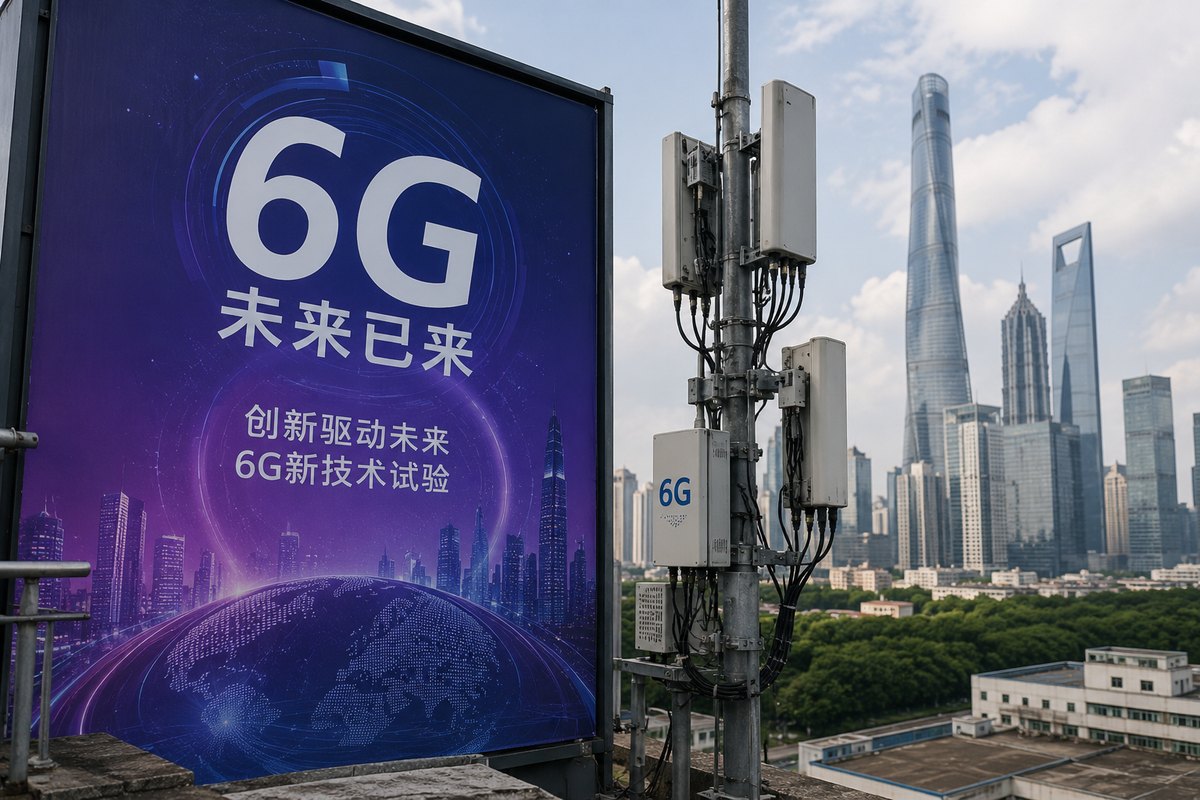
China's telecommunications regulator has granted approval for 6G field trials using the 6425-7125MHz band—a 700MHz continuous spectrum segment industry experts call the "golden zone"—marking the nation's transition from laboratory testing to commercial deployment ahead of its 2030 launch target. The move widens China's technical advantage over the US, which remains locked into higher-frequency millimeter wave spectrum due to legacy military spectrum allocation, while Japan and South Korea pursue joint standardization strategies.
China's Spectrum Advantage Reshapes 6G Economics
China's Ministry of Industry and Information Technology formally authorized the IMT-2030 (6G) Promotion Group to conduct outdoor experiments on the 6GHz band, positioning the nation to leverage Sub-6GHz spectrum's superior propagation characteristics. The allocated 6425-7125MHz range delivers longer transmission distances and lower signal attenuation compared to millimeter wave alternatives, translating to reduced infrastructure costs—a critical factor given China's deployment of over 3 million 5G base stations compared to the US's approximately 100,000.
Beijing's decision to prioritize self-reliance in 6G development signals a strategic shift from previous generation standards, where international coordination often delayed deployment. Chinese officials confirmed plans for 100% domestic control of core technologies and components, explicitly rejecting dependency on international cooperation frameworks that previously constrained 5G rollout.
US Confronts Spectrum Scarcity Legacy from Cold War Allocations
The US telecommunications sector faces structural disadvantages entering the 6G era, stemming from decades-old spectrum assignments that reserved prime Sub-6GHz frequencies for military, defense communications, and meteorological services. During the 5G deployment phase, American carriers were forced to utilize millimeter wave spectrum (24.25-52.6GHz), which requires denser base station deployment due to shorter signal range and vulnerability to physical obstructions.
This "path dependency" creates compounding disadvantages: while China operates centimeter-wave infrastructure with established supply chains, US operators must either continue millimeter wave investments or attempt costly spectrum refarming. The Trump administration's stated goal of commercial 6G service by 2029—timed for the Los Angeles Olympics—appears increasingly ambitious given the Federal Communications Commission has yet to finalize mid-band spectrum reallocation from military users.
Industry analysts note potential for US recovery if the Defense Department releases 2.7GHz spectrum currently under review, though such transfers typically require multi-year coordination periods. Qualcomm and Apple retain design leadership in chipset architecture, yet hardware advantages cannot fully compensate for network economics driven by spectrum physics.
Patent Leadership Concentrates in China, Fragmenting Among Competitors
Global 6G standard-essential patent filings through June 2025 reveal China commanding 40.3% share, compared to 35.2% for the United States and below 10% each for Japan and South Korea, according to intellectual property tracking databases. This 5-percentage-point lead represents approximately 12,000 additional patent families covering critical technologies including terahertz communication, intelligent reflecting surfaces, and AI-native network architectures.
Japan's telecommunications operators—including NTT Docomo and KDDI—recently formalized joint research agreements with South Korea's SK Telecom, while Samsung Electronics partnered with SoftBank on equipment development. These bilateral frameworks reflect both nations' strategic assessment that individual patent portfolios lack sufficient breadth to shape international standards unilaterally.
India's Department of Telecommunications declared at February's Mobile World Congress in Barcelona that the nation would "lead global 6G development," citing population scale and ongoing 5G expansion covering 80% of residents through 500,000 base stations deployed since October 2022. However, India's standard-essential patent contribution remains negligible across previous wireless generations, and 4G network gaps persist in rural regions operating on 2G infrastructure.
China's patent concentration spans the full technology stack from physical layer protocols to network slicing architectures, mirroring the vertical integration strategy that enabled its electric vehicle sector to dominate battery chemistry through motor control systems. As 6G standardization bodies convene through 2027, nations controlling foundational patents will extract licensing revenues while shaping equipment specifications that favor domestic manufacturers.
Related Coverage:
China’s 6G Push Explained: More Than Just Faster Mobile Internet