
China’s $15.7 Billion Robotics Export Surge Maps a Post-EV Globalization Playbook
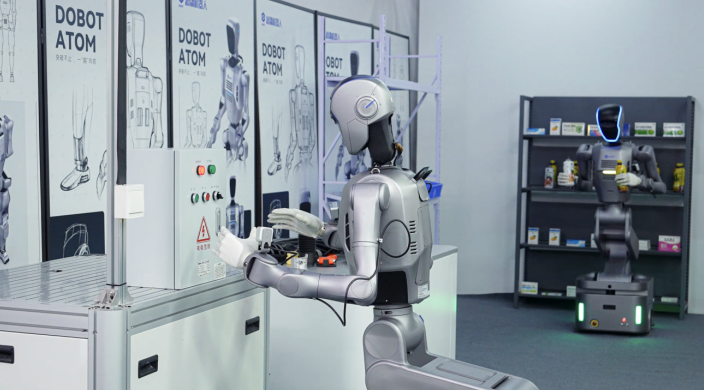
China’s robotics sector exported a record RMB 113.2 billion (US$15.72 billion) in the first quarter of 2026, executing a global expansion strategy that deliberately avoids the margin-crushing price wars and tariff vulnerabilities currently plaguing the country's electric vehicle industry.
Customs data reveals a structural pivot from import substitution to systemic global output, cementing China’s status as a net exporter of industrial robots—a threshold first crossed in 2025. Industrial robot exports surged 42% year-on-year to RMB 31.6 billion (US$4.39 billion), while cleaning robots — a newly categorized customs tariff segment — dominated shipments with RMB 77.5 billion (US$10.76 billion), accounting for 68.5% of total robot exports and capturing an estimated 60% of the global market.
Investors are pricing in this strategic divergence as Chinese automation firms leverage highly integrated domestic supply chains to export complete technological solutions rather than just hardware. This shift is evident in emerging markets, with Q1 industrial robot exports to Vietnam, Thailand, and the United Arab Emirates jumping 67%, 59%, and 83% respectively, signaling accelerated automation across alternative global manufacturing hubs.
Supply Chain Density Drives Delivery Premiums
The export momentum relies heavily on supply chain compression rather than mere labor arbitrage. In the Pearl River Delta, a "three-hour delivery circle" for components has drastically reduced inventory risks and lead times. This logistical density translates directly to corporate top lines. Guangdong Topstar Technology reported RMB 322 million (US$44.7 million) in Q1 revenue from its industrial robotics and automation systems business, an 81.2% year-on-year increase, with overseas operations contributing over 40% of the growth due to rapid deployment capabilities.
Furthermore, economies of scale—bolstered by a 33.2% year-on-year increase in Q1 domestic production—have established a formidable pricing floor. Chinese industrial robots currently average US$28,000 per unit, approximately 40% below legacy incumbents like Fanuc and KUKA AG. This capital expenditure advantage is accelerating penetration in cost-sensitive sectors globally, particularly in 3C electronics and metal processing.
AI Integration Upgrades Export Valuation
Chinese manufacturers are actively decoupling from the low-end assembly narrative by embedding proprietary artificial intelligence into their export models. Shenzhen Yuejiang Technology, which captured a 13.2% global market share to rank first in collaborative robots in 2025, utilizes real-world industrial data from over 100,000 deployed units to train Vision-Language-Action (VLA) models. This closed-loop capability allows for high-precision operations, such as the ±0.05mm tolerance of its Nova series, bypassing the limitations of purely simulated training data.
Similar technological premiums are visible in the humanoid sector, where companies like Unitree are exporting highly dynamic mobility metrics that rival Western counterparts. This hardware-AI fusion transitions the export model from singular machine sales to high-margin, sticky service ecosystems, allowing robots to autonomously perceive environments, make decisions, and execute complex tasks.
Standard-Setting Shields Against Trade Frictions
Unlike Chinese EV makers, which are currently navigating complex localized production mandates and punitive tariffs, the robotics sector is establishing a footprint via standard-setting. The February 2026 release of the "Humanoid Robot and Embodied AI Standard System" by the Ministry of Industry and Information Technology (MIIT) signals a coordinated effort to export Chinese operational protocols alongside physical units.
By offering comprehensive solutions—encompassing facility planning, system integration, personnel training, and lifecycle maintenance—Chinese robotics firms are embedding themselves into the core infrastructure of global clients. This approach secures pricing power and mitigates the geopolitical risks associated with sheer capacity dumping, offering a potentially more resilient blueprint for China’s next decade of high-tech manufacturing globalization.
Related Coverage: