
China’s 2025 Auto Market: The Explosion of Large SUVs and a Brutal Price War
The year 2025 has marked a definitive turning point for China’s automotive sector, characterized by an explosive expansion in the market for large, three-row SUVs and a fierce pricing battle that has reshaped industry economics. As family demographics shift and electric vehicle technology matures, the "5326" segment—vehicles approximately 5 meters long with three rows of seats—has become the primary battleground for domestic manufacturers seeking profitability and market share.
Data from the China Passenger Car Association (CPCA) indicates that SUV sales surpassed 10.69 million units in the first 11 months of 2025, outperforming sedans and MPVs with a 7.3% year-on-year growth rate. Within this surge, the market share for six-seater SUVs climbed to 6.5%, while seven-seaters held steady at around 5%. This structural shift has driven a wave of new product launches from major players including Huawei-backed AITO, Li Auto, and Nio, all vying for dominance in a segment previously considered niche.
The intensification of competition has precipitated an aggressive price war, forcing premium features into lower price brackets. While the segment was once dominated by vehicles costing over RMB 300,000, entry-level prices for large three-row SUVs plunged below RMB 173,800 (US$24,100) this year. Manufacturers are sacrificing margins for volume, with established players slashing prices on flagship models and new entrants disrupting the market with aggressive valuation strategies to capture the growing demand from multi-child families.
Despite the near-term volatility caused by pricing pressures, analysts remain bullish on the sector's long-term trajectory. Industry experts project that demand for large family vehicles will continue to rise for the next decade, peaking around 2035 alongside changes in China's household structures. However, the market is rapidly bifurcating, with distinct winners emerging in both the premium electric and mass-market hybrid sectors, signaling a period of consolidation ahead.
A Race to the Bottom on Pricing
The defining characteristic of the 2025 market has been the rapid erosion of pricing power among manufacturers, benefiting consumers but pressuring corporate balance sheets. In September, the launch of the Geely Galaxy M9 set a new benchmark, bringing the limited-time starting price for a large three-row SUV down to RMB 173,800 (US$24,100). The model achieved over 10,000 deliveries within its first month, validating the demand for affordable utility.
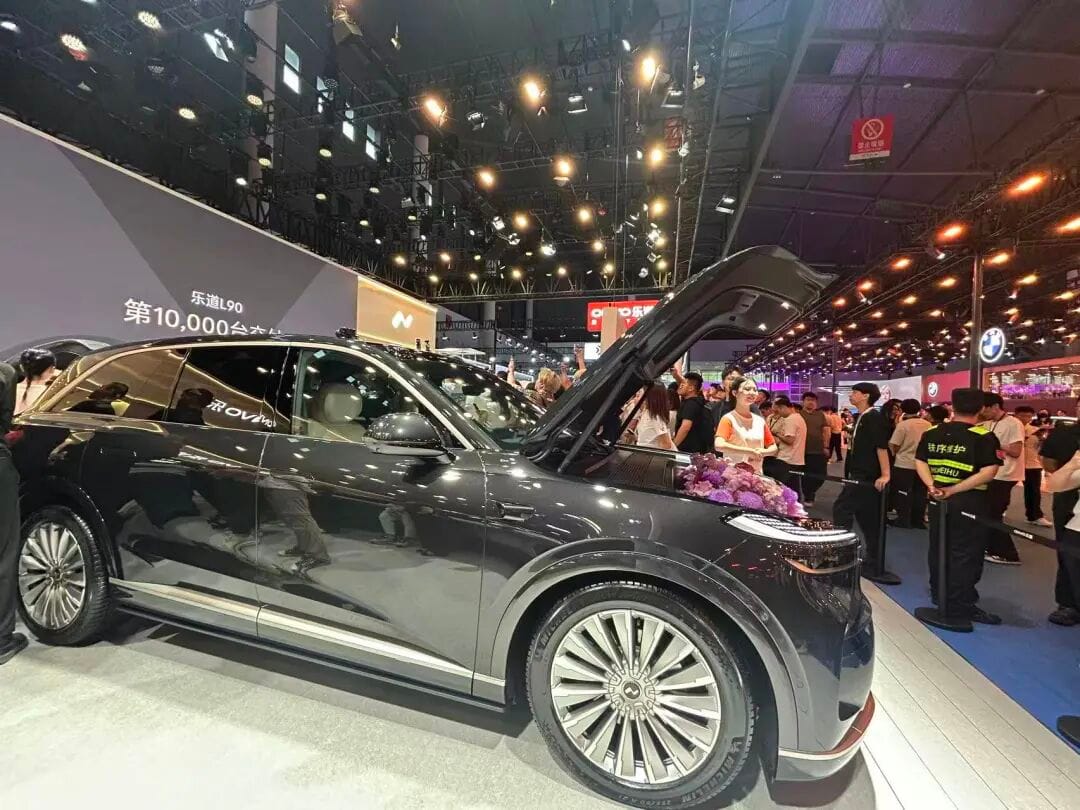
This pricing pressure rippled upward to the premium segment. NIO launched its third-generation ES8 in September with a starting price of RMB 406,800 (US$56,300)—or as low as RMB 298,800 (US$41,300) under its battery-as-a-service (BaaS) rental model. This represented a price reduction of more than RMB 100,000 (US$13,800) compared to the previous generation. Similarly, NIO’s sub-brand, Onvo, launched the L90 in July, leveraging the BaaS model to push the entry price under RMB 180,000 (US$24,900), making it the fastest model in NIO’s history to surpass 10,000 deliveries.
Deepal, a unit of Changan Automobile, also joined the fray. Its S09 model, launched in May, saw its effective starting price drop to RMB 204,900 (US$28,300) after incentives. Deepal Chairman Deng Chenghao acknowledged the loss of pricing power, noting that the "red ocean" market conditions forced the company to compete strictly on value rather than premium positioning.
The Shift Toward Pure Electric Dominance
While plug-in hybrids (PHEV) and extended-range electric vehicles (EREV) initially fueled the growth of the large SUV segment—led by Li Auto and AITO—2025 saw a decisive pivot toward pure battery electric vehicles (BEVs). According to CPCA and CAAM data, sales of pure electric large SUVs hit a record high of 46,209 units in November 2025, surpassing plug-in hybrids and extended-range models for the third consecutive month.
This shift has forced rapid strategic adjustments. Li Auto, traditionally dominant in the EREV space, faced headwinds with its pure electric push. Its Li i8 launched in July but required price adjustments and configuration upgrades within seven days of its debut to remain competitive, settling at RMB 339,800 (US$47,000). Conversely, Nio CEO William Li argued that the "golden age" of extended-range SUVs has passed, citing the packaging advantages of pure EVs, such as larger front trunks ("frunks"), which have become popular among users for ease of access in tight parking spaces.
High-end entrants continue to flood the BEV space. The Zeekr Intelligent Technology 9X, dubbed the "Hangzhou Bay Cullinan," launched in September targeting the RMB 465,900 (US$64,500) to RMB 599,900 (US$83,000) bracket, securing over 10,000 orders in 13 minutes.
Demographics Drive Long-Term Optimism
Despite the fierce competition, the structural fundamentals of the large SUV market remain robust. Cui Dongshu, Secretary General of the CPCA, predicts that the segment will enjoy "ten good years," driven by the transformation of Chinese family structures from single-child households to multi-generational and multi-child families.
This demographic shift is transitioning consumer demand from basic functional mobility to comfort-oriented travel. Traditional five-seat vehicles are increasingly insufficient for 2+2+3 family structures, making six and seven-seat configurations essential. Cui notes that the number of multi-child families is expected to peak in 2035, providing a long runway for growth.
While the Tesla Model Y remains the overall sales volume leader for the first 11 months of 2025, and newcomers like the Xiaomi YU7 are breaking order records, the domestic large SUV segment is creating its own hierarchy. AITO’s M8 and M9 have secured the top two sales spots in the large SUV category year-to-date, both exceeding 100,000 units. As manufacturers like Li Auto prepare for significant model refreshes in 2026, the battle for the "family travel solution" is expected to remain the central narrative of China's auto market.