
China's AI Capital Race: Why Every Major Player Is Raising Billions at Once
What Is Happening?
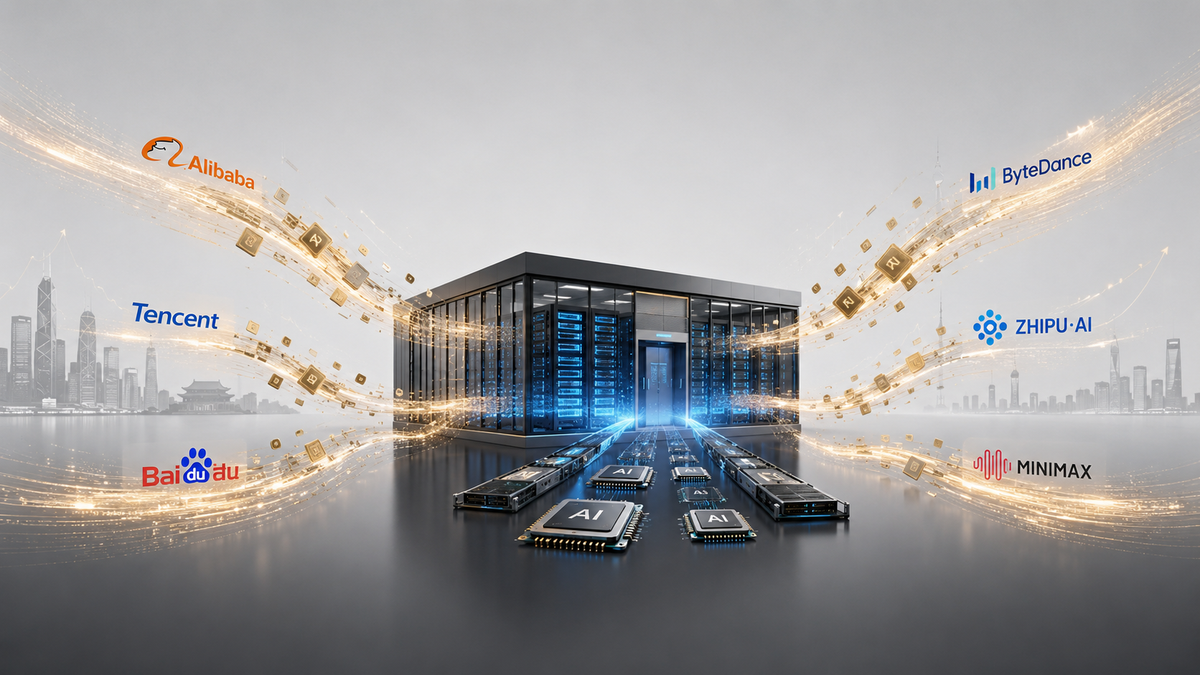
Within the span of roughly two months in mid-2026, nearly every significant player in China's AI ecosystem — from internet giants to freshly listed foundation model startups — launched major capital raises in near-simultaneous fashion.
Alibaba sold 710 million new shares on the Hong Kong Stock Exchange, raising HK$80 billion (approximately US$10.2 billion), with 100% of net proceeds earmarked for AI infrastructure. This was the company's first share placement since its Hong Kong listing in 2019 — despite holding RMB 474.5 billion in cash on its balance sheet as of June 2026.
Zhipu AI, which listed on the Hong Kong Stock Exchange in January 2026 raising HK$4.35 billion, announced within five months that it would pursue a secondary listing on China's STAR Market targeting an additional RMB 15 billion — and then raised a further HK$31.41 billion through a Hong Kong share placement in July.
MiniMax, which listed one day after Zhipu raising HK$5.54 billion, initiated A-share listing preparation in May and announced a new HK$16 billion financing round the day after its lock-up period expired, with 80% directed toward compute capacity and model development.
The pattern is unmistakable. This is not a coincidence of timing. It reflects a structural shift in what it costs to compete in AI — and a shared judgment about how long the window to secure that capital remains open.
Why Is This Happening Now? The Demand-Supply Collision
To understand the urgency, two parallel trends need to be held in view simultaneously.
On the demand side, AI usage in China has moved far beyond consumer experimentation. According to China's National Data Administration, daily token call volume nationwide reached 140 trillion in March 2026. In early 2024, that figure stood at approximately 100 billion — an increase of more than 1,000x in roughly two years. The workloads driving this consumption are no longer hobbyists testing chatbots; they are factories, logistics networks, and pharmaceutical research pipelines paying real money for reliable inference capacity. AI has, in practical terms, become utility infrastructure.
On the supply side, the global memory supply chain has been systematically redirected. Major DRAM manufacturers have prioritized production capacity for HBM (High Bandwidth Memory) and DDR5 required by AI servers, compressing supply of conventional DRAM and NAND flash. The result: conventional DRAM contract prices rose 90–95% quarter-on-quarter in Q1 2026, while NAND prices rose 55% — the largest single-quarter increases on record, according to TrendForce. Wells Fargo estimates that global DRAM demand will grow 26% in 2026 against supply growth of only 21%. UBS projects the DRAM supply shortage will persist at least through 2028.
The consequence for AI companies sitting in the middle: compute costs are rising, cloud providers including Alibaba Cloud and Tencent Cloud have already raised AI compute service pricing, and the only way to secure capacity at scale is to commit capital now — before prices climb further or supply tightens more.
How Are the Big Tech Players Responding?
China's largest internet companies have shifted from announcing AI commitments to executing them at a scale that would have seemed implausible two years ago.
- Alibaba: Q2 2026 capital expenditure reached RMB 67.7 billion, up 75% year-on-year. Total H1 2026 capex: RMB 190 billion. Its stated three-year AI investment plan totals RMB 380 billion; half of that has already been deployed by mid-2026.
- Tencent: Q2 2026 capex hit RMB 52.8 billion, up 176% year-on-year. H1 2026 total of RMB 84.7 billion already exceeds its full-year 2025 figure.
- Baidu: Q2 2026 capex of RMB 11.4 billion, up 201%.
- ByteDance (unlisted): Estimated 2026 AI infrastructure spending of RMB 200 billion, of which approximately RMB 85 billion goes toward chips and RMB 90 billion toward AI data centers.
This is no longer a race of stated intentions. It is a capital deployment competition with measurable quarterly scorecards.
Three Structural Signals From This Fundraising Wave
Signal 1: Upstream "Shovel Sellers" Are Capturing the Profits
The most durable economic reality of this cycle is that the companies with the most reliable profit trajectory are not the AI model developers — they are the hardware and memory manufacturers supplying the infrastructure those developers depend on.
Changxin Memory Technology (CXMT), China's leading DRAM manufacturer, filed for a STAR Market IPO in July 2026 seeking to raise RMB 29.5 billion — the largest A-share IPO of 2026. Its Q1 2026 net profit was RMB 33 billion; H1 2026 net profit guidance reached as high as RMB 75 billion. A single memory manufacturer is generating more profit in six months than most of China's major internet platforms produce in a full year.
Yangtze Memory Technologies (YMTC), China's primary NAND flash producer, completed its IPO guidance registration in May and formally submitted its STAR Market prospectus in August 2026. Its Q1 2026 revenue was RMB 47 billion, with net profit of RMB 33.4 billion and a NAND flash gross margin of 78.73%. Its prospectus explicitly notes that large language model inference workloads are increasingly offloading KV-cache data from HBM to SSD storage — a structural demand driver that extends well beyond current market conditions.
Meanwhile, the AI application companies raising capital are reporting very different numbers. Zhipu AI posted 2025 revenue of RMB 724 million against R&D expenditure of RMB 3.18 billion and an adjusted net loss of RMB 3.18 billion. MiniMax recorded an adjusted net loss of approximately US$251 million. The capital these companies raise flows directly to compute procurement, and compute spending flows directly to the upstream hardware layer. Profits are migrating up the value chain, and there is no near-term mechanism to reverse that flow.
Signal 2: The A+H Dual-Listing Structure Is Becoming Standard Operating Procedure
Hong Kong's Chapter 18C framework for specialist technology companies — which permits listings by companies that are not yet profitable — opened the door for China's AI startups to access international capital markets. But the fundraising pattern of 2026 reveals that a single listing venue is no longer sufficient.
Hong Kong equity markets primarily serve international long-term capital. China's STAR Market channels domestic renminbi investment. The two markets have different investor bases, different currency exposures, and different appetite cycles. For companies with capital needs that are continuous rather than one-time, maintaining access to both is a strategic necessity, not a luxury.
The speed with which Zhipu AI and MiniMax initiated STAR Market preparations — within five months of their Hong Kong IPOs — signals that their capital requirements cannot be satisfied by a single fundraising event. The window during which investors are willing to fund pre-profitability AI infrastructure at scale may not stay open indefinitely. Companies that can access it through multiple channels simultaneously are rationally doing so.
Signal 3: AI Has Become a Capital-Intensive Industry, Not a Software Business
For most of the past decade, the dominant model for Chinese internet entrepreneurship was asset-light: iterate quickly, scale on existing infrastructure, defer hardware investment. AI has structurally invalidated that model.
Building and operating competitive AI capabilities now requires GPU clusters at the scale of tens of thousands of units, purpose-built data centers, power infrastructure, and liquid cooling systems. These are not discretionary expenditures that can be deferred during a downturn — they are the minimum cost of participation.
Alibaba's HK$80 billion placement came with an explicit commitment: 100% of proceeds to AI, none to e-commerce expansion, acquisitions, or share buybacks. Zhipu AI's planned RMB 15 billion STAR Market raise allocates RMB 12 billion to its general-purpose foundation model project, RMB 2 billion to its MaaS platform, and RMB 1 billion to working capital. These are not growth investments layered on top of a profitable core business — they are the cost of maintaining a position at the frontier.
What Does the Commercial Trajectory Look Like?
There are early indicators that demand is real and pricing power is beginning to emerge, even as profitability remains distant.
Zhipu AI's MaaS (Model-as-a-Service) annualized recurring revenue reached approximately RMB 1.7 billion in 2025, representing a 60x increase over twelve months. More telling: when the company raised its API pricing by 83% in Q1 2026, call volume did not decline — it increased by 400%. This is a meaningful signal. When customers absorb a price increase of that magnitude without reducing consumption, it suggests the underlying use cases have become operationally embedded rather than discretionary.
The structural challenge is that rising revenue is being outpaced by rising costs. As long as compute prices are increasing and supply remains constrained, the economics of AI inference are difficult to stabilize. The companies that can raise capital to lock in compute capacity at current prices — rather than buying at spot rates during a supply squeeze — have a material structural advantage over those that cannot.
What Comes Next? The 2027 Inflection Point
The current phase of the cycle — characterized by constrained supply, rising prices, and aggressive capital deployment — is unlikely to be permanent. A plausible scenario for 2027 and beyond involves a meaningful shift in the supply picture.
Domestic Chinese compute capacity is expected to come online in significant volume over the next 18–24 months, as investments in domestic GPU manufacturing and AI data center construction begin to yield deployable infrastructure. If supply expands faster than demand, the current pricing environment for AI inference could reverse — compressing margins for companies that built their business models around current cost structures.
In that scenario, the competitive question shifts from "who can secure enough compute to serve demand" to "who can sell tokens at a price that sustains a viable gross margin in a more competitive market." The companies best positioned for that transition are those that have used the current window to build scale, establish enterprise customer relationships, and develop differentiated model capabilities — not simply those that raised the most capital.
The first companies to exit the race are unlikely to be the ones with the weakest technology. They are more likely to be the ones whose cash runs out before the market structure clarifies.
Key Variables to Watch
- Domestic compute supply timeline: When Chinese-made AI chips and expanded data center capacity come to market at scale, and how quickly that supply is absorbed
- DRAM and NAND price trajectory: Whether the supply-demand imbalance eases by 2028 as projected, or persists longer
- Enterprise AI adoption depth: Whether B2B use cases continue to deepen and expand, sustaining demand growth even as consumer-facing applications mature
- STAR Market receptivity: Whether China's domestic capital markets continue to support pre-profitability AI listings at the valuations required to justify continued infrastructure investment
- Gross margin evolution: Whether any foundation model company can demonstrate a credible path to positive unit economics on inference revenue before the next supply cycle shifts the pricing environment
Related Coverage:
Alibaba’s HK$80B AI Raise Redefines China Tech’s Investment Thesis
Zhipu’s H1 Revenue Surges 400% as API Pivot Cuts Gross Margin in Half
MiniMax Triples Alibaba Cloud Spending Cap to $1.2 Billion as AI Compute Demand Surges