
China's Automakers Pivot to Global Markets as Domestic EV Consolidation Accelerates
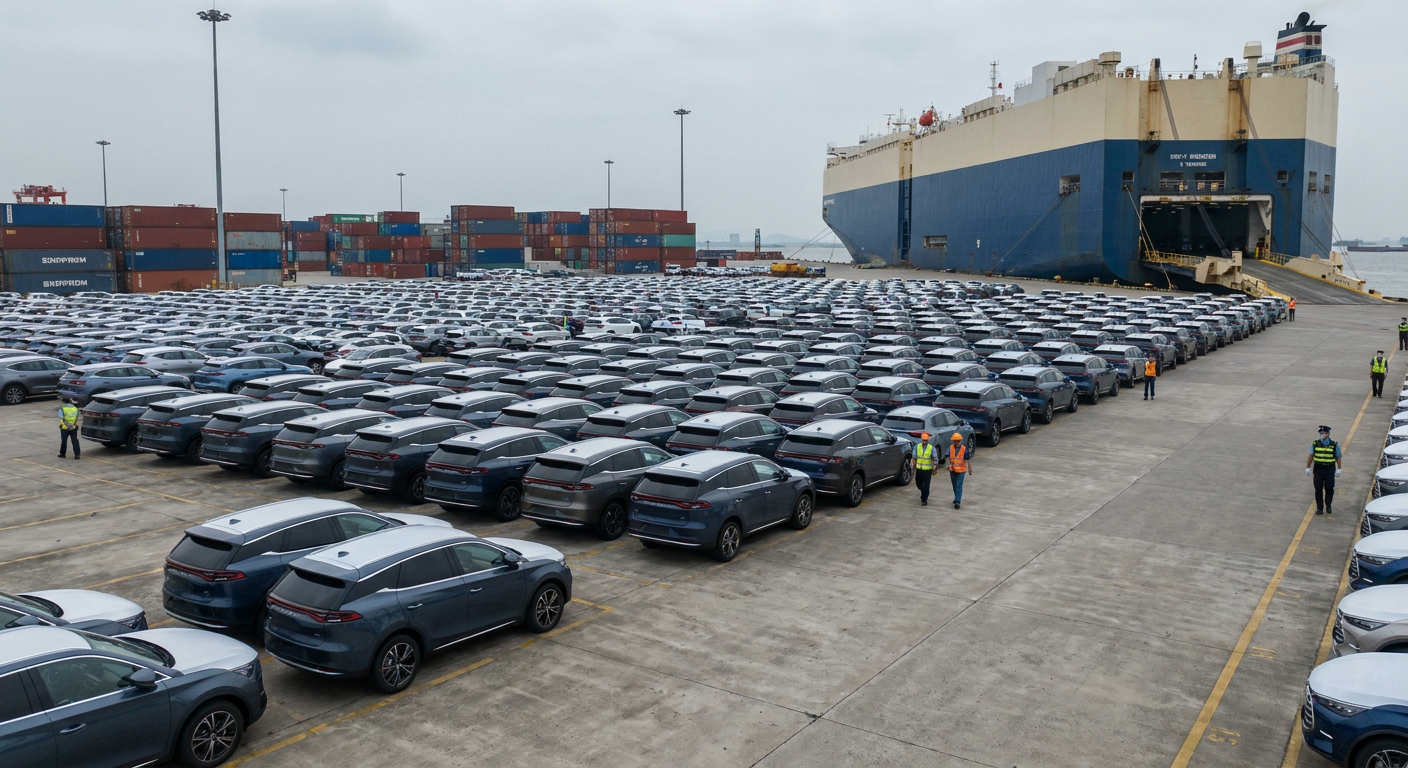
In a decisive mid-2026 pivot, China's leading electric vehicle manufacturers are increasingly relying on overseas markets to offset a contracting domestic auto sector. As 14 major automakers delivered over 6.6 million vehicles in the first half of the year, the monthly survival threshold for emerging EV players has aggressively shifted from 30,000 to over 40,000 units, signaling a brutal new phase of industry consolidation.
The June 2026 delivery data reveals a stark market reality: while overall domestic passenger vehicle retail sales contracted 19.5% year-on-year in the first five months to 7.09 million units, top-tier automakers maintained their growth trajectories almost entirely through record-breaking export volumes and rapid product iteration.
Export Volumes Eclipse Domestic Headwinds
Legacy automotive giants have established a formidable global footprint to hedge against domestic saturation. BYD reached a staggering 400,000 units in June sales, representing a 5% year-on-year increase. Crucially, the company's export volumes hit a record 174,900 units, accounting for nearly 44% of its total monthly output.
Chery mirrored this aggressive overseas strategy, reporting total June sales of 256,600 units, with exports comprising an industry-leading 191,100 units. Geely maintained steady momentum with 240,800 total units sold, pushing its overseas deliveries past the 102,000-unit mark. The convergence of these figures indicates that for China's traditional auto giants, international shipping capacity is now as critical as domestic manufacturing output.
Premium Segments Fuel Surging Delivery Metrics
Among the new energy vehicle (NEV) startups, global expansion and premium segment dominance generated triple-digit growth. Leapmotor shattered single-month records with 93,400 units delivered in June, a 95% year-on-year surge. The company's strategy of simultaneous domestic production scaling—pushing its A10 model daily capacity to 1,000 units—and European market penetration with its Lafa5 right-hand drive variant has pushed its cumulative global deliveries past 1.5 million units.
Zeekr led the growth metrics with a 111% year-on-year surge to 35,200 units. The Geely-backed premium brand has capitalized on high-margin niches, notably dominating the RMB 400,000 (US$57,970) pure-electric MPV segment with the Zeekr 009, while aggressively expanding output for its 007GT model targeting European markets.
NIO leveraged its multi-brand matrix to deliver 40,600 units, a 63% jump from 2025. The company's flagship ES9 set a new benchmark by reaching 10,000 deliveries shortly after launch, dominating the RMB 500,000 (US$72,460) premium tier. Meanwhile, its mass-market ONVO brand contributed 11,700 units, proving the viability of a diversified price-point strategy.
Tech Giants Navigate Capacity Bottlenecks
The intersection of consumer electronics and automotive manufacturing continues to disrupt traditional market shares. HIMA, Huawei's ecological auto alliance, hit a 2026 peak with 50,600 units delivered in June. The AITO brand remains the alliance's cornerstone, generating nearly 60% of volume, driven by the AITO M9 which cleared 8,000 deliveries within two weeks of scaling. Additionally, the Xiangjie Z7 series crossed the 10,000-unit threshold, providing HIMA with a secondary growth engine.
Xiaomi maintained its production momentum, clearing the 30,000-unit milestone for the third consecutive month. However, the smartphone manufacturer is battling severe supply chain constraints, with wait times for its YU7 standard and Pro models extending between 48 to 56 weeks. Investors are now pricing in expectations for Xiaomi's anticipated large-scale vehicle platform slated for late 2026.
XPeng successfully navigated past production bottlenecks to deliver 40,100 units, up 16% year-on-year. The localized success of its GX model (6,739 units) was amplified by the G6 and G9 models securing top sales positions in multiple European pure-electric segments.
Product Transitions Spark Short-Term Volatility
Not all prominent players emerged unscathed in the mid-year sprint. Li Auto reported a 15% year-on-year contraction, delivering 30,900 units. The decline reflects vulnerability to product cycle gaps, as the company transitions between its L9/L8 models and the upcoming L6. This transition period coincided with a flood of new competitor models entering the extended-range electric vehicle (EREV) segment, diluting Li Auto's previously undisputed market share.
Traditional automaker spin-offs showed resilient, albeit moderate, growth. Hyper Aion and Deepal maintained structural stability with 33,700 and 33,600 units respectively, while eπ faced an 11% contraction to 23,200 units, awaiting margin relief from its upcoming premium M8 rollout.
As the Chinese auto market solidifies its transition from a high-growth environment to a zero-sum stock market, the second half of 2026 promises intensified margin compression. Automakers unable to secure export channels or dominate high-margin premium segments will increasingly find themselves marginalized in the world's most aggressive automotive arena.
Related Coverage:
China EVs End H1 Strong, Leapmotor Nears 100K Monthly Deliveries