
China's Automakers Take Battery Control—Beyond the Headlines
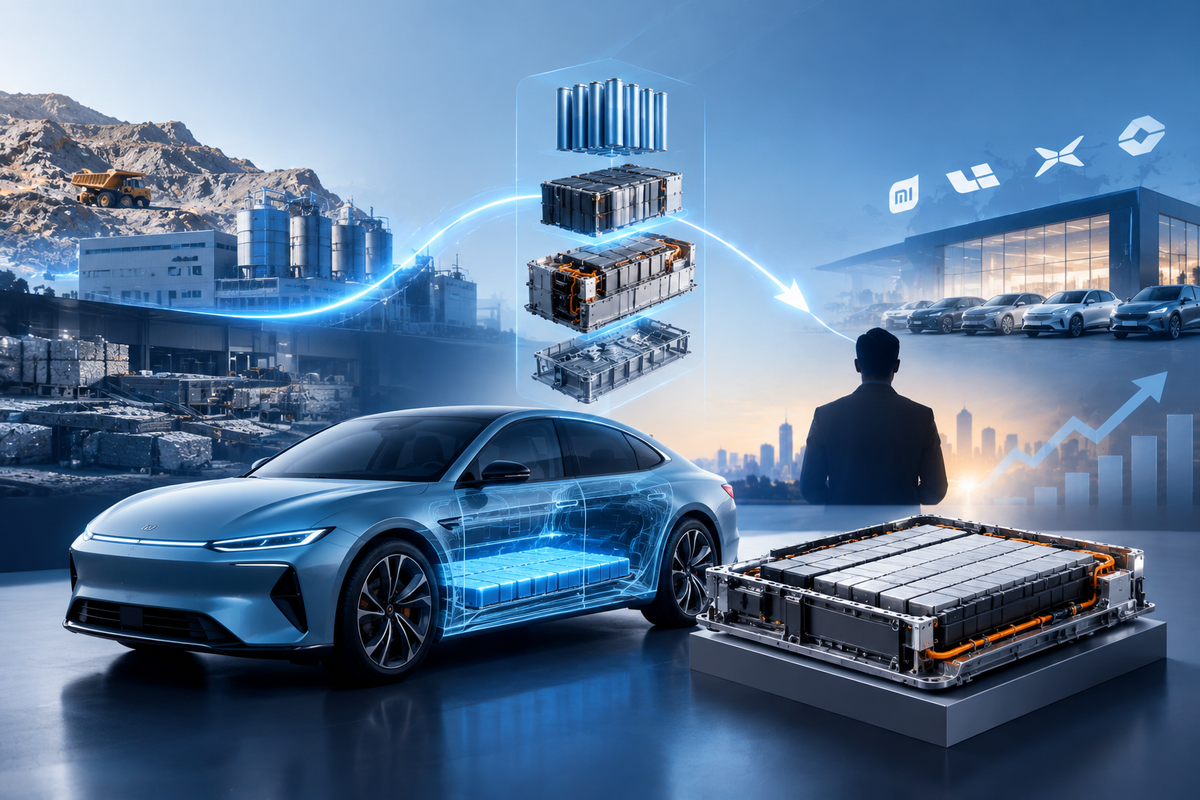
China's electric vehicle makers are engineering a fundamental power shift in the world's largest auto market—wresting control of battery technology from suppliers in a movement that threatens to redraw the economics of a supply chain worth hundreds of billions of yuan, yet the "self-development" revolution is far less uniform than the marketing suggests.
In a span of weeks in mid-2026, Xiaomi Auto unveiled its "Dragon Armor" battery co-developed with China Innovation Aviation and Sunwoda Electronic; Li Auto announced plans to integrate proprietary battery cells into upcoming models; Xpeng Chairman He Xiaopeng declared publicly that "starting this year, all our batteries will be built in-house"; and Leapmotor claimed the title of one of only two automakers globally to both design and manufacture its own cells. The cascade of announcements has ignited investor debate over whether Chinese original equipment manufacturers are genuinely closing the technology gap with dedicated battery specialists—or executing a sophisticated procurement negotiation dressed up as an engineering breakthrough.
The distinction carries direct financial consequences. In the first half of 2026, Contemporary Amperex Technology reported net profit attributable to shareholders of RMB 43.28 billion (approximately US$6.01 billion), while the combined net profit of 15 mainstream A-share and Hong Kong-listed automakers totaled just RMB 21.05 billion (approximately US$2.92 billion)—less than half of CATL's figure. That single data point, more than any press release, explains why self-development has become the automotive industry's most urgent strategic imperative.
Defining "Self-Development" Exposes a Spectrum, Not a Binary
The term obscures critical differences in depth of involvement. In a standard MTP (Module-to-Pack) architecture, the battery system comprises individual cells, modules, and a pack assembly incorporating a Battery Management System (BMS) and thermal management hardware. Of these layers, the cell is simultaneously the energy core and the dominant cost driver—making cell manufacturing the true axis along which all self-development claims must be evaluated.
At one extreme sits BYD and its captive supplier BYD Fudi Battery, which controls the full vertical stack from lithium ore procurement through cell production to pack integration. No other volume automaker currently replicates this model.
Xiaomi Auto and Li Auto occupy a structurally distinct middle tier. Both companies have moved decisively into cell design—specifying not merely performance targets such as voltage and cycle life, but actively co-engineering electrochemical parameters and front-loading thermal and power management architecture aligned to downstream pack integration. A senior battery engineer with direct knowledge of the Xiaomi Auto program, identified as Engineer Wang, described the shift as qualitative: "Previously, OEMs handed over a spec sheet. Now they sit inside the design loop." Critically, neither company manufactures cells; production is contracted to partners including Sunwoda and China Innovation Aviation.
A third tier covers joint ventures between legacy state automakers and CATL. SAIC, GAC Group, FAW Group, Dongfeng Motor and Changan Automobile have all established joint venture entities with CATL, contributing capital and guaranteed order volumes in exchange for supply security. OEM participation in cell-level R&D within these structures is limited compared with the Xiaomi-Li Auto model, with technology and manufacturing control remaining primarily with CATL.
At minimum involvement, a significant subset of automakers continues to purchase cells outright from battery suppliers, developing only the pack layer in-house.
Cost Arithmetic Drives the Strategic Pivot
The financial logic is unambiguous. Battery cells account for between 40% and 60% of total vehicle manufacturing cost—a figure GAC Chairman Zeng Qinghong cited as early as 2022 when he quipped publicly that automakers were effectively "working for CATL." Four years on, that dynamic has intensified rather than moderated.
Zhu Weiqi, research director at Lingze Private Equity, estimates that sourcing from tier-two battery suppliers can generate a 10% to 15% cost reduction relative to CATL-supplied cells. The introduction of dual-sourcing or "horse-racing" supplier strategies further compresses the negotiating leverage of even dominant suppliers.
Supply security constitutes a second material driver. Battery output is exposed to upstream raw material volatility, capacity constraints, and demand cycles. Deeper OEM integration into cell development provides earlier visibility into production risk and stronger contractual standing in allocation decisions.
A third factor is engineering fit. Historically, vehicle architecture was adjusted to accommodate battery pack geometry. As OEMs accumulate cell-level design authority, the priority hierarchy inverts: vehicle structure increasingly sets the boundary conditions that batteries must satisfy, enabling more aggressive space utilization and weight optimization.
The "Relational Knowledge" Argument Reframes the Investment Case
Beyond unit economics, a less-quantifiable but strategically critical motivation is emerging among automakers: the accumulation of what corporate strategist Zhu Yi describes as "relational knowledge"—the proprietary, context-specific understanding generated at the intersection of cell chemistry and vehicle-level operating scenarios.
Under a pure procurement model, battery suppliers optimize cell performance in isolation; automakers optimize vehicle architecture without deep electrochemical expertise. The cross-domain knowledge that governs real-world outcomes—thermal behavior under specific driving patterns, charging adaptation across temperature ranges, degradation trajectories correlated with software control algorithms—falls into a gap between the two organizations.
Li Auto's Senior Vice President of Electric Powertrain R&D Liu Liguo articulated the operational implication directly: battery development cannot be decoupled from concurrent engineering of chassis, body structure, thermal management, charging architecture and software algorithms. The integration imperative is not a preference—it is a functional requirement for competitive differentiation on range, charge speed and safety.
Zhu Yi argues that this category of knowledge is inherently non-transferable through commercial transactions: "The real risk is not the inability to procure mature battery technology. It is acquiring standardized technology while permanently forfeiting the capacity to generate proprietary knowledge that compounds with each product cycle. External partnerships can purchase today's optimal solution; they cannot purchase the cognitive advantage that drives iterative superiority tomorrow."
Manufacturing Barriers Protect Tier-Two Suppliers From Displacement
Despite the strategic momentum toward self-development, full vertical integration on the BYD model remains economically prohibitive for most automakers. Engineer Guo, a cell testing and development engineer with supplier-side experience, estimates that a single cell production line requires capital expenditure of "several hundred million yuan at minimum," with a 20 GWh facility requiring approximately RMB 5 billion (approximately US$694 million) in upfront investment, followed by a construction and ramp-up period of no less than two years.
NIO Founder Li Bin reached an analogous conclusion in 2023 after formally evaluating in-house cell production, determining that the investment offered no pathway to gross margin improvement within a three-year horizon.
The deeper barrier, however, is tacit process knowledge. Engineer Wang identified the locus of competitive advantage with precision: it resides not in documented standard operating procedures, but in the calibrated interdependencies among process parameters—anode-to-cathode coating thickness ratios, electrode composition proportions, calendering pressure tolerances—each of which simultaneously influences cell capacity, internal resistance and aging rate in ways that create non-linear optimization trade-offs. Increasing anode ratio improves cycle aging characteristics but risks internal resistance escalation if miscalibrated. "You cannot acquire this through hiring executives or running simulations," Wang said. "It was never written into an SOP. It accumulates through years of accumulated engineering judgment across large teams."
This structural barrier explains why tier-two suppliers are not facing displacement. Sunwoda's presence in the Xiaomi Auto and Li Auto programs has generated a commercial cascade: the high-profile endorsements are actively attracting volume inquiries from mass-market OEMs including Dongfeng, SAIC and Geely, according to Sunwoda employee Zhang Chi (pseudonym). Sunwoda, in turn, is not functioning as a passive contract manufacturer—it is embedding its mature systems into customer products and advancing its own R&D capability in parallel, with the Xiaomi Auto and Li Auto programs designated as highest-priority internal projects.
Quality Standards Tighten Across the Supply Chain
The shift in design authority is producing measurable changes in quality management protocols. Sunwoda quality engineer Wang Wei (pseudonym) described standards under the Xiaomi Auto program as materially more stringent than conventional OEM supply relationships. Defect categories that would ordinarily qualify for conditional release under low-risk assessments are subject to unconditional rejection. "The workload has increased significantly," Wang Wei acknowledged, while framing the dynamic as structurally sound: OEM quality mandates provide standard-setting authority, while supplier expertise provides granular risk identification and process control capability.
On a technical performance basis, the gap between CATL and tier-two suppliers is real but consumer-imperceptible at the product level. Under identical lithium iron phosphate chemistry and equivalent fast-charging rates, empirical testing indicates a range differential of approximately 0.5% to 1.4% between CATL and Sunwoda cells—statistically significant in rigorous test protocols, but below the threshold of perception for typical consumers in real-world operation.
Market Implications: A Structural Rebalancing, Not a Supplier Elimination
The 2026 self-development wave does not presage the elimination of independent battery manufacturers. It signals a structural rebalancing of the supply chain's power distribution, with value migrating from standardized cell supply toward integrated system engineering, proprietary design knowledge and manufacturing process mastery.
For investors tracking the sector, the key differentiation metric is not which automaker claims the most aggressive self-development narrative—it is which organization is accumulating durable, vehicle-specific electrochemical knowledge that cannot be replicated through a procurement agreement. On that measure, the race has barely started.
Related Coverage:
From Battery King to One of Many: How China’s EV Makers Are Reducing Their Dependence on CATL
The Battery Kingdom: How China Built an Empire to Power the World