
China's Autonomous Delivery Vehicle Race Escalates Beyond Scale and Price Wars
The competitive landscape for autonomous delivery vehicles in China is intensifying as industry consolidation, cross-sector entrants, and evolving business models reshape the market beyond traditional scale and pricing battles.
In late January, Zelos and Cainiao's autonomous vehicle division announced a strategic partnership, with Cainiao becoming a shareholder through business injection and cash investment. Zelos will serve as the vehicle supplier while Cainiao leverages its logistics ecosystem to accelerate commercial deployment. The move signals accelerating consolidation among leading players as the sector enters a critical expansion phase.
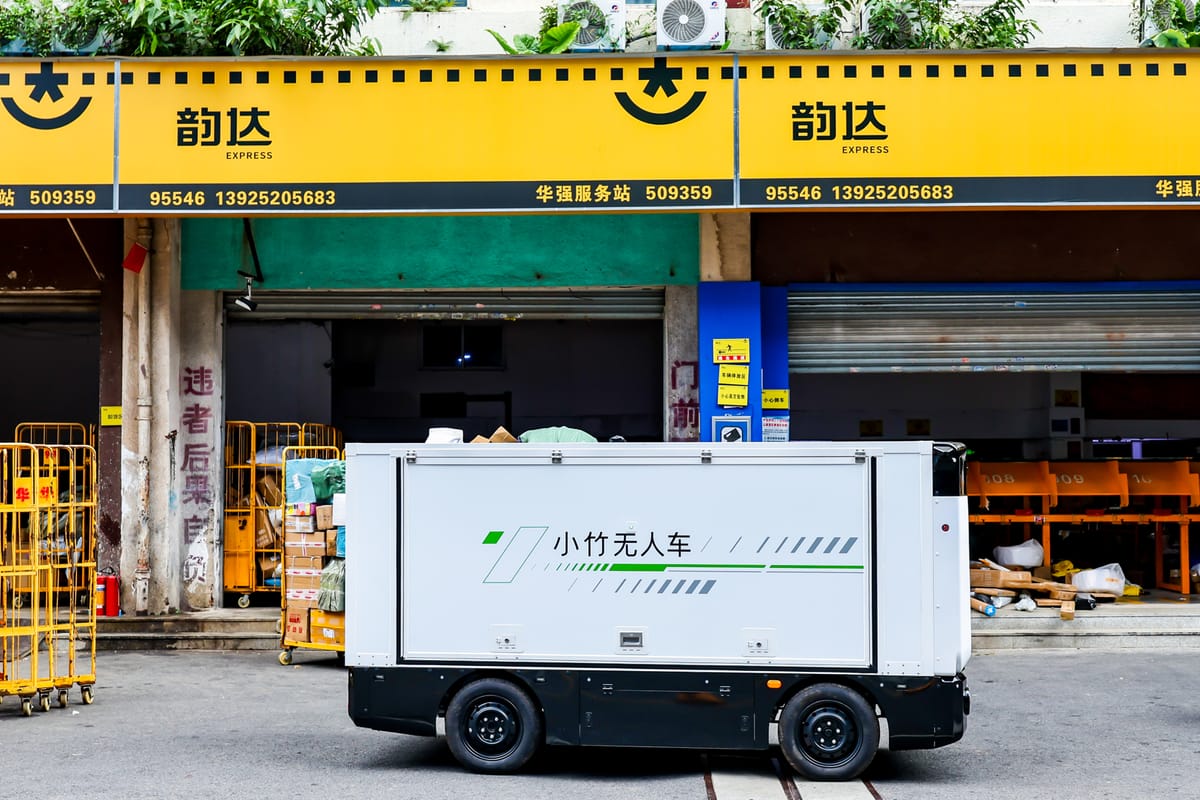
Multiple new entrants are flooding the market with delivery announcements. Jiangsu Heyi delivered over 20 intelligent autonomous delivery vehicles to SF Express in late January, while Xiaozhu Autonomous Vehicles, under Minieye, secured orders for 900 units. Industry observers note that this wave of competition comes as established e-commerce and logistics giants including JD.com, Meituan, SF Express, and China Post ramp up procurement, driving commercial adoption across diversified scenarios from traditional parcel delivery to retail, fresh food, pharmaceuticals, and industrial parks.
Cross-Industry Players Enter the Fray
Traditional automotive and technology companies are rapidly pivoting into autonomous delivery. In late January, Banmo Yixing, a brand under Tuojiangzhe Intelligent Technology— a company specializing in remote control systems for mining and port machinery — held its brand launch and unveiled the T6 logistics delivery robot designed for the embodied intelligence era.
Mingwei Automotive Technology, previously focused on automotive architecture design and components, announced its autonomous delivery vehicle product launch and delivery ceremony. Since last year, BYD, Desay SV, Minieye, ClixPilot, and Qcraft have all entered the autonomous delivery segment, leveraging their technical platforms and resource integration capabilities to accelerate market penetration.
Qcraft announced a partnership with Chery Commercial Vehicle in November last year, with their jointly developed autonomous logistics vehicles already operating in Suzhou, Jinhua, and Wuhu. Minieye has deployed vehicles in Shenzhen and Changsha, targeting a fleet of 10,000 units in 2026.
Scale Race Reaches Critical Inflection Point
Following an initial land-grab phase, the autonomous delivery sector is entering deeper competitive waters. Market dynamics showed clear differentiation in the second half of 2025, with first-tier players including Neolix and Zelos each surpassing 10,000 unit deliveries.
Driven by capital inflows, supportive policies, and declining costs, 2026 represents a critical juncture for mass-scale deployments. In 2025, leading players including Neolix, Bainiaohe, and Zelos completed multiple financing rounds. Neolix secured over $600 million, setting a record for single-round fundraising in the autonomous vehicle sector. The company aims to deliver 50,000 autonomous delivery vehicles in 2026.
However, intensifying competition has triggered aggressive pricing strategies. Since the second half of 2025, price wars have escalated to the point where some suppliers are reportedly operating at losses to gain market share. Industry analysts note that technology iteration and product optimization require large-scale fleet operations and diverse scenario data, while commercial expansion demands higher safety standards, superior performance, and lower total cost of ownership.
Business Models Evolve Beyond Vehicle Sales
The commercial framework has evolved beyond simple vehicle transactions to encompass diverse revenue streams including vehicle sales, capacity leasing, after-sales maintenance, and system services. Zelos launched the "Zelos City Distribution" app, providing customers with integrated solutions covering vehicle customization, delivery tracking, daily operations management, and service renewals.
Cost competition now extends beyond unit pricing to encompass total system operating costs and efficiency across the entire project lifecycle. This requires mature and reliable technology, deep scenario understanding for customized intelligent solutions, enhanced delivery efficiency and operating hours, and comprehensive maintenance service systems.
According to Neolix, its deployed fleets frequently operate overnight, achieving 24-hour capacity growth. In a textile and garment warehouse delivery project in Nantong, Jiangsu, automated loading and unloading via cage carts eliminated manual high-intensity handling and resolved safety hazards of electric vehicles entering elevators. The solution shortened overall operation time by 1.5 hours and reduced comprehensive costs by 60%.
As Neolix CEO Yu Enyuan stated, the 2026 race is no longer about "who delivers the most," but "who can provide customers with the best experience and lowest-cost operational services."