
China's Bus Exports to Africa Double as North African Demand Surge Masks a Deeper Structural Shift
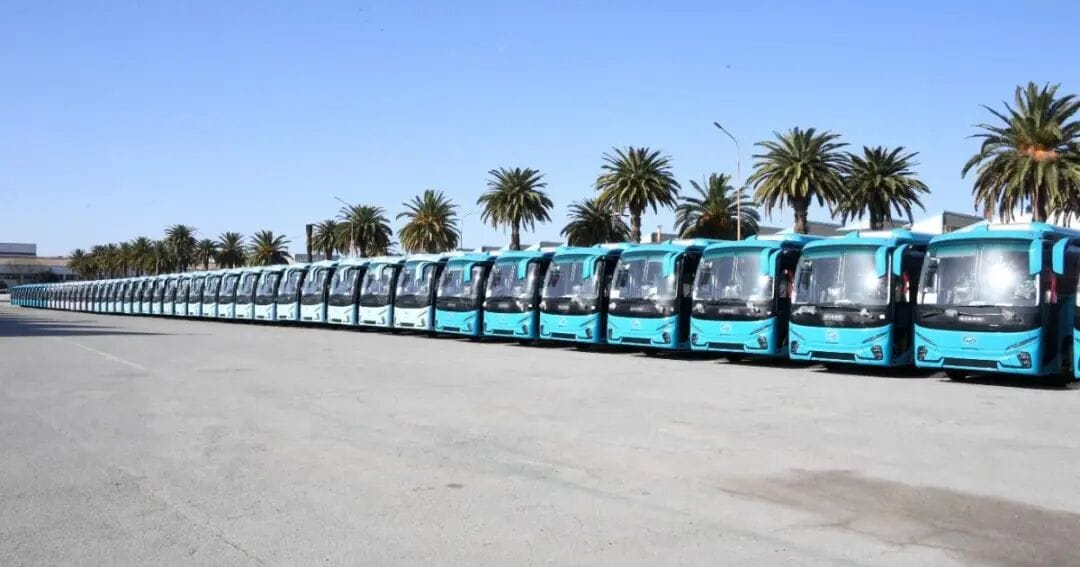
China's bus exports to Africa more than doubled in the first nine months of 2026, but the headline surge conceals a market in transition—one where the most durable competitive advantage belongs not to the manufacturer that ships the most vehicles, but to the one that builds the deepest after-sales infrastructure on the ground.
A report published by Zhongtai Securities shows China exported approximately 14,800 buses to Africa in the January–September 2026 period, a 115% year-on-year increase. Africa's share of total Chinese bus exports jumped from 23% in 2025 to roughly 37%, making it the fastest-growing destination market by a substantial margin. The data repositions Africa from a secondary export corridor into the primary driver of near-term volume growth for China's listed bus manufacturers.
Initial market reaction has been reflected in the share performance of the three principal A-share bus companies—Yutong Bus, King Long Motor Group, and Zhongtong Bus —all of which reported overseas revenue exceeding 50% of total revenue in the first three quarters of 2026.
Three Demand Triggers Converge, Creating a Misleading Spike
The 115% growth rate is real, but it is not replicable. It is the product of three structurally distinct demand events occurring simultaneously across Algeria, Egypt, and Morocco—the three most populous nations in North Africa—each with its own trigger, timeline, and buying mechanism.
Algeria represents a classic demand-destruction-and-release cycle. Beginning in 2016, the government curtailed new vehicle imports to promote domestic assembly. Political turbulence in 2019 disrupted assembly operations and blocked CKD (completely knocked-down) kit imports, effectively halting fleet renewal for nearly a decade. Factories operated by Volkswagen and Kia suspended production. Annual car imports, which had reached 450,000 units in 2012, fell to a few thousand by 2019.
The consequence: Algeria's national bus fleet of approximately 84,000 vehicles aged severely, with an estimated 5,400 units exceeding 30 years of service and a further 28,000 exceeding 20 years. A fatal crash in El-Harrach, east of Algiers, in August 2025 provided the political catalyst. President Tebboune ordered the immediate import of 10,000 replacement buses.
The procurement moved with unusual speed. On January 8, 2026, 3,000 Higer Bus vehicles assembled at the Suzhou factory were dispatched to Algeria—the single largest export order in Chinese bus industry history. In February, 650 Yutong units followed. According to Algerian media outlet TSA, 5,650 of the 10,000 buses originated from China. On April 9, the military's Vehicle Industry Development Bureau (EDIV) distributed 908 units in a single handover. Financing flows from hydrocarbon revenues, with the vehicles qualifying for tax exemptions written into Algeria's 2026 fiscal policy.
Egypt represents a demand-recovery cycle driven by macroeconomic stabilization. Acute foreign exchange shortages in 2023 compressed vehicle imports for two consecutive years. Following the Egyptian pound's sharp devaluation and the conclusion of an $8 billion IMF lending program, FX supply normalized. Egypt's bus sales grew 53.6% in 2025; in the first seven months of 2026, sales reached 10,449 units, up 88% year-on-year, according to the Automotive Market Information Council (AMIC).
The monthly unit data reveals the competitive ranking. In August 2026, King Long's Golden Dragon sold 353 units and its affiliate King Long Higer sold 377 units—730 combined, more than double Toyota's 313. The significance, however, is structural rather than volumetric: approximately 80% of buses sold in Egypt are locally assembled. King Long has already established a joint assembly plant with Saudi partner ATM Misr in the Suez Economic Zone.
Morocco represents event-driven procurement with a long investment tail. The country purchased 723 Yutong buses to support the 2025 Africa Cup of Nations. Those vehicles subsequently transitioned into urban transit service. Morocco's larger ambition—co-hosting the 2030 FIFA World Cup with Spain and Portugal—requires 7,000 new buses by 2030 and the modernization of public transport systems across 84 cities between 2025 and 2029. Unlike Algeria, Morocco carries no fuel subsidies, and its procurement plans explicitly include electric vehicles.
Why Electric Buses Capture Only 3% of Africa Volume
Of the approximately 14,800 buses exported to Africa in the nine-month period, roughly 500 were battery-electric—a 3% penetration rate. The contrast with Europe is stark: Chinese buses sold into European markets in the same period carried a 69% new-energy share.
The divergence is not primarily about grid infrastructure. It is about fuel subsidy economics.
Algeria's retail diesel price stands at approximately 31 dinars per liter—roughly $0.23—among the lowest in Africa and less than one-sixth of the global average. Electricity, also subsidized, costs approximately $0.04 per kilowatt-hour.
A back-of-envelope calculation illustrates the investment case: a 12-meter transit bus covering 60,000 kilometers annually consumes approximately 35 liters of diesel per 100 kilometers, generating annual fuel costs of roughly $4,800. An equivalent electric bus, consuming approximately 1.2 kWh per kilometer, incurs annual electricity costs of approximately $3,000. The annual operating saving of $1,800 cannot recover the tens of thousands of dollars of price premium an electric bus carries over its diesel equivalent within a standard service life.
In Algeria, the electric bus loses on price arithmetic, not on charging infrastructure.
Europe's 69% EV share is similarly policy-manufactured: retail diesel exceeds €1.50 per liter in most markets, the EU Clean Vehicles Directive mandates minimum clean-bus thresholds in public procurement, and multiple member states layer additional purchase subsidies. China's own domestic new-energy bus fleet—now overwhelmingly electric—was built over 15 years of purchase and operating subsidies.
The directional rule holds across Africa: where fossil fuel subsidies are heavy, the electric bus case collapses. Ethiopia is the exception that proves the rule—diesel costs approximately $1.10 per liter (nearly five times Algeria's rate), hydropower keeps electricity cheap, and the government banned imports of fossil-fuel private vehicles in 2024. Nigeria offers a cautionary counterexample: fuel price liberalization has pushed diesel to approximately $1.20 per liter, making the EV economics plausible, but grid instability creates a separate operational barrier.
For Chinese bus manufacturers, the reform trajectory of North African fuel subsidy regimes is the single most important variable governing EV uptake. Until that changes, the continent runs on diesel—and China's commercial vehicle supply chain, having fully depreciated its diesel bus technology over two decades of domestic scaling, is well-positioned to supply it.
Profitability Gaps Expose a Seven-Fold Margin Disparity
Aggregate export volumes obscure a critical divergence in financial performance among the three listed players.
Yutong Bus generated an overseas gross margin of approximately 29.6% in the first three quarters of 2026, exceeding its domestic gross margin by 10.5 percentage points. King Long Motor Group—whose three sub-brands, Xiamen King Long, King Long Higer, and Suzhou King Long Higer,secured Algeria's largest single order and outsold Toyota in Egypt—reported a net margin of approximately 1.9%. The gap between the two companies on a net profit basis approaches seven-fold.
The explanation is structural. King Long's three sub-brands operate largely independent international sales networks, dividing service resources and in some markets competing directly against one another. Without coordinated channel management, pricing power erodes.
Yutong's approach is differentiated by deliberate service infrastructure investment. By September 2026, the company had established sales and service networks across nearly 50 African countries. In Algeria, it designated Peng Pu as its sole authorized local partner and initiated technician training programs through that entity. In Morocco, the 723 buses deployed for the Africa Cup of Nations did not exit Yutong's commercial ecosystem when the tournament ended—they entered urban service, and the downstream maintenance, parts, and eventual replacement contracts remain with the brand.
In a market where authorized dealers remain scarce, after-sales coverage functions as a competitive moat. Higher vehicle uptime strengthens brand credibility, improves contract renewal probability, and justifies premium pricing. Yutong's 10-percentage-point overseas gross margin advantage over its domestic business is, in substantial part, a return on that infrastructure investment.
Zhongtong Bus recorded the highest growth rate of the three—approximately 186% in Africa exports—with Africa now accounting for roughly one-third of its total export volume. That concentration amplifies both the upside from the current North African cycle and the downside risk when the cycle turns.
Structural Transition Signals 2027 Volume Correction
The 115% growth rate is not a run-rate. It is a confluence event, and its principal driver—Algeria's emergency 10,000-unit procurement—is finite.
Once the initial order is fulfilled, Algeria's remaining renewal backlog (the 28,000-plus buses exceeding 20 years) is more likely to be addressed through local assembly than further bulk imports. The government signed framework agreements with three local partners—Peng Pu, EDIV, and Tirsam—in October 2025, and the transport minister has publicly stated that imports represent only a transitional phase. Algeria is following the trajectory Egypt completed years earlier.
As that transition progresses, the Chinese companies best positioned are those that established local assembly partnerships and parts distribution before the import window closes. Yutong's Peng Pu relationship and Higer's two decades of Algerian market presence represent exactly this kind of optionality. For manufacturers without local industrial anchors, the window is narrowing.
Currency and financing risk add further complexity. Bus contracts are typically denominated in hard currency while operational revenues are collected in local currency. The ability to offer installment financing and operating leases—a capability requiring balance sheet capacity and local financial partnerships—is increasingly a contract-qualifying criterion. Research from the Development Bank of Nigeria shows transport sector lending constitutes approximately 3% of the country's private sector credit, illustrating how capital-constrained African bus operators are.
The structural read: Chinese bus exports to Africa by whole-vehicle count will likely decelerate materially in 2027 as Algeria's emergency procurement cycle ends and local assembly absorbs incremental demand. The decline in unit export figures, however, will not map linearly onto Chinese brand market share. In markets like Egypt, the shift from finished vehicle imports to CKD kits and technology licensing is already underway—a transition invisible to conventional trade statistics but commercially significant. Volume and share can move in opposite directions.
The industry's most durable African franchise belongs to manufacturers who treat the current export surge not as a revenue event, but as a window to embed service infrastructure deep enough to survive the inevitable statistical correction.