
China's Enflame Technology Advances to IPO Inquiry Phase in 20 Days as Tencent Backs AI Chip Unicorn
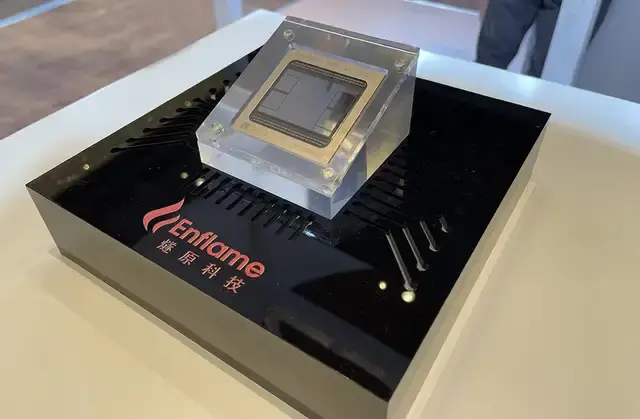
Enflame Technology, a cloud-based AI chip developer backed by Tencent, has moved to the inquiry phase of its Science and Technology Innovation Board listing just 20 days after filing its initial application. The Shanghai-based company, valued at approximately 20.5 billion yuan (US$2.8 billion), is seeking to raise 6 billion yuan (US$830 million) despite cumulative losses of 5.1 billion yuan (US$705 million) over the past three years and heavy reliance on Tencent for over 70% of its revenue.
The Shanghai Stock Exchange updated Enflame's IPO audit status to "under inquiry" on February 11, marking one of the fastest progressions from application acceptance to inquiry stage for a Science and Technology Innovation Board candidate. The company, the earliest established but last to pursue listing among China's "Big Four" domestic GPU makers, is racing to capitalize on the current capital market window for AI chip manufacturers.
Enflame's rapid advancement comes as domestic AI chip companies face mounting pressure to secure funding amid intensifying competition and escalating research and development costs. The company's dependence on a single major customer and persistent cash burn raise questions about its commercial sustainability, even as China's push for semiconductor self-sufficiency drives investor interest in local alternatives to Nvidia Corp.
The proposed 6 billion yuan fundraising will target development and commercialization of the company's fifth and sixth-generation AI chip products, as well as advanced AI software-hardware integration projects. This represents a critical "blood transfusion" for Enflame as it attempts to balance technological ambition with commercial viability.
Tencent's Seven-Year Bet
Founded in March 2018, Enflame Technology is the oldest among China's "Big Four" domestic GPU manufacturers but the last to pursue public listing. The company's core founding team came from Advanced Micro Devices Inc., bringing deep technical expertise in processor design.
Founder and CEO Zhao Lidong, a Tsinghua University graduate in wireless communications, previously led CPU and GPU core IP development at AMD before joining Tsinghua Unigroup to oversee semiconductor investments. Co-founder Zhang Yalin, who serves as COO, worked alongside Zhao at AMD for five years.
Since inception, Enflame has completed multiple funding rounds backed by over 20 investment institutions, spanning venture capital firms like ZhenFund and China International Capital Corporation, to the National Integrated Circuit Industry Investment Fund, Shanghai Guotou, Wuyuefeng Capital, and Chengdu state-owned capital, as well as corporate investors including Tencent and Meitu.
Tencent has participated in every major funding round since the Pre-A stage. Tencent Technology and its concert party Suzhou Paiyi collectively hold 20.26% of Enflame's shares, making them the largest institutional shareholder. Yao Leiwen, managing director of Tencent Investment, sits on Enflame's board as a key strategic decision-maker.
According to the 2025 Hurun Global Unicorn Index, Enflame ranks 395th globally with an enterprise valuation of 20.5 billion yuan.
While most domestic GPU manufacturers have chosen the GPGPU route compatible with Nvidia's CUDA ecosystem, Enflame has taken a more challenging path. Based on proprietary instruction sets, the company independently developed the GCU-CARE acceleration computing unit and GCU-LARE chip-to-chip high-speed interconnect technology, alongside a complete AI computing and programming platform called "TopsRider."
This non-GPGPU architecture achieves higher operational efficiency in specific scenarios but requires building an entirely new software ecosystem from scratch, explaining Enflame's persistently high R&D spending.
High Growth Meets High Cash Burn
Enflame's financial performance presents a stark contradiction between surging revenue and mounting losses. From 2022 to 2024, operating revenue soared from 90.1 million yuan (US$12.5 million) to 722 million yuan (US$99.9 million), representing a compound annual growth rate of 183.15%. In the first three quarters of 2025, revenue reached 540 million yuan (US$74.7 million).
However, the company recorded cumulative net losses of 5.179 billion yuan across the reporting period, with 888 million yuan ($122.8 million) lost in just the first three quarters of 2025 alone. Research and development expenses consumed 181.66% of revenue in 2024, moderating only slightly to 164.77% in the first three quarters of 2025.
Cash generation remains problematic. From 2022 through the first three quarters of 2025, net cash flow from operating activities totaled negative 4.764 billion yuan ($659 million), never turning positive. The company attributes this to large-scale inventory and advance payments for key materials procurement.
Enflame projects it will reach breakeven as early as 2026, based on orders in hand, product delivery schedules, and R&D plans.
AI accelerator cards and modules constitute the company's primary revenue source. However, production-to-sales ratios have declined since 2023, falling from 99.46% in 2023 to 78.53% in 2024, and further to 69.48% in the first three quarters of 2025. The company explains this reflects advance inventory building to meet anticipated fourth-quarter customer demand.
In 2024, Enflame sold 38,800 AI accelerator cards and modules, capturing approximately 1.4% of China's AI accelerator card market. The company's third-generation inference accelerator card "Enflame S60," mass-produced in the second half of 2024, has secured orders exceeding 100,000 units.
Tencent Dependency Risk
Enflame's business model reveals deep integration with Tencent. From 2022 through the first three quarters of 2025, sales to the top five customers consistently exceeded 90% of total revenue. Sales to Tencent Technology jumped from 8.53% in 2020 to 33.34% in 2023, 37.77% in 2024, and 71.84% in the first three quarters of 2025.
This means 71 of every 100 yuan in revenue came from Tencent during the most recent reporting period. The prospectus acknowledges that "the situation of relatively high sales proportion to Tencent is expected to continue for a certain period in the future."
This customer concentration presents both opportunity and risk. While stable orders from Tencent have sustained operations, excessive dependence on a single customer raises questions about growth potential and commercial independence. The precedent of Cambricon Technologies struggling after separating from Huawei Technologies Co. serves as a cautionary tale.
Gross margins for AI accelerator cards and modules have fluctuated significantly due to product iteration, ranging from 46.25% in 2022 to 15.51% in 2023, then rebounding to 40.78% in 2024. Notably, Enflame's 2024 gross margin remained below the industry average of 66.77%.
Racing to Join Capital Markets
On July 27, 2025, at the World Artificial Intelligence Conference, Enflame unveiled its fourth-generation training-inference integrated AI chip, the Enflame L600. Featuring 144GB memory capacity, 3.6TB/s memory bandwidth, 800GB/s interconnect bandwidth, and FP8 low-precision support, the company claims performance "benchmarking and significantly exceeding Nvidia's H20."
The company plans to launch its fifth-generation AI chip in 2027 and sixth-generation product in 2028, indicating preparation for a three-year technology race.
Enflame is the last of China's "Big Four" domestic GPU makers to pursue listing. In 2025, Moore Threads Technology and MetaX Integrated Circuits (Shanghai) listed on the Science and Technology Innovation Board, while Biren Technology debuted on the Hong Kong Stock Exchange on January 2, 2026, becoming the "first Hong Kong-listed domestic GPU stock."
The secondary market performance of peers has fueled expectations: Moore Threads' pre-listing valuation of 30 billion yuan ballooned to over 400 billion yuan post-IPO, while MetaX's market capitalization exceeded 300 billion yuan.
With inquiry documents now issued, Enflame faces critical scrutiny of its business model, customer concentration, and path to profitability. For China's domestic computing power ambitions, the real test is just beginning: when capital market enthusiasm fades, only technological moats and commercial cash-generation capabilities can sustain a hard-tech enterprise through market cycles.