
China's EV Battery Output Hits 192GWh in May as Installation Rate Slides to Record Low 38%
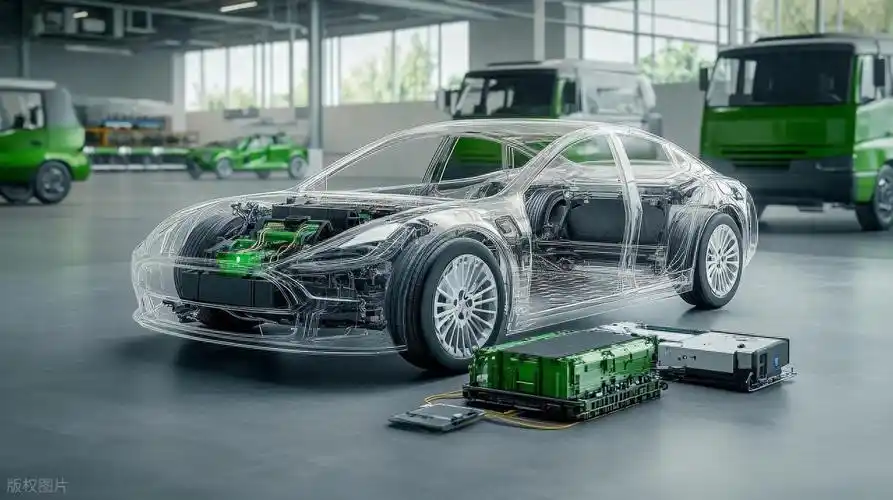
China's lithium battery sector is flashing a structural warning signal: output is surging while the share of batteries actually installed in vehicles is falling to multi-year lows, exposing a deepening inventory overhang that is reshaping competitive dynamics across the supply chain.
Total lithium battery production in China reached 192GWh in May 2026, up 38% year-on-year, pushing the January–May cumulative figure to 863GWh, a 30% increase over the same period in 2025. Yet the vehicle installation rate — the share of power battery output that ends up in a new vehicle — dropped to just 38% in May, the lowest reading in at least five years and down sharply from 70% in 2021, 54% in 2022, and 44% in 2025. The divergence between production growth and end-demand absorption is the defining tension in China's battery market heading into the second half of 2026.
Battery installation volume for the January–May period reached 259GWh, growing only 7% year-on-year — a steep deceleration from the 40% growth recorded in full-year 2025 and 41% in 2024. The slowdown confirms that headline output figures are masking a demand-side correction that is pressuring both battery manufacturers and upstream raw material suppliers.
Installation Rate Collapse Signals Inventory Pressure Building Upstream
The structural decline in the installation rate reflects two concurrent forces. First, energy storage applications — accelerated by the post-Ukraine global energy crisis — are absorbing an increasing share of battery output, pulling capacity away from vehicle programs. Second, and more immediately, new energy vehicle (NEV) sales momentum in early 2026 has been weaker than production schedules anticipated.
May 2026 NEV vehicle installations totaled 1.03 million units domestically, down 8% year-on-year. Pure electric passenger vehicles (BEV sedans and SUVs) fell 1% to 660,000 units, while plug-in hybrid passenger vehicles (PHEV) dropped a sharper 28% to 280,000 units. The PHEV contraction is particularly notable given the segment's multi-year outperformance and suggests that consumer incentive fatigue or model-cycle gaps may be at play.
The one bright spot: pure electric trucks surged 39% year-on-year to 70,000 units in May, driven by heavy-duty commercial vehicle subsidies. On a year-to-date basis through May, pure electric trucks posted 75% growth, making commercial vehicles the fastest-growing battery demand segment in 2026 — a structural shift that is reallocating battery volume from passenger to commercial applications.
CATL Extends Lead as BYD's Share Erodes in Competitive Reset
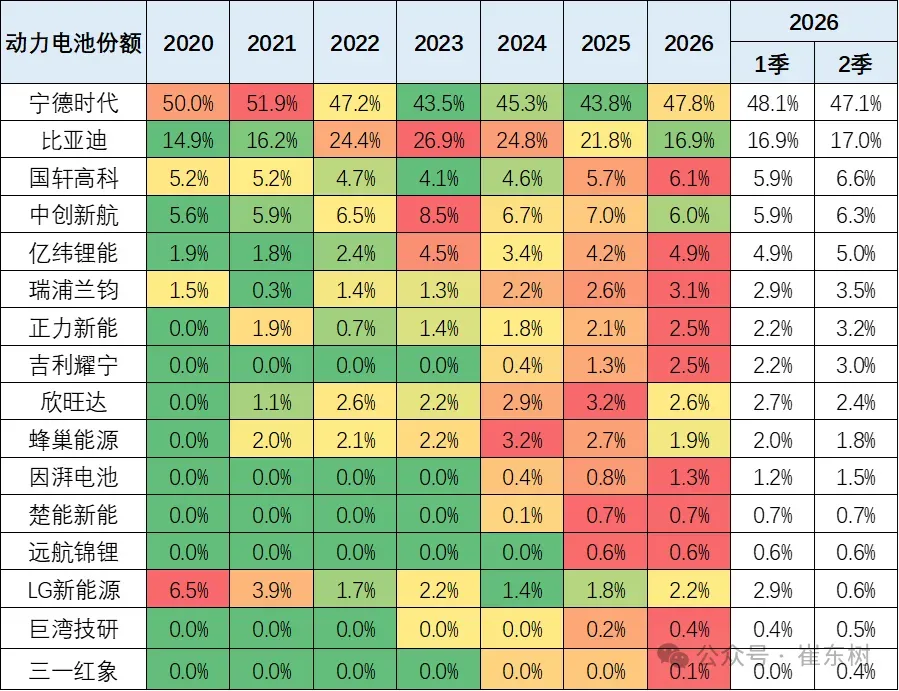
The competitive landscape among battery suppliers is undergoing a quiet but significant rebalancing. Contemporary Amperex Technology (CATL) expanded its domestic market share to 47.1% in May 2026, consolidating its position as the dominant supplier. BYD, by contrast, has seen its domestic battery supply share fall from a peak of 26.9% in 2023 to approximately 17% in Q2 2026 — a decline of 5.6 percentage points versus 2025.
The combined share of the top two players stands at 64% in 2026, down from 72% in 2022, leaving roughly 30%-plus of the market contested among a second tier of suppliers. Notably active in this space are Gotion High-Tech, Svolt Energy Technology, Geely Yaoning, and Chuneng New Energy. The number of active battery suppliers fitting vehicles dropped to just 33 in May 2026, indicating that consolidation pressure — despite the headline market fragmentation — continues to thin the supplier base.
BYD's share erosion stems directly from its strategic pivot to an all-LFP (lithium iron phosphate) chemistry lineup, which has ceded the ternary (NMC/NCA) battery segment to competitors. CATL, Svolt, CALB, and LG Energy Solution are the primary beneficiaries of the ternary resurgence. LG Energy Solution's domestic figures remain subdued, however, as Tesla China's domestic sales mix has declined relative to exports.
In the LFP segment, CATL surpassed BYD in market share as early as 2024 and has continued to widen that gap. EVE Energy and Gotion High-Tech are also gaining ground in LFP, while Sunwoda Electronic, Ruipu Lanjun Energy, and Geely Yaoning are posting meaningful share gains.
High-Density Batteries Recovering, Signaling Premium Demand Resilience
Energy density trends offer a more nuanced read on consumer demand quality. The 140–160 Wh/kg density band — the workhorse range for mainstream BEV passenger vehicles — accounted for 46% of installations in April–May 2026, up 14 percentage points year-on-year. This reflects a sustained upgrade cycle as battery costs decline and OEMs extend range specifications.
More telling is the recovery at the high end: vehicles equipped with batteries exceeding 160 Wh/kg represented 11% of installations in April–May 2026, nearly double the 6% share recorded in the same period of 2025. This rebound is driven by premium PHEV models — particularly high-end extended-range and performance plug-in hybrids — where ternary chemistry remains the technology of choice. At the low end, batteries below 125 Wh/kg have effectively exited the market, falling to a 0% share in 2026.
The overall energy density distribution reinforces a bifurcation narrative: mass-market BEVs are clustering in the 140–160 Wh/kg band, while a growing premium segment pushes above 160 Wh/kg, creating differentiated demand pockets that favor CATL and other ternary-capable suppliers over LFP-focused producers.
OEMs Tightening Grip on Supply Chain as "Vehicle-First" Era Accelerates
Beyond the near-term inventory correction, the data points to a longer-term structural shift in supply chain power dynamics. As NEV penetration deepens and vehicle manufacturers accumulate battery procurement scale, OEMs are progressively asserting greater control over battery sourcing, upstream raw material procurement, and downstream brand management. Analyst Cui Dongshu, whose data underpins this analysis, characterizes the emerging paradigm as one where "OEMs reign supreme" — a dynamic that will compress margins for independent battery and component suppliers over the medium term.
The 2026 growth deceleration — battery output growth slowing from above 69% in early 2025 to 30% year-to-date — is not merely a cyclical pause. It reflects the maturation of a market that grew at triple-digit rates as recently as 2021 and is now navigating the structural challenges of overcapacity, margin compression, and a demand mix that is shifting from high-volume passenger vehicles toward more specialized commercial and energy storage applications.
Related Coverage: