
China’s EV Industry Enters Its Hardest Phase: What Really Changes After Subsidies Fade
China’s electric vehicle (EV) market has already crossed its most visible milestone: new-energy vehicles now account for more than half of all new car sales. But the more consequential transition is only beginning.
As policy support recedes and basic electrification becomes commoditized, competition is shifting toward deeper capabilities—technology maturity, cost discipline, user experience, and ecosystem design. This marks the industry’s move from a policy-driven expansion phase to a market-driven survival phase.
This explainer breaks down what that transition means, why it matters now, and where China’s EV industry is likely heading next.
What Is Changing in China’s EV Market?
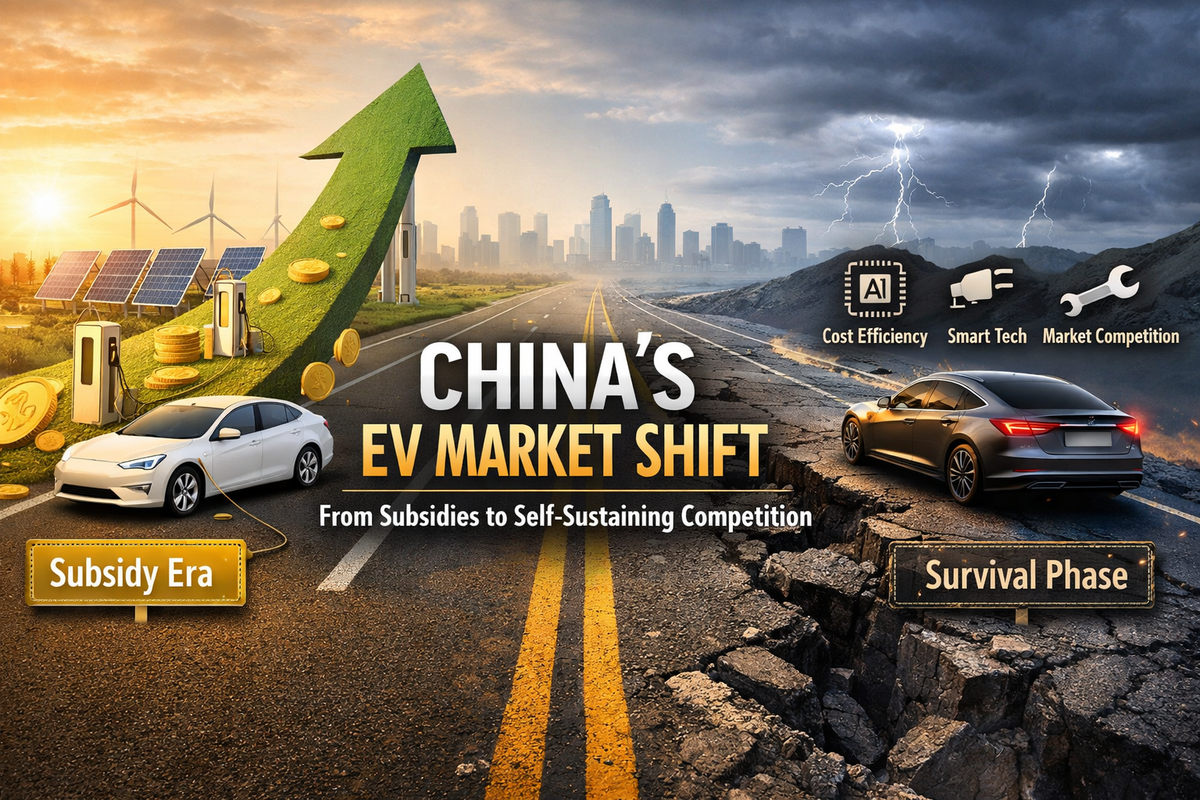
China’s EV industry is moving from “subsidy-supported growth” to “self-sustaining competition.”
For more than a decade, policy incentives—purchase subsidies, tax exemptions, and infrastructure support—accelerated EV adoption. By the mid-2020s, those policies achieved their primary goal: electrification is no longer niche.
Now, with incentives scaled back and penetration approaching saturation in major cities, EV makers face a different question:
Can they compete without policy support?
Why Does This Shift Matter Now?
Two structural thresholds have been crossed.
1. Electrification Is No Longer the Bottleneck
Charging infrastructure coverage is near-universal on highways, battery range has reached practical sufficiency for most users, and supply chains have matured. EVs no longer require policy “hand-holding” to be viable.
2. Market Penetration Has Reached Critical Mass
Once a market exceeds roughly 50% penetration, growth dynamics change. Expansion slows, replacement demand rises, and competition becomes zero-sum. Winning now requires differentiation, not just participation.
This is why the post-subsidy era is often described as a “bare-knuckle phase”—inefficient players are exposed quickly.
How Does Competition Work After Electrification Is “Solved”?
With range, charging access, and basic performance largely standardized, EV competition is shifting to four deeper layers:
Cost Structure
Price wars compress margins across the industry. Only manufacturers with scale, supply-chain control, or manufacturing efficiency can survive sustained pricing pressure.
Product Iteration Speed
Frequent model refreshes, faster platform upgrades, and rapid feature rollouts have become critical advantages—especially in China’s highly responsive consumer market.
User Experience (Beyond Specs)
As consumers mature, headline features matter less than reliability, predictability, and real-world usability.
Ecosystem Depth
Energy services, charging networks, software updates, and after-sales support increasingly influence brand loyalty.
Why Is “Smart Driving” the New Battleground—and Why Is It So Hard?
With electrification largely standardized, vehicle intelligence has become the primary differentiator. But this shift has exposed a growing gap between technical ambition and user experience.
What Automakers Are Trying to Build
Manufacturers are racing to develop advanced driver-assistance systems using large AI models, combining perception, language understanding, and action planning. Some are experimenting with “world models” that simulate physical environments to improve decision-making.
Where the Friction Appears
Despite rapid progress, current systems still struggle with edge cases, dense urban traffic, and unpredictable human behavior. Consumers increasingly recognize that these features function as advanced assistance, not true autonomy.
The result is a trust gap: marketing promises move faster than everyday reliability.
Why Policy Rollbacks Matter More Than They Appear
The reduction of EV tax incentives is not just a pricing issue—it changes industry psychology.
When incentives shrink, manufacturers lose a buffer that once masked inefficiencies. Consumers become more price-sensitive and more demanding. Marginal players can no longer rely on volume growth alone.
In effect, policy withdrawal acts as a stress test, accelerating consolidation.
How Are Charging and Energy Models Evolving?
As competition intensifies, energy replenishment has become a strategic differentiator rather than a background utility.
Ultra-Fast Charging
High-voltage platforms and megawatt-level charging are reducing wait times dramatically, making EV usage closer to traditional refueling behavior.
Battery Swapping
Once a niche approach, battery swapping is now being industrialized by multiple players. Standardization and scale—rather than novelty—will determine whether it becomes a mainstream solution.
The broader trend is diversification: no single energy model fits all users, and flexibility is becoming part of product value.
Why Powertrain Diversity Is Returning
Early EV adoption favored pure battery electric vehicles. As the market matures, range-extended and hybrid architectures are regaining relevance.
This reflects consumer reality rather than technological regression. Different usage patterns—long-distance travel, regional infrastructure gaps, cost sensitivity—demand different solutions.
Global automakers’ renewed interest in range-extended models suggests this diversification is structural, not temporary.
Who Ultimately Wins in This Phase?
History suggests that in capital-intensive manufacturing industries, only a few players survive at scale.
Long-term winners are likely to share several traits:
- Cost discipline across the full supply chain
- Fast but controlled product iteration
- Reliable, conservative delivery of “smart” features
- Strong ecosystem integration rather than feature stacking
- Brand trust built on real usage, not specifications
Market leadership will matter less than resilience.
What Comes Next?
China’s EV industry is entering a phase where growth slows, standards rise, and mistakes become expensive.
The defining competition is no longer EVs versus internal combustion engines, but which EV makers can operate sustainably in a mature market—without subsidies, without hype buffers, and under constant margin pressure.
This is the industry’s real proving ground. The transition from electrification to endurance has begun.