
China's EV Makers Post Record May Deliveries as Industry Profit Margins Languish at 3.4%
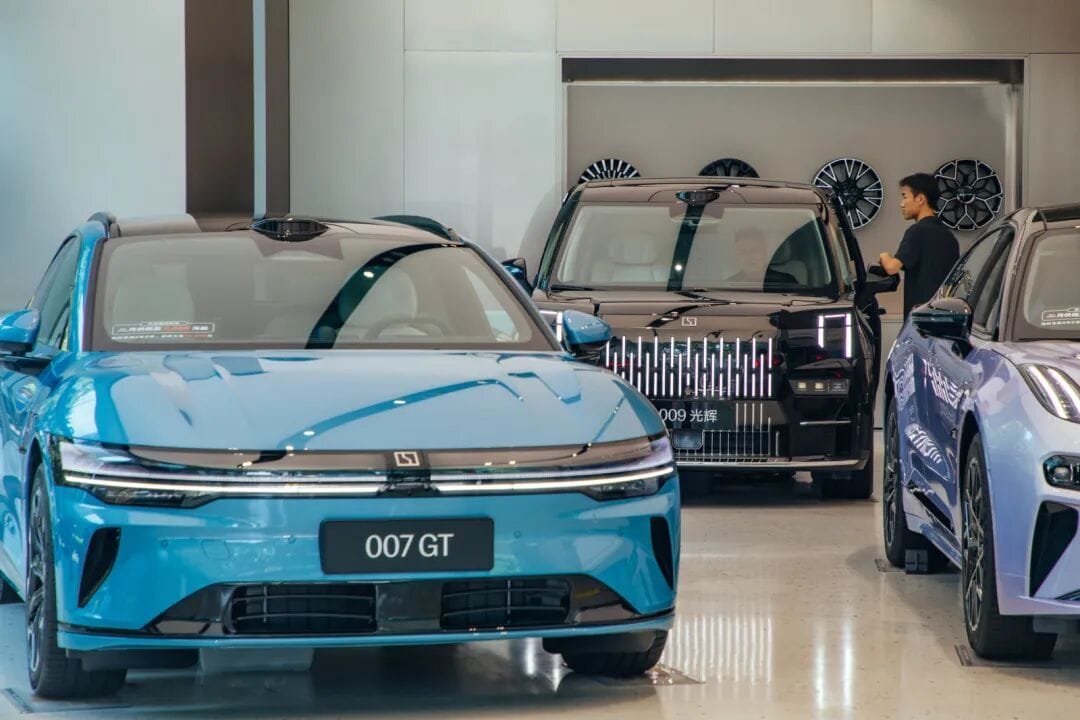
Leapmotor Surges 81% to Top NEV Sales Charts, but Surging Lithium and Chip Costs Expose a Sector Trapped Between Volume and Viability
China's new-energy vehicle sector delivered its strongest May on record, yet the headline numbers mask a deepening structural contradiction: an industry generating revenue at scale while failing to generate returns commensurate with that scale, with January-to-April aggregate profit margins at just 3.4%—barely half the 6% average for Chinese industrial enterprises.
The divergence crystallized on June 1, when monthly delivery figures from China's leading EV brands confirmed that NEV retail penetration breached 62.5% of the total passenger-car market in May, with retail volume reaching approximately 950,000 units, up 12% month-on-month, according to data from the China Passenger Car Association (CPCA). Yet the same week, Leapmotor disclosed that its Q1 gross margin had compressed to 9.4%, down sharply from 14.9% a year earlier and 15.0% in Q4 2025—even as its May deliveries hit a record 81,000 units. The juxtaposition is emblematic of an industry-wide condition analysts are calling "volume without profit."
The market's initial read is cautious. Investors tracking China's NEV supply chain note that the cost pressures driving this margin compression—lithium carbonate prices up 167% from RMB 75,000 per tonne in July 2025 to approximately RMB 200,000 per tonne (US$27,778) by early May 2026, and automotive-grade DRAM chip prices up 180% over three months due to AI workload competition for fab capacity—show no near-term reversal. The old industrial logic of scale-driven margin expansion, the foundation on which legacy automakers built their business models, is failing in real time.
Leapmotor Leads the Pack While Watching Its Own Margins Erode
Leapmotor delivered 81,000 vehicles in May, a year-on-year increase of 81%, establishing a commanding lead over its nearest new-force rival. The company's 60%-70% in-house component self-sufficiency ratio—one of the highest among pure-play NEV startups—has historically provided a cost buffer unavailable to competitors reliant on third-party supply chains. That buffer, however, proved insufficient to offset the current commodity cycle: Q1 gross margin fell to 9.4% from 14.9% in the same period of 2025.
The company's near-term product roadmap is dense. The Lafa5 model launches in 28 overseas markets in June 2026, while refreshed versions of the C10, C11, and C16 are imminent. The flagship MPV D99 is set to open pre-orders, giving the company multiple catalysts for second-half volume. Critically, Leapmotor's European market entry via Stellantis's distribution network—an asset-light model that has delivered B10 pricing premiums exceeding 100% over domestic equivalents—represents one of the clearest current illustrations of the overseas-margin arbitrage available to Chinese OEMs.
NIO, Xpeng, and Li Auto Diverge Sharply Beneath a Shared 30,000-Unit Threshold
The so-called "NIO-Xpeng-Li Auto" trio each held above 30,000 monthly deliveries in May, but the internal dynamics could not be more different.
NIO was the standout performer, delivering 37,000 vehicles in May—up 62.3% year-on-year and 28.4% month-on-month. Cumulative January-to-May volume reached 150,500 units, a 68.7% year-on-year increase. The Onvo sub-brand contributed 12,000 units, surging 91.5% year-on-year and 124.8% month-on-month, emerging as the group's primary incremental growth engine. The NIO flagship brand crossed 20,000 units, up 50.8%, while the Firefly brand delivered 5,600 units, up 53.9%. NIO's multi-brand architecture, built around a premium service ecosystem and battery-as-a-service (BaaS) infrastructure, continues to support gross margins above 20% on its core brand—a benchmark few domestic rivals can match.
Xpeng delivered 32,000 units in May, up 4% month-on-month. The newly launched GX SUV secured 24,863 firm orders within 12 hours of its launch, with the Ultra flagship variant accounting for over 80% of bookings. Because the GX launched in the final week of May, the bulk of its order conversion will flow into June and subsequent months, meaning May figures significantly understate the model's commercial momentum. Xpeng Chairman He Xiaopeng publicly flagged that the traditional six-to-eight-month cost pass-through cycle has collapsed to a monthly dynamic settlement model, and that lithium and memory cost inflation materially compressed the GX's launch-period gross margin.
Li Auto was the sole member of the trio to record year-on-year and month-on-month declines simultaneously, delivering 33,000 units in May—down 18.37% year-on-year and 2.16% sequentially. The deterioration of its range-extender (EREV) base is the central concern. On the positive side, the pure-electric i6 sedan has now exceeded 20,000 monthly deliveries for three consecutive months, partially offsetting structural pressure on the EREV lineup. The premium L9 Livis, launched last month, secured over 10,000 firm orders in its first two weeks and is projected to hold more than a 20% share in China's above-RMB 500,000 (US$69,444) NEV SUV segment—a category where margin profiles are materially more favorable.
Xiaomi and Huawei's Harmony Smart Mobility Accelerate, but Face Arithmetic Pressure
Xiaomi did not publish official May delivery figures, but available data points to approximately 30,000 units for the month. April deliveries were confirmed at 36,702 units, and Q1 cumulative deliveries reached 80,856 units. Against an annual target of 550,000 vehicles, Xiaomi has completed roughly 148,000 units through the first five months—approximately 27% of its full-year goal. Reaching the target requires monthly average deliveries of at least 57,500 units over the remaining seven months. A major new model built on an entirely new platform is planned for the second half of 2026, which management expects to serve as the primary volume catalyst.
Huawei-backed Harmony Smart Mobility delivered 46,000 units in May, up 41% month-on-month, with January-to-May cumulative deliveries up 26.5% year-on-year. The AITO brand contributed 34,000 units—74% of the total—growing 48.2% sequentially. The AITO M6 exceeded 20,000 units in its launch month, a performance that benchmarks favorably against established premium SUV competitors. The AITO M9 secured over 20,000 firm orders within 24 hours of launch, reinforcing Huawei's pricing power above RMB 500,000—a segment where the company's HarmonyOS cockpit ecosystem commands meaningful software monetization.
Second-Generation State-Backed Brands Capture Ground in Premium Segments
Among the so-called "second-generation" brands—new-energy offshoots of established state-owned automakers—Zeekr and GAC Aion both crossed the 30,000-unit threshold in May.
Zeekr delivered 34,000 units, up 81.8% year-on-year, marking four consecutive months of sequential and annual growth. The 9-series and 8-series models jointly accounted for nearly 50% of total volume, while average transaction prices rose 52.4% year-on-year. The Zeekr 9X has accumulated over 60,000 cumulative deliveries at an average transaction price above RMB 530,000 (US$73,611)—a data point that illustrates how premium positioning can partially insulate a brand from the margin compression afflicting the mass market.
GAC Aion delivered 33,000 units in May, up 23.76% year-on-year. Voyah delivered 13,000 units, up 30%, supported by strong pre-sale momentum for the flagship Taishan X8 SUV. iFly delivered 24,000 units, up 42% year-on-year, with year-to-date cumulative volume reaching 109,600 units.
Among brands in the 10,000-to-20,000 unit range, ARCFOX delivered 17,900 units, up 32.82% year-on-year, while IM Motors delivered 10,023 units, with January-to-May cumulative volume up 115% year-on-year. IM plans to launch refreshed versions of the LS6 and L6 in Q3 2026.
Traditional OEMs Hold Volume but Cede Narrative to NEV Challengers
BYD sold 383,000 vehicles in May, up a marginal 0.26% year-on-year—a figure that reflects the mathematical ceiling of commanding the largest domestic market share rather than growth deceleration. BYD's vertical integration through its Fudi Battery subsidiary remains the sector's most cited structural moat against commodity cost cycles.
SAIC Motor reported May sales of 349,000 units, down 4.62% year-on-year, though its NEV sub-segment grew 46.49% to 182,500 units—a ratio that encapsulates the broader market dynamic of NEV penetration cannibalizing internal combustion engine volume within the same corporate family.
Chery Automobile sold 247,000 units in May, up 20.5% year-on-year, benefiting disproportionately from overseas demand: the company's overseas revenue share crossed 52.4% of total revenue in 2025, the first time international sales have constituted a majority of its business. Geely sold 237,000 units, up 1% year-on-year, though its Lynk & Co brand declined 25% to 20,000 units.
Four Pathways Define Who Profits in the Next Cycle
The industry's profitability crisis—a 3.4% aggregate margin against a 6% industrial benchmark—is not uniformly distributed, and the divergence between winners and losers is already legible in the data.
Vertical integration separates those who control input costs from those who absorb them. BYD's overseas gross margin reached 19.46% in 2025, approximately three percentage points above its domestic margin; institutional estimates place its overseas vehicle gross margin closer to 28%, implying per-unit profitability approximately 2.3 times the domestic level.
Premium brand positioning provides margin headroom unavailable in the RMB 150,000-to-250,000 (US$20,833–US$34,722) mass-market segment, which has become, in the words of multiple industry participants, a "sea of blood." The AITO M9's average transaction price exceeds RMB 390,000 (US$54,167), while NIO has maintained vehicle gross margins above 20% through its premium positioning and service ecosystem. These examples suggest that the premium segment remains one of the few areas where sustainable profitability is still achievable.
Global market access is increasingly the decisive variable. Geely's overseas gross margin exceeds its domestic equivalent by approximately 10 percentage points; its overseas average selling price is 1.7 times the domestic level. Changan Automobile's overseas gross margin of 19.49% compares favorably to its 14.54% domestic margin. Leapmotor's European B10 pricing premium of over 100% versus domestic is the most extreme current illustration of the arbitrage.
Software and lifecycle services represent the highest-margin frontier. Tesla's Full Self-Driving (FSD) and Xpeng's XNGP advanced driver-assistance subscription offerings carry gross margins above 60%. NIO's BaaS battery subscription model and its swap-station network—where NIO Chairman Li Bin has indicated that 60 daily swaps per station achieves unit-level breakeven—are constructing an energy-services recurring revenue stream with no direct analog in the legacy automotive business. Huawei's HarmonyOS in-car application revenue share positions the vehicle as a consumer platform, not merely a transportation product.
The Profit Inflection Remains Ahead, Not Behind
May's delivery surge likely represents a modest margin recovery from the January-to-April trough, driven by the conversion of the approximately 80 new-model launches concentrated in March 2026—an unprecedented pace of roughly three launches per day. That product wave has now translated into terminal sales, but the underlying cost structure has not changed. Lithium carbonate and automotive-grade memory remain elevated, and the "three-month product heat decay cycle" that forces continuous launch cadence—trapping OEMs in a loop where stagnation kills volume and acceleration kills margins—shows no sign of abating.
The sector's genuine profit inflection will belong to those who have completed, or are completing, the transition from hardware assembler to technology-services platform: companies for which vehicle delivery is the beginning of a customer relationship rather than the end of a transaction. For the majority still competing on price in commoditized segments, the structural winter has not passed. For the minority that have built defensible positions in vertical integration, premium branding, global distribution, and software monetization, the current margin compression is a transitional cost—not a permanent condition.
Related Coverage:
Leapmotor Leads, Nio Surges Past Li Auto in China EV Shake-Up