
China’s eVTOL Industry Explained: Why Urban Air Mobility Is Moving From Hype to Hard Infrastructure
What is eVTOL, and why does it matter?
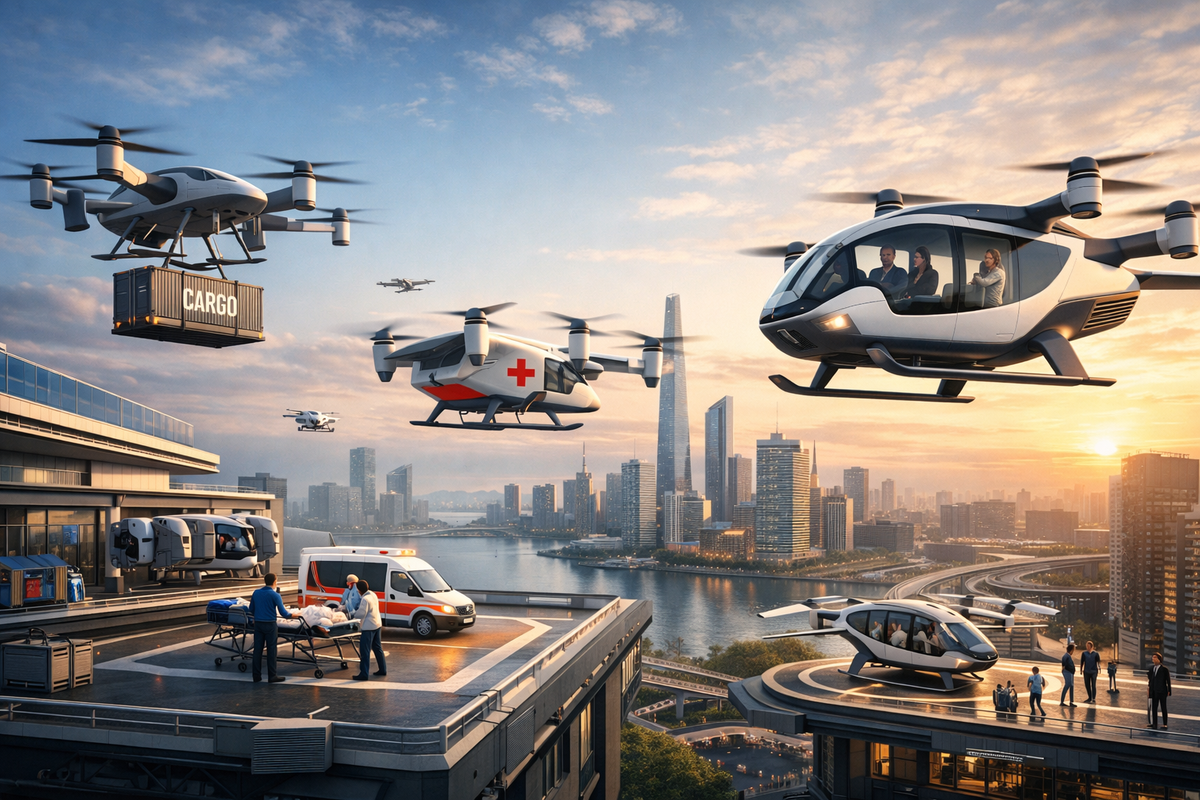
eVTOL—short for electric vertical take-off and landing aircraft—refers to a new class of electrically powered aircraft designed to take off and land vertically, without traditional runways. In policy and industry discussions, eVTOL is often treated as the technological backbone of the so-called “low-altitude economy,” covering urban air mobility (UAM), low-altitude logistics, emergency response, and industrial inspection.
What makes eVTOL strategically significant is not just the aircraft itself, but the system it enables: a new layer of transportation and logistics between ground mobility and conventional aviation. In China, this “third space” is increasingly framed as a long-term infrastructure upgrade rather than a speculative mobility experiment.
Why has eVTOL become important now?
China’s eVTOL industry is entering a different phase from the one that defined its early years.
For much of the past decade, eVTOL development was driven by technology validation and concept demonstration. Recently, however, three structural shifts have changed the industry’s trajectory:
- Policy clarity: Low-altitude airspace and the low-altitude economy have been elevated to strategic emerging industries, turning eVTOL from an optional innovation into a policy-supported direction.
- Technological maturity: Advances in electric propulsion, flight control systems, and composite materials have pushed eVTOL designs closer to certification and repeatable manufacturing.
- Commercial pressure: Capital markets have cooled from early hype, forcing companies to demonstrate certification progress, production readiness, and real operating scenarios.
As a result, the industry is moving away from open-ended experimentation toward execution, compliance, and scalability.
How does the eVTOL business model actually work?
Unlike consumer aviation narratives that focus on “flying taxis,” most viable eVTOL models today are infrastructure-driven and B2B-oriented.
The value chain typically includes:
- Aircraft manufacturing, where certification (type certification, production certification, and airworthiness approval) becomes the main barrier to entry.
- Operations and services, including logistics, emergency response, and industrial applications that prioritize reliability and cost efficiency over passenger experience.
- Infrastructure and systems, such as vertiports, charging networks, airspace management, and fleet operations software.
Revenue in early commercialization phases tends to come from cargo transport, public services, and government-linked use cases, where demand is stable and price sensitivity is lower. Passenger mobility is generally treated as a later-stage outcome rather than a starting point.
Why is China emerging as a key eVTOL market?
China’s eVTOL industry is growing faster than the global average, driven by scale, industrial depth, and coordinated policy support.
Industry estimates suggest that China’s eVTOL market reached roughly RMB 12.8 billion in 2025, with manufacturing and supply chains accounting for a rapidly growing share. Globally, the eVTOL market is projected to expand at a compound annual growth rate above 30% through 2030, but China is increasingly viewed as the core demand and supply hub rather than a peripheral participant.
Several factors explain this positioning:
- Manufacturing leverage: China’s aerospace supply chain, electric vehicle ecosystem, and battery industry provide cost and scaling advantages.
- Scenario density: Urban congestion, complex terrain, offshore and remote regions, and frequent emergency use cases create real operational demand.
- Capital structure shift: Investment has moved from short-term venture funding to long-horizon capital led by state-owned and industrial investors, favoring certification and infrastructure build-out.
Why will only a few eVTOL players ultimately survive?
Despite the number of startups, eVTOL is structurally a high-concentration industry.
The main filters are not marketing or prototype performance, but:
- Certification timelines and costs, which require sustained capital and regulatory expertise.
- Production readiness, including supply chain integration and quality control.
- Operational integration, where aircraft must fit into airspace management, ground infrastructure, and service economics.
As a result, the industry is moving from a fragmented “many experiments” phase to a smaller group of companies differentiated by strategy—such as cargo-first versus passenger-first approaches, or regional logistics versus urban mobility.
Over time, economies of scale and regulatory lock-in are likely to narrow the field further.
What are the key constraints holding the industry back?
Rapid growth does not mean smooth commercialization. Several bottlenecks remain structural rather than cyclical:
- Regulatory lag: Certification and airspace coordination often move more slowly than technological iteration.
- Infrastructure gaps: Vertiports, standardized landing sites, and charging systems remain scarce and fragmented.
- Operational economics: Weather resilience, payload limitations, maintenance costs, and fleet utilization rates still challenge profitability.
- Unsettled standards: Multiple technical routes and operating models raise system-wide costs and slow interoperability.
These constraints explain why eVTOL commercialization is uneven and why timelines often slip despite technological progress.
What is likely to happen next?
Looking ahead, the industry’s center of gravity is shifting from “can it fly?” to “can it operate at scale?”
Several medium-term trends are emerging:
- Cargo and emergency services will scale first, as they require fewer regulatory and consumer-acceptance breakthroughs.
- Urban air mobility will expand through pilots, not mass adoption, with routes designed around airports, business districts, and tourism corridors.
- Global expansion will accelerate, particularly into regions with infrastructure gaps and strong logistics demand.
- Capital markets will re-engage selectively, favoring companies that demonstrate execution, cash-flow discipline, and regulatory progress.
In this sense, eVTOL’s future is less about a sudden mobility revolution and more about patient system building.
The bigger picture
China’s eVTOL industry is no longer defined by concept videos or speculative narratives. It is becoming an infrastructure-heavy, regulation-bound, and execution-driven sector—closer to aviation and energy than consumer tech.
The real question is no longer whether eVTOL can fly, but whether it can fly reliably, economically, and repeatedly within a complex urban and regulatory environment. The answer will determine not just the fate of individual companies, but whether low-altitude airspace becomes a lasting layer of China’s transportation system.