
China's Humanoid Robot Race: After Unitree's IPO, Who Defines the Next Valuation Benchmark?
What Is This About?
On August 10, 2026, Unitree Robotics completed its IPO subscription on China's STAR Market at a listing valuation of approximately RMB 61 billion (roughly USD 8.4 billion). The subscription lottery hit a win rate of just 0.0181%—fewer than two winning tickets per 10,000 entries—making it one of the most oversubscribed tech listings in recent Chinese market history. The IPO processed from acceptance to approval in 73 days, the fastest in STAR Market history.
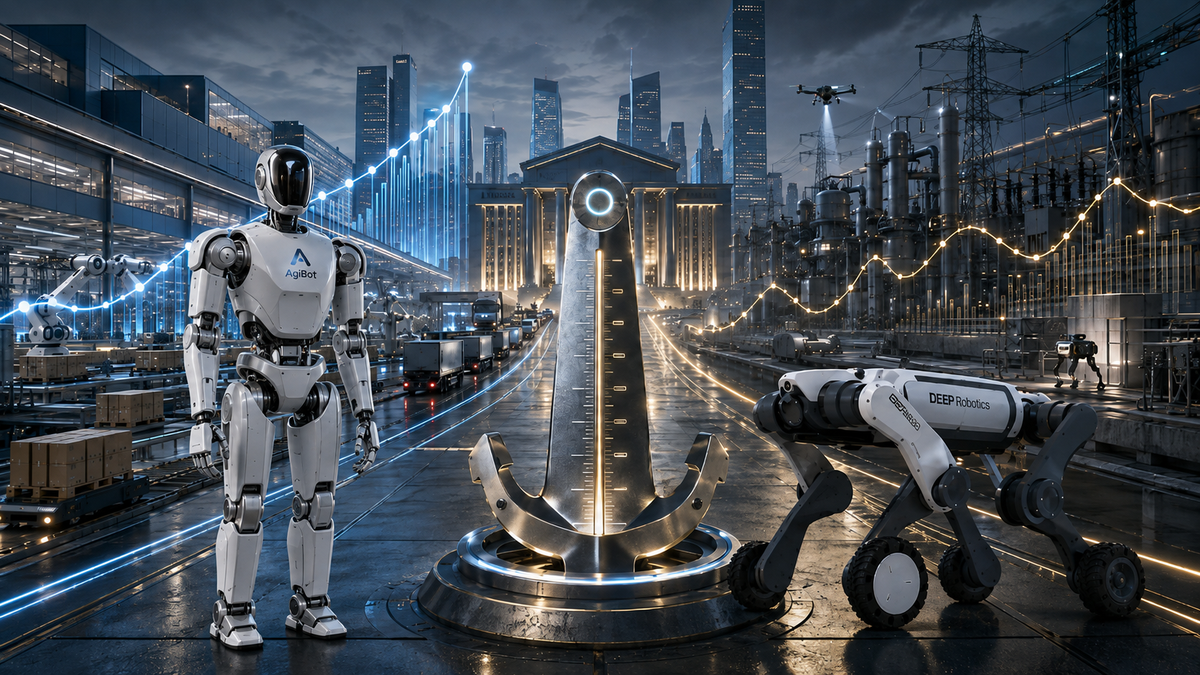
That single data point—RMB 61 billion—has since functioned less as a stock price and more as an anchor: a reference valuation that every other company in China's embodied-intelligence sector is now being measured against, whether they like it or not.
The two companies most visibly in that crosshairs are AgiBot and Deep Robotics. They are both racing toward public markets. They are both trying to answer the same structural question. And they are doing so in almost diametrically opposite ways.
Why Does This Moment Matter Beyond the IPO Headlines?
The Unitree listing is not simply a financial event. It is a market-structuring event in a sector that has, until recently, lacked publicly traded comparables in China.
Before a sector has a listed anchor, valuation is largely negotiated in private. After one exists, every subsequent entrant is priced relative to it—by investors, by regulators, and by the market. The first mover sets the price-to-sales multiples, the narrative frame, and the growth expectations that all followers must either match or justify deviating from.
This dynamic is not unique to robotics. It played out in electric vehicles (BYD and NIO setting the template), in battery technology, and in semiconductors. What makes embodied intelligence different is the speed of compression: the window between "first IPO" and "market saturation of public listings" appears to be measured in months, not years.
That compression is why both AgiBot and Deep Robotics are moving so urgently—and why their strategic choices under that pressure reveal something structurally important about how this industry may consolidate.
How Does the Humanoid Robot Market Actually Work Right Now?
To understand the race, it helps to understand the current state of the market.
Global shipments remain small but growing fast. In the first half of 2026, AgiBot shipped approximately 8,400 humanoid robots, up 562% year-over-year. Unitree shipped roughly 5,900 units in the same period. Together, the two Chinese companies account for approximately 75% of global humanoid robot shipments.
By contrast, Tesla's Optimus shipped at the low thousands level in all of 2025. Figure AI's Figure 02 shipped fewer than 500 units for the full year.
The technology gap is real, but the commercial gap is larger. The core unsolved problem in humanoid robotics is the disconnect between perception and manipulation: robots can increasingly "see" and "understand" a task (driven by vision-language models) but still struggle to execute fine-grained physical operations reliably. AgiBot's GO-1 and GO-2 model architectures attempt to address this with an "implicit planner" layer that allows the robot to mentally simulate an action before executing it—a design choice that reflects where the industry's hardest technical problems currently sit.
The customer base is still heavily industrial. Most commercial deployments are in controlled manufacturing and logistics environments, where task variability is limited and error tolerance is higher than in consumer or healthcare settings. True general-purpose deployment remains a medium-term horizon, not a current reality.
Who Are the Main Contenders, and What Are Their Actual Strategies?
AgiBot: Speed as Strategy
Founded in February 2023, AgiBot is led by Deng Taihua, a former Huawei vice president who oversaw the Kunpeng-Ascend ecosystem, and co-founded by Peng Zhihui—widely known online as "Zhihui Jun," a Bilibili creator with over one million followers and a recipient of Huawei's "Genius Youth" program distinction. Backers include Tencent, BYD, and Hillhouse Capital.
The revenue trajectory is the most cited number in any discussion of the company:
- 2023: ~RMB 300,000
- 2024: ~RMB 60 million
- 2025: RMB 1.05 billion
- Q1 2026 alone: over RMB 1 billion
- Full-year 2026 target: RMB 4 billion
That is roughly a 3,500× revenue increase in three years. Cumulative production reached 15,000 units by late June 2026.
AgiBot's technical bet is explicit: approximately three-quarters of its R&D headcount and over three-quarters of its R&D budget are concentrated on what the company calls its "big brain / small brain AI" architecture. Hardware manufacturing is largely outsourced. The logic is that the hardware layer will commoditize; the intelligence layer will not.
On the IPO front, AgiBot's move is strategically legible. In July 2025, it acquired a 63.62% controlling stake in STAR Market-listed Weibo New Materials through a combination of agreement transfer and tender offer, paying approximately RMB 2.1 billion. The target company's market cap subsequently surged from around RMB 3 billion to a peak of RMB 89.1 billion. AgiBot publicly stated it had no reverse-merger plans within 36 months—but the signal was clear.
By July 2026, AgiBot had formally initiated a Hong Kong Stock Exchange listing process. Cornerstone investors pegged a target valuation of HKD 40–50 billion (roughly RMB 34.6–43.3 billion), broadly aligned with Unitree's ~RMB 42 billion pre-IPO valuation. The company itself reportedly sought a valuation closer to HKD 80 billion, with some reports citing a USD 20 billion figure in certain discussions.
Why Hong Kong rather than the STAR Market? Hong Kong's Chapter 18C framework allows pre-revenue, pre-profit specialist technology companies to list. It is structurally faster. For a company that CTO Peng Zhihui has publicly described as "self-sustaining through commercialization"—meaning it does not need the capital—the IPO is not a fundraising exercise. It is a clock move: securing a public valuation before the listing window narrows further.
As Peng put it directly: "Embodied intelligence has reached an inflection point. Whoever achieves genuine commercial-scale deployment in the next 12 to 18 months will hold the entry ticket for the next round of competition."
Deep Robotics: Profitability as Proof
Deep Robotics was founded in 2017, spun out of Zhejiang University's robotics laboratory. Its founder, Zhu Qiuguo, is an associate professor at Zhejiang University. The company's path has been the inverse of AgiBot's: build a profitable quadruped robot business first, then use those earnings to fund a humanoid pivot.
The financial profile reflects this:
- 2023 revenue: RMB 50.11 million
- 2024 revenue: RMB 103 million
- 2025 revenue: RMB 337 million
- 2025 net profit: RMB 28.68 million—the company's first profitable year
- Gross margin: expanded from 33.48% to 52.82%
In a sector where virtually every competitor is burning cash, profitability is a genuine differentiator. According to Frost & Sullivan data, Deep Robotics ranked first globally in quadruped robot revenue from industrial applications in 2025, and second overall behind Unitree.
Its flagship product, the Jueying X industrial-grade quadruped, sells at RMB 287,500 per unit with a 54.35% gross margin. The company has deployed units in over 100 substations operated by State Grid and Southern Power Grid subsidiaries, and claims over 85% market share in China's power grid inspection segment—a near-monopoly in a specific, defensible niche.
The problem is structural: that niche has a visible ceiling. The global quadruped robot market is growing at approximately 17% annually—solid, but not the kind of growth rate that justifies the valuation multiples being assigned to embodied intelligence companies. Deep Robotics' revenue is approximately 95% dependent on quadruped and wheeled-leg robots, with industrial products comprising roughly 86% of that.
The humanoid numbers are stark: in 2024 and 2025 combined, Deep Robotics sold four humanoid robots, generating RMB 823,000 in revenue—0.24% of total sales.
Deep Robotics filed for a STAR Market IPO on May 18, 2026, seeking to raise RMB 2.502 billion. Nearly 70% of that—approximately RMB 1.723 billion—is earmarked for embodied-intelligence algorithm and model R&D, and robot hardware development. A single line item, "embodied algorithm and model R&D project," accounts for RMB 1.169 billion—more than seven times the company's cumulative R&D spend across its entire operating history (RMB 155 million).
The IPO filing has drawn pointed regulatory scrutiny. The name "Unitree" appears over 200 times in the CSRC's inquiry letter—a signal that regulators are explicitly benchmarking Deep Robotics against a company operating at a fundamentally different commercial scale.
The valuation arithmetic is uncomfortable. At its implied listing valuation of approximately RMB 13.9 billion, Deep Robotics trades at roughly 41× price-to-sales on 2025 revenue. Unitree, at its IPO valuation of ~RMB 42 billion on 2025 revenue of RMB 1.708 billion, implied a price-to-sales of approximately 25×. Deep Robotics is priced at a 60% premium to Unitree on a revenue multiple basis—for a company whose humanoid business has yet to demonstrate commercial viability.
One investor framing captures the tension clearly: "A significant portion of its valuation is a forward premium. That premium needs to be redeemed by a humanoid robot story that hasn't been written yet."
What Are the Structural Constraints and Key Variables?
Several factors will determine how this shakes out—and they are worth holding separately from the company-specific narratives.
1. The IPO window is not permanent. Public market appetite for pre-profit robotics companies is a function of macro liquidity conditions, sector sentiment, and the number of comparable listings already absorbing investor capital. Each successful IPO in the sector simultaneously validates the category and reduces the scarcity premium available to the next entrant. The window that Unitree opened is closing incrementally with each passing quarter.
2. Technology validation lags commercial deployment. The industry's core challenge—robots that can perceive tasks but cannot reliably execute them—has not been solved. Companies are deploying into controlled industrial environments precisely because those environments are forgiving enough to paper over the gap. The question of whether current architectures can generalize to unstructured environments will take years, not months, to answer definitively. AgiBot's own leadership acknowledges that "the right or wrong of the technical path won't be clear for five years."
3. Hardware is commoditizing faster than software. The strategic consensus emerging across leading Chinese robotics companies is that hardware margins will compress as manufacturing scales and supply chains mature. The durable value will sit in the intelligence layer—the models, the training data, the task-specific fine-tuning. This is why AgiBot's R&D allocation is so heavily weighted toward AI, and why Deep Robotics' IPO proceeds are almost entirely directed at algorithmic capability rather than manufacturing capacity.
4. Policy tailwinds are real but time-limited. Chinese government support for the embodied intelligence sector—through procurement commitments, R&D subsidies, and favorable listing regulations—is a meaningful accelerant. But policy windows, like IPO windows, do not stay open indefinitely. Companies explicitly racing to "capture the policy dividend period before the industry watershed" are implicitly acknowledging that the favorable conditions are temporary.
5. The gap between performance and manipulation remains the industry's defining unsolved problem. Current humanoid robots can perform scripted demonstrations convincingly. They cannot yet handle the variability of real-world industrial or consumer environments at the reliability levels required for autonomous, unsupervised deployment. Until that gap closes, revenue growth will remain dependent on controlled deployments with significant human oversight—which limits both scale and margin.
Two Strategies, One Question
The deeper analytical point is not which company has better near-term metrics. It is that AgiBot and Deep Robotics represent two coherent but fundamentally different theories about how to build durable value in a sector where the dominant player has already set the public market price.
AgiBot's theory: Scale first. In a winner-take-most market, shipment volume and revenue growth are the metrics that matter. Profitability is a later-stage problem. The priority is to establish a position at the table before the table is full—and to do so by securing a public valuation that is comparable to Unitree's before the window closes. The risk is that scale without profitability is a bet on continued investor appetite for growth-at-any-cost narratives.
Deep Robotics' theory: Prove the business model first. A profitable, cash-generating company with dominant share in a specific vertical has demonstrated something that most robotics companies cannot: that the economics actually work. Use that proof to fund the transition to a larger market. The risk is that by the time the humanoid pivot produces results, the public market valuation framework has already been set by faster-moving competitors, and the 41× revenue multiple currently assigned to Deep Robotics will be difficult to sustain.
Both theories are internally consistent. Both carry significant execution risk. And both are, in a meaningful sense, correct responses to the same underlying constraint: in a capital-intensive, technology-uncertain sector, the ability to stay at the table through multiple rounds of potential disruption matters more than being right about any single technical or commercial bet.
What Happens Next?
Several near-term signposts are worth watching:
- AgiBot's Hong Kong listing timeline. If it achieves an HKD 40–50 billion valuation, it will establish a second public anchor in the sector. If the valuation comes in significantly below that range, it will recalibrate expectations for every subsequent listing.
- Deep Robotics' STAR Market approval process. The regulatory scrutiny visible in the inquiry letter suggests the path will not be straightforward. How the company addresses the gap between its current humanoid revenue and its IPO-funded humanoid ambitions will be the central narrative of its listing process.
- Humanoid deployment data from 2026. Both companies have made specific claims about scaling humanoid production to meaningful volumes in 2026. Whether those claims materialize—and at what cost per unit—will provide the first real-world test of the commercial models underlying current valuations.
- The broader competitive landscape. At least 11 robotics companies are reported to be pursuing IPOs in the current cycle. The interaction between that supply of listings and investor demand will shape the valuation environment for all of them.
The real question the market is working through is not "who is the next Unitree." Unitree's particular combination of timing, product-market fit, and capital efficiency is not easily replicated. The more durable question is whether the embodied intelligence sector can produce multiple distinct, defensible business models — one built on scale and intelligence-layer dominance, one built on vertical specialization and proven unit economics—and whether public markets will sustain differentiated valuations for each.
That question will take longer than 12 to 18 months to answer. But the capital allocation decisions being made right now, in IPO filings and listing applications and R&D budget lines, are the first chapter of whatever answer eventually emerges.
Related Coverage:
AgiBot Overtakes Unitree in H1 Humanoid Robot Shipments, But the Lead Remains Fragile
Deep Robotics Files $347M STAR Market IPO as Industrial Quadruped Sales Drive Profitability