
China’s Humanoid Robot Startups Face a New Rival: Automakers With Deeper Pockets
China's humanoid robot pioneers—led by Unitree Robotics and UBTECH Robotics — are entering the most consequential phase of their short existence, as cash-rich automakers including XPeng and Li Auto pivot aggressively into a market the startups spent years building from scratch.
The competitive inflection point arrived on June 10, 2026, when XPeng CEO He Xiaopeng issued a company-wide letter announcing he would personally assume the role of CEO of its robotics division, taking direct responsibility for strategy, product development and commercialization. Days earlier, Li Auto CEO Li Xiang declared that "the ultimate form of the automobile is the robot" and that the company would "100% enter humanoid robotics." Neither statement left room for ambiguity. For Unitree and its peers, the window to entrench defensible market positions is now measured in months, not years.
Startups Claiming Territory Before the Flood Arrives
The robotics startups enter this confrontation with genuine operational credentials. Unitree shipped 5,511 humanoid robots in 2025—the highest global unit volume for that year—establishing leadership in research, education and industrial inspection. Its G1 consumer model, priced at RMB 99,000 (approximately US$13,750), represents an early probe into the mass consumer segment. UBTECH, listed in Hong Kong as the market's first pure-play humanoid robotics stock, delivered 1,079 full-size industrial humanoid robots in 2025, claiming the top position globally in that specific category.
Differentiation is also emerging at the low end. Songyan Dynamics launched its "Xiaobumi" companion robot in 2025 at RMB 9,998 (US$1,388)—the first sub-RMB 10,000 high-performance humanoid robot commercially available—targeting family, companionship and education use cases that larger players have yet to systematically address.
Financially, the startups' unit economics are striking. Unitree posted a gross margin of 60.13% in 2025; UBTECH's gross margin reached 37.7%, up nine percentage points year-on-year. These figures stand in sharp contrast to the broader automotive sector, where industry-wide profit margins fell to 4.1% in 2025—a five-year low—and deteriorated further to 3.7% in the January-to-April 2026 period, according to data cited by China Passenger Car Association Secretary-General Cui Dongshu.
Automakers Arrive with Structural Advantages That Startups Cannot Easily Replicate
The financial asymmetry between incumbents and challengers is stark. Unitree's IPO prospectus—the company recently cleared China's listing review—disclosed cash and cash equivalents of RMB 1.42 billion (US$197 million) as of December 31, 2025. XPeng, despite never having achieved annual profitability and widely regarded as still operating in a financially precarious zone, held cash and equivalents exceeding RMB 17.3 billion (US$2.4 billion) at the same date. That is a 12-to-1 cash advantage in favor of a company that has not yet turned a profit in its core business.
The technology transfer calculus further tilts toward automakers. Industry analysts estimate that smart vehicle and humanoid robot technologies share more than 70% overlap at the software and hardware level. Autonomous driving algorithms, sensor fusion stacks and vision-language-action (VLA) architectures developed for cars can be redeployed into robotics with limited re-engineering. XPeng's second-generation VLA architecture already runs simultaneously across its passenger vehicle intelligent-driving system, its RoboTaxi platform and its IRON humanoid robot—a capital efficiency that pure-play startups structurally cannot match.
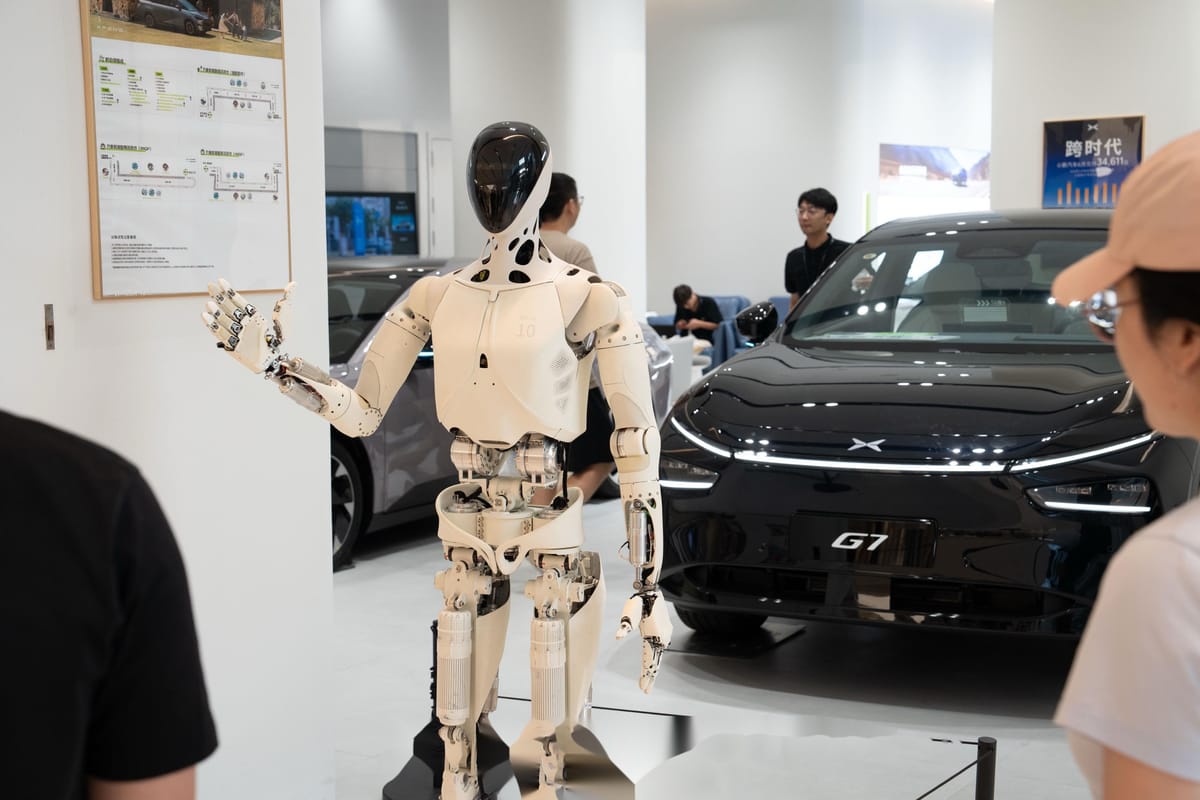
XPeng's IRON robot already supports natural language dialogue and replicates complex human postures including standing, sitting and reclining. The company has set a target of 1,000 units of monthly production capacity by end-2026, with initial deployment prioritized in retail stores and industrial parks for standardized tasks such as sales assistance and facility inspection.
Distribution infrastructure compounds the gap. XPeng and Li Auto each operate several hundred direct-to-consumer retail locations across China. Unitree opened its first direct retail store—at Beijing's Wangfujing Silver Tai in88 mall—only in late April 2026. The channel disparity is not merely a marketing inconvenience; it determines who controls the consumer's first physical experience with a humanoid robot.
A Global Battlefront Opens on Multiple Fronts
The competitive pressure is not confined to China's domestic market. Unitree generated 43.65% of its revenue from overseas markets in 2025; in each of the two prior years, that share exceeded 55%. The company has invested heavily in international brand recognition, with its robots appearing on U.S. television programs including America's Got Talent and ESPN's Inside the NBA.
Chinese automakers, having pivoted aggressively to overseas expansion since China's domestic auto market entered a volume plateau in 2018—ending 28 consecutive years of growth—have already built dealer and distribution networks in key export markets. Those networks are now potential conduits for robot sales, placing them in direct competition with Unitree's established overseas distributor relationships.
A third force complicates the overseas equation. Tesla's Optimus humanoid robot is scheduled to begin scaled mass production between July and August 2026. Tesla CEO Elon Musk has publicly stated that Optimus could eventually account for 80% of Tesla's total market capitalization. A retail launch targeting general consumers is planned for end-2027.
Startups Accelerating R&D Spend and Talent Acquisition to Defend "Brain" Advantage
Unitree's IPO fundraising plan signals where the startup believes the decisive battle will be fought. Of the total RMB 4.201 billion (US$583 million) it intends to raise, RMB 2.022 billion (US$281 million)—nearly half—is earmarked for embodied intelligence model research and development. The company's CEO Wang Xingxing has stated publicly: "Whoever can deploy a purpose-built large model adapted to robotics will become the world's leading AI and robotics company."
Talent flows are reinforcing this thesis. In April 2026, Zhongqing Robotics appointed Dr. Li Liyun—formerly XPeng's Vice President and head of autonomous driving—as its Chief Technology Officer, a hire the market interpreted as a direct effort to close the "brain" capability gap with automakers.
Songyan Dynamics is pursuing a different defensive strategy: deepening penetration in companion and education segments that automakers are unlikely to prioritize near-term. On June 9, 2026, the company announced a strategic partnership with Kidswant Children Products, a children's and family retail chain, to expand offline access to its core demographic.
Historical Precedent Offers a Cautionary Framework
The structural dynamics of this confrontation carry echoes of prior technology market disruptions. Disney's Disney+ streaming service, launched after Netflix had already validated the subscription video model, leveraged financial scale and intellectual property depth to surpass Netflix in subscriber count within approximately three years. Microsoft Teams displaced Zoom's early dominance in video conferencing by embedding itself within an existing enterprise user base that Zoom could not replicate organically.
The humanoid robotics market remains small in absolute terms—global full-body robot shipments totaled just 18,000 units in 2025—but Morgan Stanley projects global humanoid robot installed base to reach one billion units by 2050, implying annual market revenues of US$7.5 trillion. For context, the entire global automotive value chain currently generates between US$3.5 trillion and US$4.9 trillion annually.
The market is large enough to accommodate multiple winners. Whether Unitree and its peers can convert their first-mover operational knowledge, superior gross margins and overseas brand equity into durable competitive moats—before XPeng, Li Auto and eventually Tesla saturate the channels they currently control—is the defining strategic question of China's robotics industry in 2026.
Related Coverage:
China's Humanoid Robot Industry Confronts Reality Check After $56 Billion Investment Surge