
China's 'LineShine' Supercomputer Reclaims Global Top Spot After Nine-Year Absence
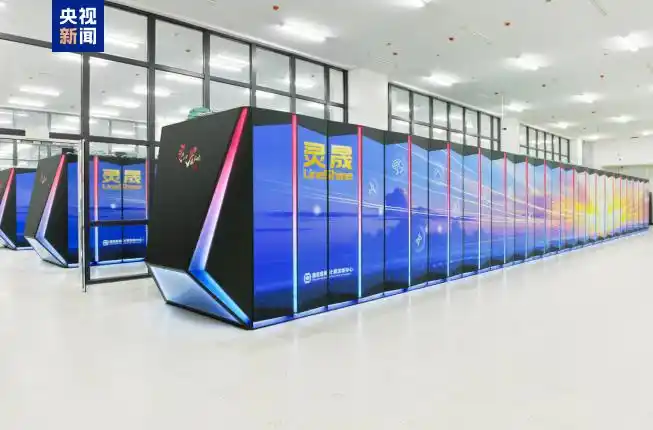
China has returned to the summit of global supercomputing for the first time in nine years, with the domestically developed "LineShine" system claiming the top position on the TOP500 list at the ISC 2026 international supercomputing conference held in Hamburg, Germany on June 23.
The system, developed and operated by the National Supercomputing Center in Shenzhen, recorded a sustained double-precision floating-point performance of 2.19 exaflops — making it the world's first supercomputer to surpass the two-exaflop threshold in sustained performance. The result places LineShine ahead of leading exascale systems from both the United States and Europe.
The achievement carries strategic weight beyond raw computing power. Built entirely on domestically sourced components and software, LineShine represents China's most concrete demonstration to date of its ability to develop a fully independent, sovereign computing stack in the face of foreign technology restrictions.
Homegrown Silicon at Its Core
At the hardware level, LineShine is powered by a proprietary LX2 CPU that integrates multi-precision and matrix acceleration capabilities, enabling the on-chip convergence of high-performance computing and AI workloads. The processor also incorporates what developers describe as China's first domestically produced HBM (High Bandwidth Memory), delivering memory bandwidth ten times higher than conventional CPUs.
The system's networking layer uses a self-designed high-speed interconnect — dubbed Lingqi — capable of supporting up to two million ports and 100,000 nodes, enabling deployment at extreme scale. Storage is handled through a tiered architecture designed to balance high-performance job execution with high-capacity data retention, with scalability extending to the exascale range.
On energy efficiency, LineShine employs a fully liquid-cooled cabinet design — described as a first in the industry at 100% liquid cooling — achieving a power efficiency ratio of 51 gigaflops per watt, a metric its developers say sets a new benchmark for green computing at this performance tier.
Broad Application Footprint
Since deployment, the system has been applied across a range of scientific and industrial domains, including atmospheric and ocean modeling, engineering simulation, materials science, drug discovery, neuroscience, scientific AI, and large-model inference. In large-scale parallel environments, LineShine has achieved an average scaling efficiency of 84.4%, supporting full-system operation across more than ten million processor cores simultaneously.
Developers say the platform is designed to serve as a production-grade scientific intelligence infrastructure, supporting multi-disciplinary, full-workflow, and multi-precision workloads across research, engineering, and industrial applications.
Geopolitical and Industrial Implications
China last held the top position on the TOP500 ranking nine years ago. The return to the summit, achieved with a fully domestic hardware and software stack, signals a meaningful advance in the country's efforts to build self-reliant critical computing infrastructure — a priority that has intensified as U.S. export controls have restricted access to advanced foreign chips and related technologies.
For investors tracking China's semiconductor and high-performance computing sectors, LineShine's performance data — particularly the integration of domestically produced HBM and a custom high-speed interconnect — suggests that domestic supply chains for advanced computing components are maturing faster than many external assessments had anticipated.
Related Coverage:
China’s AI Agent Boom Triggers Compute Bottlenecks and Industry Price Hikes