
China's Low-Altitude Economy Gains Momentum as Funding and Policy Support Converge
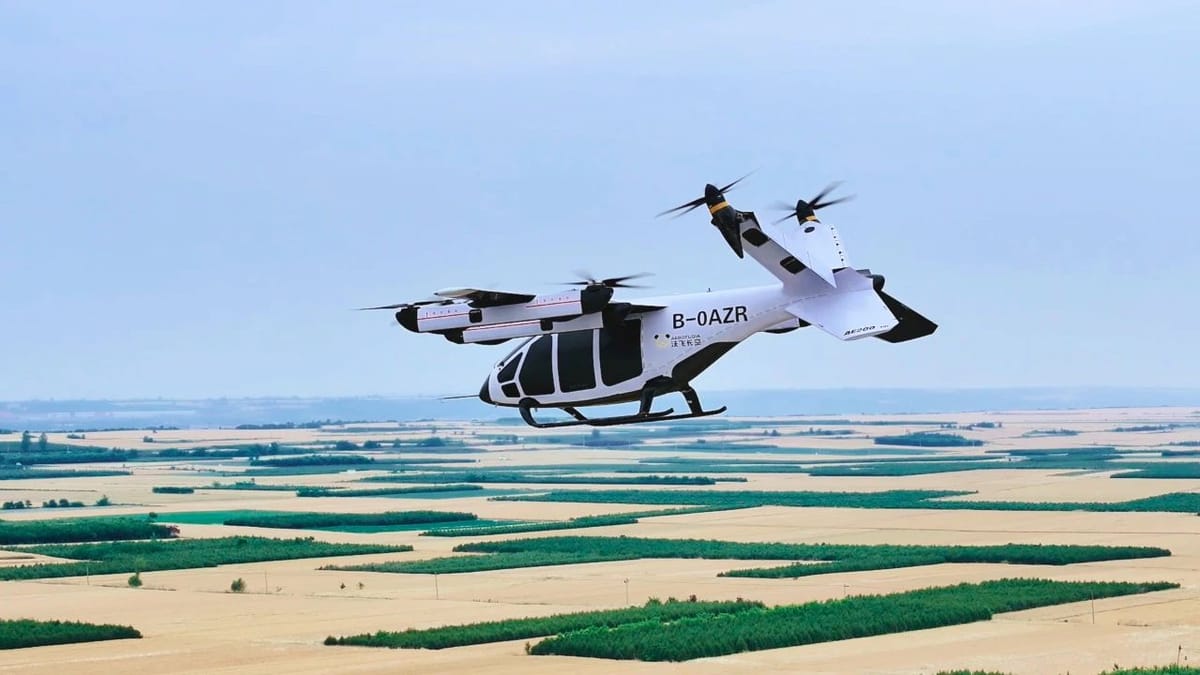
After nearly two years of subdued activity, China's low-altitude economy sector is showing renewed vigor, propelled by significant capital inflows, policy support, and a surge in orders. The convergence of funding, regulatory frameworks, and commercial validation signals a potential inflection point for the industry, though questions about profitability and order quality remain.
eVTOL manufacturer AEROFUGIA recently announced the completion of a near 1 billion yuan ($138 million) financing round, marking the largest single fundraising in the low-altitude economy sector this year. The round was led by CSC Financial Co. Ltd., with participation from Lianxin Capital, Vertex Ventures, Photosynthesis Ventures, and Guoce Investment, alongside continued support from existing shareholders including Panlin Capital, Yunsheng Capital, CAS Star, and Songhe Capital.
Shortly after the announcement, regulatory authorities delivered significant policy momentum. The State Administration for Market Regulation, in coordination with the Central Air Traffic Management Office and the National Development and Reform Commission, jointly released the "Low-Altitude Economy Standard System Construction Guidelines (2025 Edition)." The guidelines stipulate that by 2027, a basic standard system for the low-altitude economy will be established, and by 2030, more than 300 standards will be formulated to support the sector's safe and healthy development.
Market activity has also intensified in the secondary market. According to media statistics, since January 2026, 15 low-altitude economy concept stocks have seen net margin purchases exceeding 100 million yuan. AVIC Jonhon Optronic Technology Co. led with net purchases of 884 million yuan, while AVIC Xi'an Aircraft Industry Group and Aerospace Power both exceeded 400 million yuan. Multiple companies have disclosed improved fundamentals, with Longxin General, Wanfeng Auto Holding Group, Zongshen Power, and Changyuan Donggu reporting positive earnings outlooks for 2025.
Record Funding Reflects Industry Momentum
As the core vehicle for Geely Technology Group's low-altitude economy strategy,
AEROFUGIA was established in 2016 and focuses on the research, development, and commercial operation of low-altitude intelligent transportation aircraft. The company has built comprehensive capabilities covering product development, airworthiness certification, manufacturing, and commercial operations. Its independently developed AE200 series passenger eVTOL production aircraft has completed rollout and first-stage verification flights, maintaining a leading position in the airworthiness process.
The company stated that proceeds from the latest round will be entirely devoted to the final airworthiness certification sprint for the AE200 series, the commissioning of its global headquarters base, and the construction of commercial models for low-altitude travel. The AE200 is a 5-6 seat flying vehicle with a cruise speed of approximately 248 kilometers per hour and a maximum range of 200 kilometers, designed to operate at altitudes of around 300 meters above urban areas.
Notably, this marks AEROFUGIA's second independent market-based financing round within three months. In November 2025, the company completed a Series C round worth several hundred million yuan, invested by Hangzhou Industrial Investment Group, Prosperity7 Ventures, and Songhe Capital, with additional investment from existing shareholders including Yunsheng Capital and Aoxiang Tianxing. To date, the company has completed five rounds of independent market-based financing.
According to third-party data, angel rounds dominated the low-altitude economy sector over the past year with 63 financing events, followed by Series A with 46 and Pre-A with 39. Early-stage rounds (angel, Pre-A, Series A, and A+) totaled over 170 events, accounting for more than 60% of annual financing activity. This structure clearly indicates that the low-altitude economy remains centered on startup incubation and technology verification, with substantial capital flowing into promising early-stage projects.
By contrast, later-stage financing events from Series C onward were significantly fewer, with C, D, and E rounds combined totaling fewer than 30 events, representing only about 10% of the total. This characteristic reflects that the industry remains in a phase of technological iteration and scenario exploration, with most enterprises yet to enter mature, scalable profitability. Notably, strategic investments reached 28 deals, indicating that industrial capital has begun locking in quality targets through strategic positioning, preparing for future ecosystem integration.
Order Pipeline Expands Amid Quality Questions
Since 2021, nearly every financing round has carried labels like "future mobility" and "low-altitude economy," but by 2025, capital sentiment had shifted. Primary market tolerance for "heavy asset, long cycle" projects declined noticeably, with remaining investors adopting a more pragmatic approach, prioritizing clear delivery schedules and verifiable commercial pathways over grand narratives.
As a critical vehicle for future air transportation, eVTOL (electric vertical takeoff and landing aircraft) is viewed as one of the most promising subsectors within the low-altitude economy. In October 2023, EHang Intelligent's EH216-S unmanned passenger eVTOL received a type certificate from the Civil Aviation Administration of China, becoming the world's first product to obtain such certification. It subsequently obtained production and standard airworthiness certificates, and on March 28, 2025, received an operating certificate, becoming China's first eVTOL enterprise to achieve certified operations.
Market consensus holds that 2025 marked a critical juncture for eVTOL's transition from technical verification to scaled application, with orders experiencing concentrated release.
Overseas markets heated up first. In October 2025, XPeng AeroHT signed the Middle East's first batch order for 600 flying vehicles, setting a record for the largest overseas procurement in the sector. AutoFlight and TCab Tech also subsequently announced orders from Middle Eastern customers. Domestic demand activated simultaneously, with AEROFUGIA and EHang Intelligent securing purchase agreements from Guizhou, Beijing, and other locations.
At the International Low-Altitude Economy Expo, TCab Tech secured China's largest single eVTOL intention order: UAE-based Autocraft ordered 350 units with a total value of US$1 billion. Subsequently, Volant Aviation signed a 500-unit VE25-100 "Tianxing" eVTOL purchase agreement with Thailand's Pan Pacific Company, with total order value reaching US$1.75 billion.
November 2025 was dubbed the "order frenzy month" by industry insiders: AEROFUGIA signed a confirmed order for 50 units with Hualong Aviation; Volant secured 95 units worth 2.375 billion yuan at the China International Import Expo; AutoFlight's cumulative orders exceeded 2,000 units; and TCab Tech finalized a 100-unit purchase agreement with ICBC Leasing. Entering 2026, order momentum has continued—the "2030 Pioneer Project" disclosed on January 28 has secured 160 confirmed and intention orders.
However, impressive figures have also drawn scrutiny over "water content." Industry insiders point out that over 90% of current eVTOL orders are intention orders, most lacking legal binding force and requiring no deposits, more closely resembling strategic positioning. Such "order inflation" is not uncommon in early-stage emerging industries: manufacturers need orders to support valuations and financing, while buyers use early commitments to secure future market entry.
The enthusiasm at the order level contrasts sharply with enterprise financial performance pressures. EHang Intelligent, viewed as a "leading player" in the low-altitude economy, posted a net loss of 82.11 million yuan in Q3 2025, expanding 70.7% year-over-year, with cumulative losses reaching 242 million yuan for the first three quarters. This stark contrast highlights the industry's core contradiction—technical feasibility is being continuously validated, but commercial viability still requires refinement.
Listed Companies Accelerate Strategic Positioning
According to Civil Aviation Administration of China forecasts, China's low-altitude economy market will reach 1.5 trillion yuan in 2025 and potentially exceed 3.5 trillion yuan by 2035.
The entrants extend beyond startups. Based on disclosed 2025 performance reports and median forecast values, multiple low-altitude economy-related listed companies are expected to achieve profitability. Longxin General, Wanfeng Auto Holding Group, Zongshen Power, and Changyuan Donggu led in net profit scale, reaching 1.725 billion yuan, 950 million yuan, 692 million yuan, and 400 million yuan respectively. AECC Aviation Power and Shanglo Electronics also reported net profits above 300 million yuan.
Facing potential trillion-yuan market opportunities, listed companies are cutting into different segments of the industry chain, accelerating strategic positioning. Recently, multiple enterprises have proactively deployed in this emerging sector through introducing strategic investors, increasing R&D investment, and establishing research institutions, attempting to complete capability reserves before industry explosion.
Fulin Precision announced plans to introduce CATL as a strategic investor through a private placement, raising total funds of 3.175 billion yuan. After deducting issuance expenses, funds will be directed toward projects including annual production of 500,000 tons of high-end energy storage lithium iron phosphate, key components for new energy vehicle electric drive systems, robotic integrated electric joints, intelligent chassis wire control systems, and key components for low-altitude aircraft power systems. The capital allocation clearly shows the company extending upstream into the low-altitude industry chain through power and core components.
Shenzhen Urban Transport plans a private placement to raise no more than 1.8 billion yuan, with funds allocated to transportation industry large model and ecosystem application development, scaled application of embodied intelligent transportation equipment including low-altitude and autonomous driving, global business expansion, and working capital supplementation. Leveraging its accumulation in intelligent transportation, the company aims to migrate technical advantages into an integrated "air-ground" comprehensive transportation system.
Meanwhile, Unigroup Guoxin announced the establishment of a Central Research Institute, focusing on research into end-side AI chip architectures, new models, and efficient algorithms for application scenarios including autonomous driving, embodied robots, and low-altitude aircraft, to further strengthen forward-looking technology layout and industry chain collaboration capabilities. Early investment at the chip level is viewed as a critical step in competing for the future air transportation "computing power foundation."
From complete aircraft manufacturing to core components, and further to computing power and intelligent systems, listed companies are accelerating penetration across the entire low-altitude economy industry chain. As capital, technology, and industrial resources continue to converge, competition in this sector has moved beyond the conceptual level, gradually transitioning toward a contest of systematic capabilities.