
Chinese GPU Chipmaker Moore Threads Surges 469% on Trading Debut
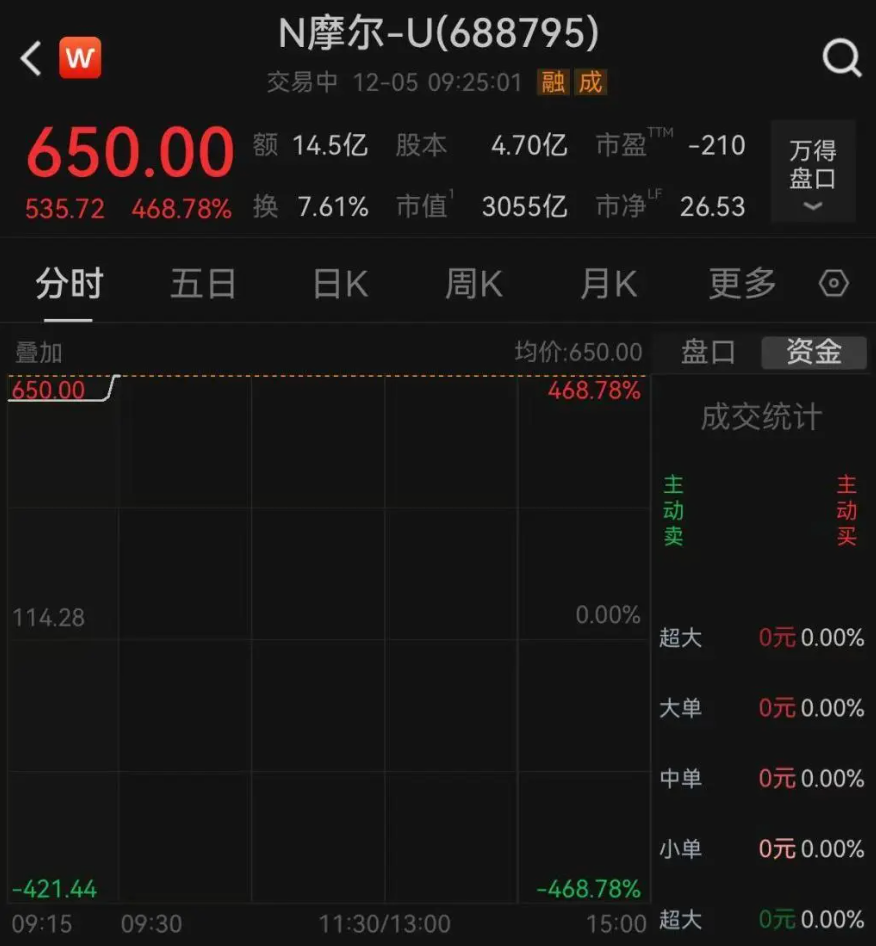
Moore Threads Intelligent Technology surged 469% in its trading debut on Shanghai's STAR Market on December 5, valuing the domestic graphics processing unit maker at over 300 billion yuan ($41.5 billion) and marking one of the year's most successful initial public offerings in China's semiconductor sector.
The stock opened at 650 yuan per share, compared with its IPO price of 114.28 yuan, giving investors who secured allocations gains of 267,860 yuan ($37,070) per lot. The company, dubbed China's first domestically listed GPU maker, completed its regulatory approval process in just 88 days from application to clearance—an unusually swift timeline for the tech-heavy board.
The strong debut reflects investor appetite for China's domestic semiconductor capabilities amid ongoing technology competition with the United States. Moore Threads positions itself as a rare fully functional GPU chipmaker in China, competing in a market long dominated by Nvidia Corp.
IPO Structure and Investor Response
Moore Threads raised approximately 8 billion yuan ($1.1 billion) through the offering of 70 million new shares, representing about 14.9% of its expanded share capital. The company's total share capital stands at 470.03 million shares, with 29.38 million shares available for trading without restrictions at listing.
Institutional investors fully subscribed their allocation of 39.2 million shares, committing 4.48 billion yuan with zero shares abandoned. Retail investors subscribed 16.77 million shares worth 1.92 billion yuan, abandoning just 29,302 shares valued at 3.35 million yuan. Lead underwriter CITIC Securities underwrote the abandoned shares, representing 0.05% of the offering excluding strategic placements.
Industry analysts attributed the minimal abandonment rate to operational issues rather than weak demand. Investment banking veteran Wang Jiyue noted that such cases typically result from insufficient funds in brokerage accounts at the time of payment.
Technology and Market Position
Moore Threads develops GPUs based on its proprietary MUSA architecture, which the company says enables a single chip design to support AI computing acceleration, graphics rendering, physical simulation, scientific computing, and ultra-high-definition video encoding and decoding. This multi-functional capability distinguishes it from most domestic GPU makers that focus on specialized applications.
The company's products serve applications including large language model training and inference, digital twins, consumer electronics, digital office solutions, and cloud computing. Its customer base spans cloud data centers, AI computing centers, energy, and manufacturing sectors.
Moore Threads claims some of its performance metrics approach or match international advanced levels. The company's MTT S80 graphics card reportedly delivers single-precision floating-point performance comparable to Nvidia's RTX 3060. A 1,000-card GPU cluster built on its MTT S5000 products allegedly exceeds the computing efficiency of similar-scale foreign GPU clusters of the same generation.
The company is among the few domestic GPU manufacturers providing full computational precision support from FP8 to FP64, and the first in China to launch GPUs supporting DirectX 12 graphics acceleration engines.
Financial Performance and Outlook
Moore Threads reported revenue of 702 million yuan ($97.2 million) for the first half of 2025, reflecting growth driven by artificial intelligence development and accelerated domestic substitution trends. The company said its loss narrowed during the period compared with previous years.
For full-year 2025, Moore Threads projects revenue between 1.22 billion yuan and 1.50 billion yuan (169 million to 208 million), representing year-over-year growth of 178% to 242%. The company expects net loss attributable to shareholders, excluding non-recurring items, to range from 878 million yuan to 1.24 billion yuan.
The company has not yet achieved profitability as it continues investing in research and development and ecosystem building. Through its MUSA community developer program and Moore College initiative, the company provides developers with comprehensive development tools and technical support to foster a domestic GPU ecosystem.