
Chinese Startup AutoFlight Unveils World's First 5-Ton eVTOL Aircraft With 10-Passenger Capacity
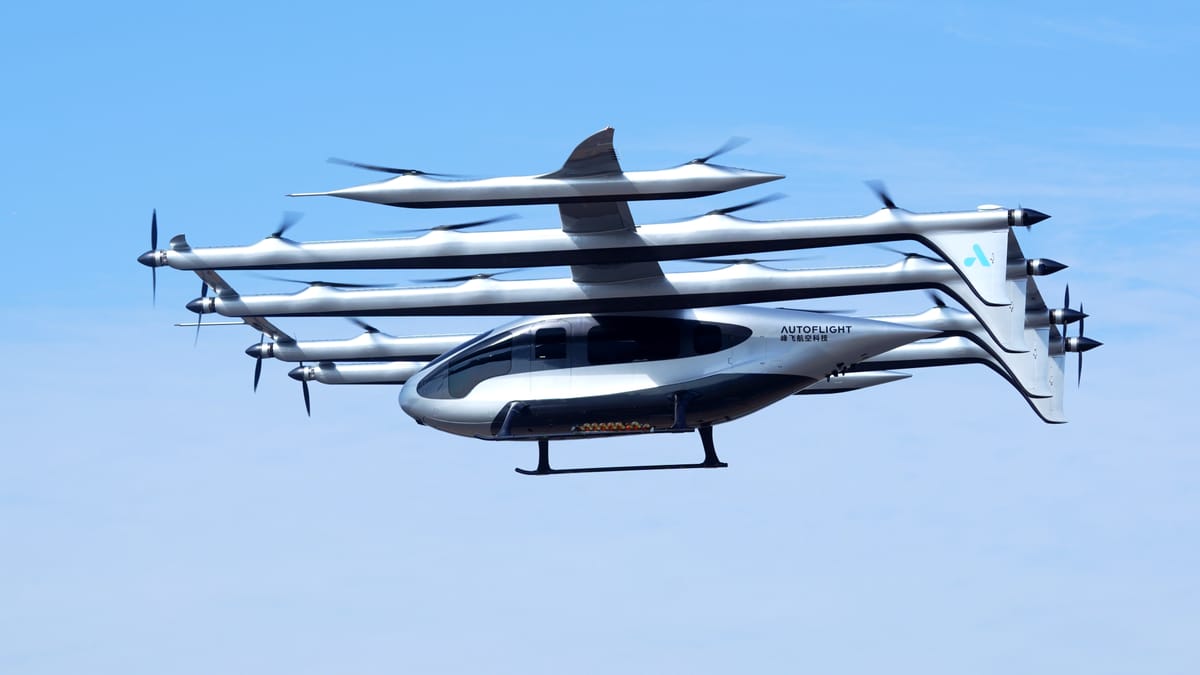
AutoFlight has completed the first transition flight of the V5000 Tianjilong, marking a milestone in electric vertical takeoff and landing aircraft development. The 5-ton-class vehicle, which can carry 10 passengers or one ton of cargo, represents a significant scale-up from current eVTOL models and positions the Chinese company as the first globally to achieve conversion flight at this weight class.
The demonstration flight took place on February 5, 2026, at AutoFlight's Bailiandahu low-altitude aviation base, where the V5000 flew in formation with the company's V2000CG Carrieall model. The event marked the public debut of the facility as a comprehensive eVTOL operations center.
The aircraft offers pure-electric range of 250 kilometers and hybrid-electric range extending to 1,500 kilometers, addressing critical operational constraints that have limited commercial deployment of smaller eVTOL platforms. Industry observers note the 5-ton platform could substantially reduce per-seat-kilometer and per-ton-kilometer operating costs, making low-altitude transportation economically viable.
AutoFlight's achievement comes as the eVTOL sector enters rapid expansion, with most current designs clustering in the 1.5-ton to 3-ton takeoff weight range and accommodating four to six passengers.
Scale-Up Addresses Economic Viability
The V5000 Tianjilong's increased capacity represents what industry analysts view as a crucial step toward commercial sustainability in urban air mobility. Current mainstream eVTOL products operate at takeoff weights between 1.5 tons and 3 tons with passenger capacity of four to six seats, limiting their economic efficiency for commercial operations.
The passenger version of the V5000 accommodates 10 people, while the cargo variant can transport one ton of freight. The pure-electric configuration delivers 250 kilometers of range, with the hybrid-electric version extending operational distance to 1,500 kilometers. These specifications position the aircraft as what AutoFlight describes as a breakthrough toward heavy-duty aerial platforms.
The larger platform enables significant cost distribution across more passengers or cargo weight, a factor industry participants consider essential for achieving profitability in low-altitude transportation services.
Strategic Backing and Technology Development
AutoFlight was established in 2017 as a vertical transportation technology company focused on eVTOL innovation. The company's product portfolio includes large-scale eVTOL cargo aircraft, six-seat passenger vehicles, the 5-ton-class platform, and zero-carbon waterborne eVTOL facilities.
In August 2024, Contemporary Amperex Technology Co. Ltd. (CATL, 宁德时代) made a strategic investment in AutoFlight, creating collaborative links across research and development, manufacturing, operational support, and ecosystem partnerships. The alliance aims to advance development of the low-altitude economy and marine economy sectors.
The company positions itself as delivering systematic capabilities for safe and reliable solutions through product technology innovation in the eVTOL space.
Infrastructure and Operational Readiness
The February 5 demonstration at the Bailiandahu low-altitude aviation base represented the facility's first public appearance as an integrated eVTOL operations center. The base supports both development testing and operational activities for AutoFlight's aircraft portfolio.
The formation flight involving both the V5000 Tianjilong and the V2000CG Carrieall demonstrated the facility's capacity to handle multiple aircraft types simultaneously, a requirement for scaled commercial operations.
AutoFlight's development timeline positions the company among global competitors racing to achieve certification and commercial deployment of eVTOL aircraft. The ability to conduct conversion flights—transitioning between vertical and forward flight modes—at the 5-ton weight class addresses technical challenges that have constrained aircraft size in the emerging industry.