
Chinese Startup HiDream.ai Upends Generative AI Hierarchy, Overtaking Google and ByteDance
A three-year-old Chinese artificial intelligence startup has disrupted the global generative AI landscape, leveraging a novel unified architecture to bypass the industry’s capital-intensive compute race and dethrone established tech giants in benchmark rankings.
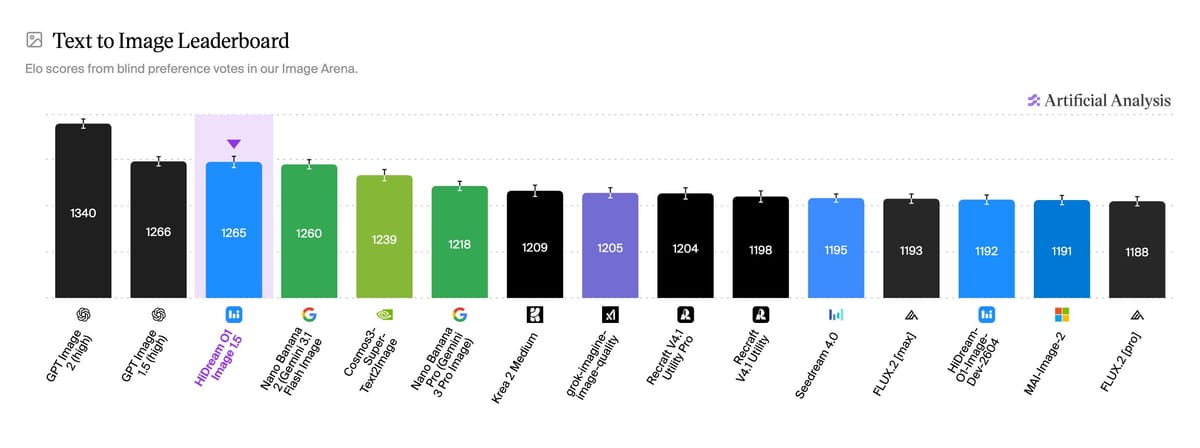
HiDream.ai launched its commercial image generation model, HiDream-O1-Image-1.5, in early June 2026, securing the number two spot globally—second only to OpenAI—on the independent evaluation platform Artificial Analysis. Scoring a 1265 ELO rating across more than 4,000 blind sample comparisons, the startup's model outperformed flagship iterations from heavily capitalized incumbents, including Google Nano Banana 2, NVIDIA Cosmos3-Super-Text2Image, and ByteDance’s Seedream 4.0.
This milestone marks a critical inflection point in the 2026 AI sector, signaling that the prevailing paradigm of brute-force parameter scaling is facing diminishing returns. Market observers note that HiDream.ai’s dual victory—having also topped the global open-source charts weeks prior with its HiDream-O1-Image-Dev-2604 model—validates an alternative technical trajectory that could significantly lower the barrier to entry and alter venture capital allocation in the foundational model space.
Abandoning Modular Legacy Drives Efficiency Gains
The core driver behind HiDream.ai’s ascent is its departure from the industry-standard modular architecture, which relies on a patchwork of text encoders, Variational Autoencoders (VAE), and Diffusion Transformers (DiT). Instead, the company deployed a Unified-in-Transformer (UiT) framework. This pixel-level, native omni-modal architecture maps text, image, and video signals into a single shared representation space, eliminating the semantic loss and structural instability inherent in multi-step data conversions.
For investors and supply chain stakeholders, the UiT architecture presents a compelling cost-efficiency narrative. By utilizing an 8-billion-parameter model to match or exceed the performance of traditional models sized at over 10 billion parameters, HiDream.ai has compressed training costs to between 10% and 20% of the industry average. This asset-light approach directly challenges the hardware-heavy moat defended by hyperscalers, proving that architectural innovation can offset deficits in raw computing power and data volume.
Monetization Metrics Validate Commercial Viability
Beyond benchmark victories, HiDream.ai has aggressively bridged the gap between foundational models and enterprise workflows. The company operates a "1+1+3" commercial matrix, deploying its core model through three distinct agent applications designed for immediate revenue generation. Its e-commerce marketing agent, HiBurst, has secured a position among TikTok’s top five official service providers, generating over one million videos annually and supporting a Gross Merchandise Volume (GMV) exceeding RMB 100 million (US$13.88 million).
In the professional content sector, its film and television co-creation agent, Zhenzan, has integrated with industry heavyweights such as Changjiang Film Group and Ciwen Media. The platform achieves a one-shot success rate of over 70% for generating one-to-three-minute videos, a metric that significantly reduces post-production overhead. Meanwhile, its social media creation agent, vivago, recently topped the Product Hunt daily charts, accumulating over 40 million users across more than 100 countries.
As the AI development cycle advances deeper into 2026, HiDream.ai’s trajectory underscores a macro shift in the generative AI market: competitive advantage is migrating from sheer computing power toward architectural efficiency and workflow integration. For global tech conglomerates, the rapid rise of agile challengers signals that the window for architectural complacency has firmly closed.
Related Coverage:
China’s AI Models Sustain Global Lead as Inference Cost Advantages Reshape Developer Ecosystem