
Citi: Nvidia’s H200 Sales Can’t Explain China’s AI Capex Surge
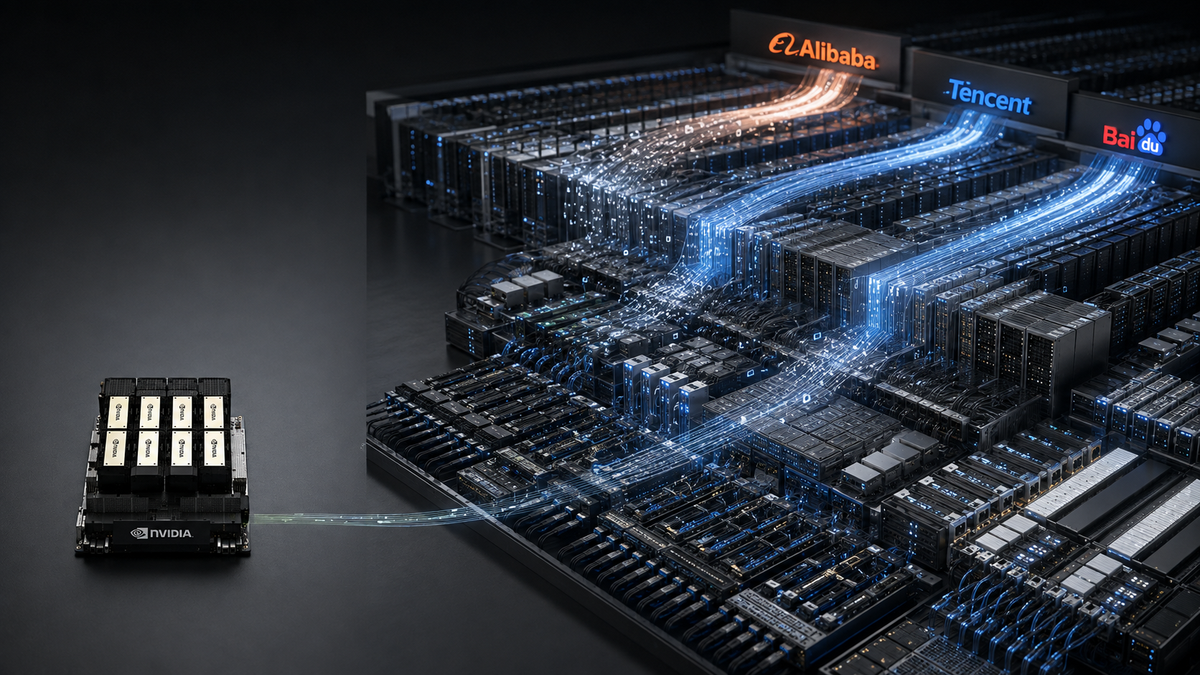
Citi Research published a flash note on August 27, 2026, dissecting Nvidia Corp's (NVDA) disclosure during its fiscal second-quarter earnings call that it had sold a small number of H200 chips to Chinese customers. The report, authored by analysts Alicia Yap, Nelson Cheung, and Vicky Wei, cuts through the headline and arrives at a more consequential conclusion: the H200 sales are statistically irrelevant to explaining the explosive capital expenditure surge reported by China's three largest internet companies in the second quarter of 2026.
A Headline That Overpromises
On August 26, Nvidia confirmed on its earnings call that it had sold H200 chips to customers in China under U.S. government licenses during its most recent fiscal quarter — the first AI chip sales to China since approximately US$60 million worth of H20 chips were shipped in early 2025. The disclosure triggered immediate market attention, but Citi's math quickly deflates the narrative.
With Nvidia's total data center revenues hitting US$89 billion in the quarter, and H200 China sales accounting for less than 1% of that figure, Citi estimates the revenue from those chips totaled no more than US$890 million, or RMB 6 billion (approximately US$830 million at current exchange rates). Nvidia separately took a US$400 million charge over the past six months for excess H200 inventory, a signal that demand for the product has been anything but robust. The company also made clear that no China data center compute revenue is reflected in its forward outlook, citing ongoing geopolitical uncertainty.
"We find this too insignificant compared to the big spike of capex recorded by Alibaba, Tencent and Baidu in 2Q26," the Citi team wrote.
The Capex Surge That Demands Explanation
The numbers from China's hyperscalers in the second quarter of 2026 are, by any measure, staggering. Alibaba Group reported capital expenditure of RMB 67.7 billion (US$9.4 billion), up 75% year-over-year and 111% sequentially, attributing the surge to procurement cycle fluctuations, expanded CPU-compute capacity, and higher chip component pricing. Tencent went further, posting capex of RMB 52.8 billion, a 176% year-over-year and 158% sequential increase, citing accelerated AI infrastructure investment without providing a spending breakdown. Baidu rounded out the trio with capex of RMB 11.4 billion, up 201% year-over-year and 95% quarter-over-quarter.
Against that combined spending wave, Nvidia's sub-US$890 million in H200 revenues barely registers. Citi's analysts argue the real drivers are almost certainly domestic GPU procurement, along with purchases of global and domestic memory chips — categories where neither the companies nor Nvidia have provided granular disclosure.
Procurement Timing, Not a Structural Inflection
Rather than treating the 2Q26 capex spike as a new baseline, Citi interprets it as a timing-driven anomaly. All three companies cited "fluctuations in procurement cycles" as a contributing factor, and Citi is taking that explanation at face value — forecasting a sequential decline in capex for all three in the third quarter of 2026.
That said, the full-year picture remains aggressive. Citi projects total 2026 calendar-year capex of RMB 207 billion for Alibaba, representing 68% year-over-year growth; RMB 200.7 billion for Tencent, up 153% year-over-year; and RMB 32.2 billion for Baidu, a 169% increase. The implication is clear: the second-quarter surge pulled forward spending that will normalize in Q3, even as the annual totals reflect a genuine and sustained AI infrastructure buildout.
What the Market Should Focus On
The Nvidia H200 disclosure matters symbolically — it marks a resumption, however modest, of U.S. AI chip flow into China after an extended freeze. But Citi's note is a useful corrective for investors tempted to read it as the primary explanation for the capex explosion at Alibaba, Tencent, and Baidu.
The more important question — what exactly China's hyperscalers are spending hundreds of billions of renminbi on — remains unanswered. Domestic GPU suppliers, memory chip vendors, and networking infrastructure providers are the more likely beneficiaries of this spending cycle, even if none of the companies involved have chosen to say so explicitly.
Citi maintains Buy ratings on all four companies covered in the note, with price targets of US$190 for Alibaba's U.S.-listed shares, HK$765 for Tencent, US$166 for Baidu, and US$315 for Nvidia.
Related Coverage:
China's GPU Challengers Outpace Nvidia in R&D Ratios as 2025 Sector Spending Hits Record