
DeepSeek V4: What the Next-Generation AI Model Could Mean for the Global AI Landscape
What is DeepSeek V4?
DeepSeek V4 is an upcoming flagship AI model from Chinese AI company DeepSeek, expected to launch in mid-February 2026. According to reports from The Information, V4's coding capabilities are set to surpass leading models including Claude and OpenAI's GPT series. This positions V4 as DeepSeek's answer to what was originally expected to be the R2 model, scheduled for May 2025.
DeepSeek has established itself as a significant player in AI development by consistently releasing open-source models that challenge the performance-cost equation dominating the industry. The company gained attention with its R1 model in early 2025, which achieved competitive performance at a fraction of the training cost of frontier models from OpenAI and Anthropic.
Why V4 Matters Now
Shifting Cost Dynamics in AI Development
The AI industry has operated under an assumption that frontier model performance requires exponentially increasing computational resources and corresponding costs. OpenAI's GPT-4 and similar models from Western competitors reportedly cost tens of millions of dollars to train. DeepSeek's approach challenges this paradigm.
According to updated technical documentation released in January 2026, DeepSeek's R1 model cost just $5.86 million to train in total—with 95% allocated to pretraining and 5% to post-training reinforcement learning. This represents less than half the typical cost for comparable-performing models, suggesting fundamental architectural efficiencies rather than simple resource optimization.
Geopolitical Context: The Chip Constraint
DeepSeek operates under U.S. export controls that restrict access to cutting-edge AI chips, particularly NVIDIA's most advanced GPUs. These constraints force Chinese AI companies to develop more efficient architectures and training methods. Rather than handicapping development, these limitations have pushed DeepSeek toward innovations in model architecture that reduce dependency on raw computational power and specialized memory components like high-bandwidth memory (HBM).
The Open Source Strategy
Unlike OpenAI, Anthropic, and Google DeepMind—which keep their most capable models proprietary—DeepSeek consistently releases its models with open weights and detailed technical papers. This transparency serves multiple purposes: it accelerates research globally, builds ecosystem support for DeepSeek's technical approaches, and positions the company as a counterweight to Western AI dominance.
How DeepSeek's Technical Innovations Work
DeepSeek has published five significant research papers between October 2025 and January 2026 that likely preview V4's capabilities. These papers address fundamental challenges in large language model architecture:
1. Separating Computation from Memory: The Engram Architecture
Traditional large language models store all knowledge implicitly in their neural network parameters, forcing the model to "compute" answers even for factual questions that could be simply retrieved. This is inefficient.
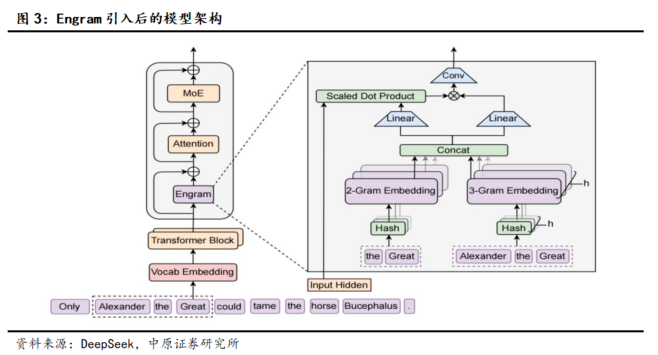
In January 2026, DeepSeek introduced "Engram," a conditional memory module that works alongside the main model. Engram uses hash-based lookups to retrieve static knowledge embeddings—essentially a searchable external memory. When 20-25% of model capacity is allocated to Engram (with the remainder using mixture-of-experts architecture), overall performance improves while reducing computational requirements.
More importantly, Engram enables decoupling computation from memory. The memory tables can be offloaded to standard RAM rather than GPU memory without significant performance loss. This architectural choice directly addresses China's limited access to HBM—the specialized, expensive memory used in AI accelerators. By reducing HBM requirements, Engram makes it feasible to run larger models on domestically-produced AI chips that may have less sophisticated memory systems.
2. Information Flow: The mHC Architecture
Since 2017, essentially all large language models have built on the Transformer architecture, which itself incorporates ResNet (residual networks)—a 2015 innovation that allows information to skip layers in deep neural networks.
ResNet solved the problem of training very deep networks but has limitations: information channels have fixed width, creating computational redundancy and memory overhead that scales poorly as models grow larger.
In January 2026, DeepSeek proposed "manifold-constrained Hyper-Connections" (mHC), an evolution of ByteDance's 2024 Hyper-Connections (HC) architecture. Where HC allowed multiple parallel information streams but suffered from signal amplification that made training unstable in large models, mHC introduces weighted averaging that prevents signals from amplifying infinitely.
In mixture-of-experts models, mHC accelerates training convergence by approximately 1.8x. This means reaching the same performance level with significantly less compute—a critical advantage when computational resources are constrained.
3. Visual Text Compression: Using Images as Information Carriers
Processing long text contexts—documents with hundreds of thousands or millions of tokens—requires massive computational resources. DeepSeek's OCR models (released October 2025, upgraded January 2026) introduce a counterintuitive solution: render text as images and process the visual representation.
Because vision models compress visual information efficiently, presenting text as an image can reduce token count dramatically. DeepSeek's experiments show 97% decoding accuracy when compression ratios are below 10x (text tokens to visual tokens), and approximately 60% accuracy even at 20x compression.
This approach addresses the long-context problem differently than extending context windows—it changes the format of information input itself. The upgraded OCR 2 model also explores using language model architectures as vision encoders, suggesting a path toward unified multi-modal encoders.
4. Native Sparse Attention Mechanisms
Separately from these papers, DeepSeek has progressively refined sparse attention mechanisms—methods for selectively attending to relevant parts of input rather than processing everything uniformly. The company introduced Native Sparse Attention in February 2025 and integrated DeepSeek Sparse Attention (DSA) into its V3.2 model in September 2025.
Sparse attention reduces computational requirements in both training and inference, enables longer context handling, and creates headroom for post-training optimization. Importantly, DeepSeek has extended sparse attention from inference-only (where it reduces serving costs) to pretraining, making it a fundamental architectural feature rather than an optimization technique.
What Makes V4 Potentially Disruptive
Based on DeepSeek's recent research trajectory and public statements, V4 likely incorporates several elements:
Cost Reduction Through Architectural Efficiency
The Engram and mHC architectures both reduce training costs. If V4 integrates these innovations, total training cost could fall well below the $5.86 million spent on R1—potentially approaching the $2-3 million range. This would establish a new baseline for frontier model development costs, pressuring competitors to match efficiency.
Open Release of State-of-the-Art Capabilities
DeepSeek has consistently open-sourced its models. If V4 delivers on reported coding performance superiority over Claude and GPT-4 class models while remaining open, it would represent the first open-source model to clearly exceed proprietary alternatives in a major capability domain.
This matters because most open-source models trail proprietary ones by 6-12 months in capability. Simultaneous open release of frontier performance would:
- Provide developers globally with access to state-of-the-art capabilities without API costs or rate limits
- Accelerate downstream AI application development, particularly in cost-sensitive markets
- Challenge the business model of AI-only companies like Anthropic, which generate revenue primarily through API access to proprietary models
- Intensify pressure on OpenAI, already facing competition from multiple directions
Potential Architectural Departure from Transformer
In January 2026, code repository updates revealed references to "Model 1"—a designation suggesting a new model family distinct from DeepSeek's V-series. Given DeepSeek's innovations in information flow (mHC), memory organization (Engram), and attention mechanisms, V4 may represent a more fundamental departure from standard Transformer architecture than incremental improvement.
If V4 successfully demonstrates that alternative architectures can match or exceed Transformer-based models, it would:
- Open new research directions for the field
- Reduce dependency on NVIDIA's CUDA ecosystem, which is optimized for standard Transformer operations
- Potentially accelerate progress toward AGI by escaping local optima in the current architectural paradigm
Deeper Integration with Domestic Chips
DeepSeek has progressively adapted its models to Chinese AI accelerators. V3.1 used FP8 numerical formats designed for upcoming domestic chips. V3.2 achieved zero-day compatibility with Huawei Ascend and Cambricon processors.
V4 may extend this integration further—potentially using domestic chips for portions of training or inference. This would validate Chinese AI hardware for frontier model development and reduce vulnerability to export restrictions.
Who Benefits and Who Faces Pressure
Winners in a V4 Success Scenario:
Chinese AI chip manufacturers: If V4 reduces HBM requirements and demonstrates effective training on domestic accelerators, it validates the technical approach of Chinese chip companies and increases demand for their products.
AI application developers: Open access to frontier capabilities at low cost enables more experimentation and faster product development, particularly for startups and developers in emerging markets.
Research community: Transparent technical documentation and open model weights accelerate collective progress in AI research.
Cloud providers offering DeepSeek models: Companies that integrate V4 into their services can offer competitive AI capabilities at lower cost than OpenAI/Anthropic-based alternatives.
Facing Pressure:
OpenAI and Anthropic: These companies generate revenue primarily through API access. If open alternatives match their capabilities, the premium pricing for proprietary access becomes difficult to justify. Both companies would need to either achieve significant capability leads, reduce pricing, or pivot toward application-layer offerings.
NVIDIA's ecosystem dominance: If alternative architectures reduce dependency on CUDA and models run efficiently on non-NVIDIA hardware, NVIDIA's structural advantage weakens. The company would remain important but less indispensable.
Western AI policy frameworks: If China continues developing frontier models under export restrictions, it demonstrates that controls on computational resources alone cannot maintain AI leadership. This may force reconsideration of how technological competition is managed.
Constraints and Unknowns
Validation Requirements
DeepSeek's claims await independent verification. Reported capabilities, particularly coding performance superiority, need testing across diverse real-world scenarios before being accepted as definitive.
Scaling Questions
While DeepSeek has demonstrated efficient training at current scales, it's unclear whether its architectural innovations maintain advantages as models grow toward 10+ trillion parameters or require more substantial computational resources.
Post-Training Complexity
DeepSeek has increased investment in reinforcement learning during post-training (allocating over 10% of pretraining compute to this phase for V3.2). The company has also indicated plans to scale up pretraining. V4's final capabilities will depend on execution in both areas, not just base architecture.
Regulatory and Geopolitical Risk
International tension around AI development could lead to further restrictions on knowledge sharing, computational resources, or market access. DeepSeek operates in an environment where rules can change rapidly.
What Happens Next
The AI industry operates on rough 3-6 month capability cycles, with companies releasing improved models in response to competitive pressure. V4's mid-February 2026 release will likely trigger responses:
- OpenAI may accelerate release of GPT-5 or substantial GPT-4 improvements
- Anthropic will need to demonstrate clear advantages in Claude's reasoning or safety characteristics
- Google DeepMind may increase emphasis on Gemini's multimodal capabilities as a differentiator
- Chinese competitors (Alibaba, Baidu, ByteDance) will face pressure to match V4's efficiency
The broader question is whether V4 represents incremental progress or a genuine paradigm shift. If DeepSeek has achieved fundamental architectural innovations that change cost-performance tradeoffs permanently, the implications extend beyond one model release. The entire economic structure of AI development—who can afford to compete, what capabilities are accessible to whom, and where value accumulates in the stack—could shift.
For now, the AI community waits to see whether DeepSeek's research translates into the disruption that its technical papers suggest is possible.