
Gen-Z Founder's Startup Secures Orders for Megawatt Airborne Wind System
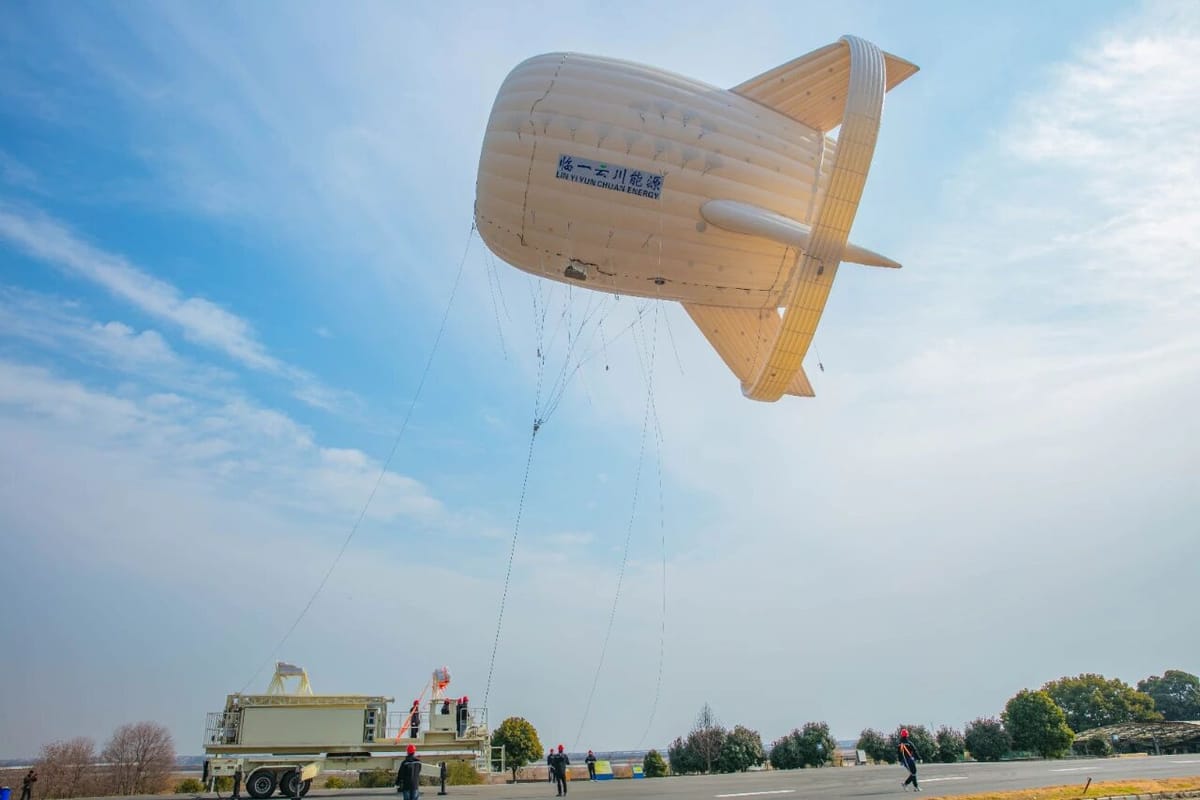
A two-year-old Chinese startup founded by a Gen-Z entrepreneur has secured its first major orders for a megawatt-scale airborne wind energy system, a critical milestone in the race to commercialize high-altitude wind power and address the industry's “impossible trinity” of providing clean, stable, and affordable energy.
Beijing Linyi Yunchuan Energy Technology this year successfully demonstrated its technology and began attracting significant commercial interest. The company announced in September 2025 that its S1500 model, an airship-like aerostat tethered to a ground station, completed a test flight in Xinjiang, becoming the world's first megawatt-class airborne wind energy system to achieve this stage. Following the demonstration, the company has secured several large-scale orders.
The technology aims to disrupt conventional renewable energy by tapping into the powerful and consistent winds found at high altitudes. Unlike ground-based wind and solar, which are intermittent and often require expensive battery storage, Linyi Yunchuan’s system promises a more stable power supply. This makes it a compelling alternative for off-grid locations such as remote islands, mining operations, and rural villages that currently depend on costly diesel generators.
Led by 27-year-old founder Dun Tianrui, the company’s ultimate goal is to progressively increase the operational altitude of its systems. By doing so, it plans to drastically lower the levelized cost of electricity to levels competitive with, and eventually far below, traditional power sources. This pursuit of higher altitudes forms the core of its strategy to deliver on the long-held promise of high-altitude wind power.
A Ladder to the Sky
Linyi Yunchuan’s product development is benchmarked by altitude, with each successive model designed to fly higher and generate more power at a lower cost. The company’s product line began with the S500, which in October 2024 flew to an altitude of 500 meters and generated a stable 50 kilowatts of power. This surpassed the previous world record held by U.S.-based Altaeros, which had reached 297 meters with a 30-kilowatt output.
In early 2025, the company launched the S1000, which climbed to 1,000 meters and produced 100 kilowatts, setting new world records for both altitude and power generation from a single airborne unit. The latest model, the S1500, which completed its test flight in September, is designed for commercial deployment in off-grid markets where its cost of electricity is already significantly lower than diesel.
The company's roadmap includes a series of systems—S3000, S6000, and S9000—that aim to compete directly with ground-based wind and thermal power. According to Dun, at an altitude of 9,000 meters, the system could theoretically operate for over 8,000 hours a year, approaching continuous power generation. This would enable the cost of electricity to fall to as low as RMB 0.03 yuan per kilowatt-hour, a tenth of the cost of coal-fired power. “This is the ultimate state we want,” said Dun, “to achieve economic, stable, and clean energy simultaneously, breaking the energy trilemma.”
Tackling the Energy Trilemma
The conventional energy sector has long been constrained by an “impossible trinity,” where it is difficult to achieve economic viability, cleanliness, and stability at the same time. While solar and ground-based wind are clean, their intermittency requires large-scale energy storage to ensure a stable supply, driving up costs. The company cites an example where adding storage to a large-scale solar project can increase its capital cost by a factor of 15, from RMB 1,000-2,000 yuan (about 138−138−276) per kilowatt to significantly more.
High-altitude wind is an attractive solution because wind speeds increase and become more consistent with altitude. Since wind power density is proportional to the cube of wind speed, a doubling of wind speed can theoretically increase power output eightfold. This allows for smaller, more efficient, and ultimately cheaper generating equipment compared to ground-based turbines of the same capacity. The potential energy resources in high-altitude winds are estimated to be 100 times greater than those accessible by terrestrial wind farms.
A Strategic Bet on Niche Technology
Dun, born in 1998, founded Linyi Yunchuan in 2023. His interest in aerostats—lighter-than-air aircraft such as balloons and airships—dates back to his university years. He and his co-founder astutely predicted that high-profile stratospheric internet projects from companies like Google and Facebook would fail due to high costs and uncertain profitability, which they did in 2021 and 2018, respectively.
Instead, Dun saw an opportunity to apply aerostat technology to the energy sector. He assembled a team that includes veteran engineers from China’s earlier generation of aerostat research, allowing the company to rapidly advance to the engineering and validation phase. Linyi Yunchuan’s strategy, as Dun describes it, is to use a niche technology to unlock a massive industry, similar to how Zeiss's precision lenses for lithography machines enabled the multi-trillion dollar advanced semiconductor industry.
Securing a Commercial Foothold
Linyi Yunchuan’s recent commercial success was accelerated after its technology was selected for a program sponsored by China’s Ministry of Industry and Information Technology (MIIT). The exposure led to investments from firms including CICC Capital and Casstar, as well as interest from its first major customers.
Despite the validation from early orders, Dun insists on a disciplined business model focused solely on equipment manufacturing. The company does not operate the power systems itself and refuses to accept any non-commercial, subsidy-based revenue. “It is more important than anything that customers are willing to pay for the equipment with real money,” Dun stated, emphasizing that the products must succeed on their own economic merits.
The company currently employs over 90 people, 80% of whom are technical staff, and operates with a flat organizational structure. Its operations are distributed across four locations: Beijing for sales and finance, Changsha for R&D, Yueyang for final assembly, and Zhoushan for producing the aerostat’s specialized skin material. Dun likens this to the Coca-Cola model, where core components are produced centrally while final assembly is decentralized to scale production quickly. "Either this technological path fails," Dun said, "or in our lifetime, we will become the most important company of our era, bar none."