
Honor Pivots to Hardware-Heavy AI ‘RobotPhone’ to Arrest Market Slide and Salvage Stalled IPO
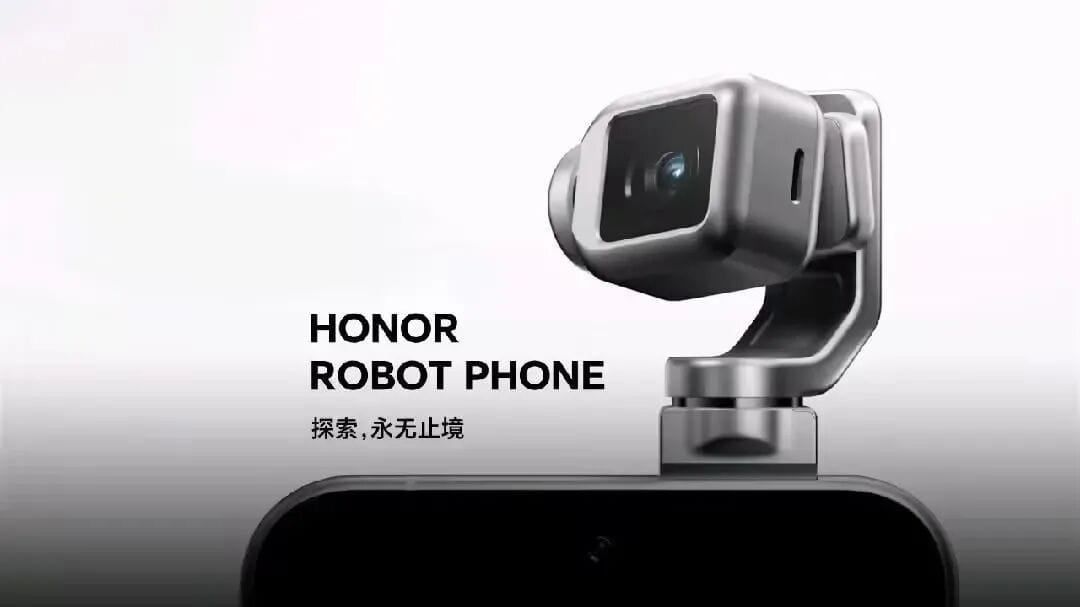
Honor is pivoting to radical hardware innovation—a smartphone equipped with a mechanical micro-gimbal—in a high-stakes bid to arrest a severe domestic sales slump, differentiate its artificial intelligence strategy, and resuscitate a stalled initial public offering.
On May 15, 2026, CEO Li Jian announced the third-quarter launch of the "RobotPhone" (RP), a flagship device integrating a proprietary 4-Degree-of-Freedom (4DoF) gimbal system and a 200-megapixel sensor co-tuned by ARRI. Entering the market with an estimated price tag of RMB 6,000 (US$833), the device bypasses traditional form factors by mounting the camera array on an elevated top bezel, directly challenging the premium duopoly of Huawei and Apple.
The launch marks a critical inflection point for the Shenzhen-based manufacturer. Initial market feedback suggests the RP is less of a routine product cycle update and more of a strategic pivot to rewrite its valuation narrative. Investors are closely watching whether this AI-integrated hardware can erode the dominance of Huawei, whose current flagship sales outpace Honor's by a five-to-one margin.
Faltering Flagships Delay IPO Timeline
Honor’s urgency stems from a contracting domestic footprint that threatens its capital market ambitions. Once China's top smartphone vendor in 2022, the company exited 2025 in sixth place with a 13.4% market share, overshadowed by Huawei’s 16.4% dominance and nearly 50 million units shipped.
The downward trajectory has persisted into 2026. First-quarter domestic shipments fell below 9 million units, hovering around a 13% market share. The company’s conventional premium offering, the Magic 8 series, has severely underperformed. By the 15th week of 2026, cumulative sales of the Magic 8 reached only 1.045 million units, capturing a mere 1.58% of the segment and trailing behind even mid-tier sub-brands like vivo’s iQOO 15 (1.087 million units).
This premium-segment weakness has directly impacted Honor’s corporate restructuring. The company’s IPO tutoring process, originally slated for completion and acceptance by March 2026, has missed its deadline with no regulatory updates as of early May. The RP launch serves as a necessary catalyst to convince institutional investors that Honor can command high-margin sales independent of its historical ties to Huawei.
Engineering Hardware to Differentiate AI Strategy
With global AI smartphone shipments projected to reach 600 million units in 2026—including 200 million in China—Honor is utilizing the RP’s mechanical architecture to physically differentiate its AI capabilities.
Rather than relying solely on large language models (LLMs) processed on standard chipsets, the self-developed micro-motor and 4DoF system provide a tangible hardware moat. This integration aims to optimize spatial computing and AI-driven imaging, establishing a proprietary technological ecosystem. For Honor, the RP is designed to prove that its internal R&D can yield industry-first form factors, a critical metric for a tech firm seeking a premium public market valuation.
Exporting Growth Amid Domestic Component Squeeze
The RP’s third-quarter rollout coincides with an increasingly hostile domestic macroeconomic environment. Rising memory chip prices are compressing hardware margins, prompting industry analysts to cap China’s 2026 smartphone shipment forecasts at 278 million units. Furthermore, the consumer replacement cycle has stretched to an unprecedented 51 months, meaning domestic growth is now a zero-sum game heavily monopolized by Apple and Huawei.
Consequently, the RP’s ultimate success may hinge on international deployment. Overseas markets represent Honor’s strongest fundamental pillar. In 2025, international shipments surpassed 35.5 million units, accounting for more than 50% of its 71 million global total. This momentum continued into Q1 2026, with overseas volume growing nearly 20% year-on-year.
If Honor can leverage the RP’s unique camera capabilities to penetrate high-ARPU (Average Revenue Per User) regions such as the Middle East, while expanding its footprint in Africa, the device could offset domestic stagnation. However, overcoming the entrenched global brand equity of Samsung and Apple remains a formidable barrier as Honor approaches its fifth year of independent operation.
Related Coverage:
Honor's ROBOT PHONE Targets August Mass Production, Setting Up Direct Clash With Apple's Q3 Cycle