
How China Built 22% of the World's Chip Capacity
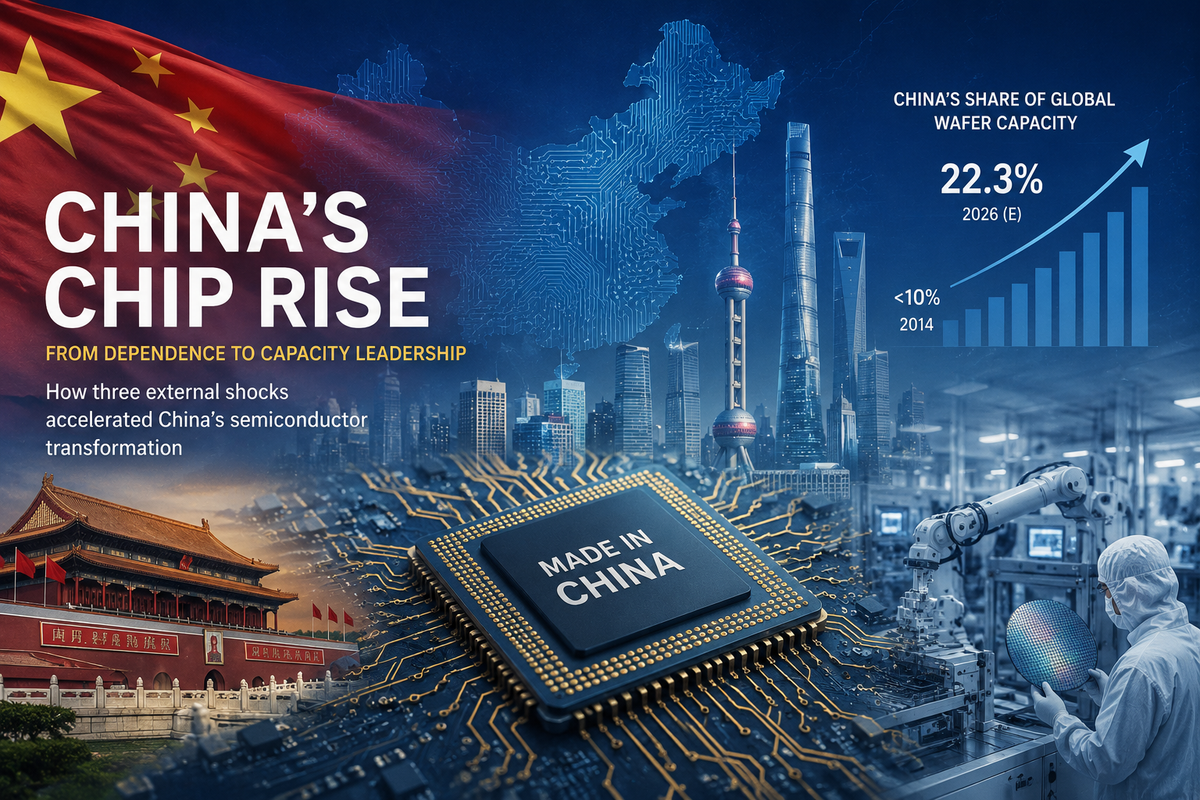
Between 2014 and 2026, China's share of global semiconductor wafer production capacity grew from less than 10% to a projected 22.3%, enough to rank first globally ahead of South Korea and Taiwan.
That rise represents one of the fastest industrial expansions in modern technology history.
But the story is often misunderstood.
China did not suddenly become the global leader in advanced semiconductors. Instead, it built enormous manufacturing scale primarily in mature chip technologies—while still facing major constraints in cutting-edge production.
More importantly, this transformation was not driven by long-term planning alone. It was accelerated by three major external shocks that fundamentally changed how China's semiconductor industry operated:
- The 2019 Huawei Entity List restrictions
- The 2020 TSMC supply cutoff
- The 2022 U.S.-led export control regime
Each shock increased pressure on China's technology supply chain. And each shock triggered a faster push toward domestic substitution.
Understanding that dynamic is critical to understanding China's semiconductor rise.
Why the Semiconductor Industry Matters
Semiconductors sit at the center of the modern global economy.
They power:
- Smartphones
- AI systems
- Electric vehicles
- Data centers
- Military hardware
- Industrial automation
For decades, the industry evolved as a highly specialized global supply chain:
- Taiwan dominated advanced manufacturing through TSMC
- South Korea led memory chips through Samsung and SK Hynix
- The U.S. controlled chip design and software through companies such as Nvidia, Qualcomm, Synopsys, and Cadence
- Japan and the Netherlands dominated key materials and manufacturing equipment
China, despite being the world's largest electronics manufacturing base, remained heavily dependent on foreign semiconductor technology.
That dependency became increasingly difficult to tolerate as chips turned into a geopolitical issue.
The Starting Point: China in 2014
In 2014, China's semiconductor industry remained relatively weak across most critical areas.
- Manufacturing: SMIC, China's leading foundry, was operating at 28nm while TSMC was already developing 10nm processes
- Materials: High-end silicon wafers, photoresists, and deposition materials were overwhelmingly imported from Japan and the U.S.
- Design: Huawei's HiSilicon was one of the few globally competitive Chinese chip design firms
- Dependence: More than 60% of chips consumed in China were imported
That same year, Beijing launched the National Integrated Circuit Industry Development Guidelines alongside the first phase of the National Integrated Circuit Industry Investment Fund, commonly known as the "Big Fund."
The initiative carried initial capital of roughly 138.7 billion yuan ($22 billion).
At the time, many industry observers viewed the plan skeptically. China's technology gap with TSMC and Samsung appeared enormous, and catching up was widely considered a multi-decade challenge.
First Shock: The 2019 Huawei Entity List
The first major turning point came in May 2019.
The U.S. placed Huawei and dozens of affiliated entities on the Entity List, restricting American companies from supplying technology to them without approval.
This immediately exposed how dependent China's technology champions were on foreign suppliers.
Huawei's supply chain relied heavily on:
- TSMC for advanced chip manufacturing
- ASML for lithography equipment
- ARM for processor architecture licensing
All three became vulnerable to U.S. restrictions.
What Changed After 2019
Before the sanctions, Chinese companies generally preferred foreign semiconductor suppliers because they offered:
- Better reliability
- Higher yields
- Proven performance
- Lower operational risk
Domestic alternatives existed in some categories, but adoption was slow because switching costs were high.
The Huawei sanctions changed the calculation.
The key question shifted from:
"Are domestic suppliers good enough?"
to:
"What happens if foreign suppliers become unavailable entirely?"
That shift triggered the first major wave of domestic substitution.
Chinese semiconductor firms rapidly expanded:
- SMIC accelerated capacity construction
- Equipment companies such as NAURA and AMEC saw demand surge
- Domestic materials suppliers gained their first large-scale validation opportunities
The industry began moving from policy-driven localization to survival-driven localization.
Second Shock: The 2020 TSMC Cutoff
In September 2020, TSMC officially stopped supplying Huawei.
This was even more significant than the Entity List because it directly severed China's access to advanced manufacturing capacity.
Huawei's HiSilicon division had depended almost entirely on TSMC's leading-edge nodes.
Without access to TSMC:
- Huawei stockpiled chips
- Smartphone shipments collapsed
- Chinese firms were forced to search for domestic alternatives regardless of performance disadvantages
Why This Shock Was Different
The 2019 restrictions created awareness.
The 2020 cutoff created urgency.
After Huawei lost access to advanced foundry services, China's semiconductor industry increasingly viewed foreign dependency not as a theoretical vulnerability, but as a confirmed strategic risk.
The response was massive capital mobilization.
According to SEMI data:
- Mainland China had roughly 40 fabs with 12-inch wafer capacity in 2020
- By 2026, that number is projected to exceed 70
This expansion rate far exceeded the global average.
The 2020 shock effectively transformed semiconductor localization from an industrial policy goal into a full-scale national investment cycle.
Third Shock: The 2022 Export Controls
The third turning point came in October 2022.
The U.S. Commerce Department introduced broad semiconductor export controls targeting China, restricting:
- Advanced AI chips
- High-end semiconductor manufacturing equipment
- Technology used for sub-14nm production
Unlike earlier sanctions focused on individual companies, the 2022 measures targeted entire technology categories.
The Netherlands and Japan later introduced similar restrictions affecting ASML lithography systems and Japanese semiconductor tools.
This marked a transition from targeted restrictions to systemic containment.
China's Three-Part Response
China's response unfolded across three fronts.
1. Massive Expansion in Mature Nodes
Chinese fabs accelerated investment in mature process technologies such as 28nm and above, where export controls were less restrictive.
These chips remain essential for:
- Automotive electronics
- Industrial systems
- Power management
- Consumer devices
Even without leading-edge capability, mature nodes still represent enormous global demand.
2. Big Fund Phase III
China launched a new phase of the Big Fund with more than 300 billion yuan ($42 billion) focused on:
- Semiconductor equipment
- Materials
- Advanced process R&D
The strategic focus increasingly shifted from simple capacity expansion toward supply-chain resilience.
3. Forced Validation of Domestic Tools
Chinese fabs began systematically testing and qualifying domestic equipment and materials.
In many cases, the goal was not immediate technological superiority. The goal was ensuring that domestic alternatives became commercially usable before foreign access deteriorated further.
What the 22% Figure Actually Means
At this point, an important distinction becomes necessary.
Capacity Leadership Is Not the Same as Technology Leadership
China's 22.3% global wafer capacity share primarily reflects leadership in mature process manufacturing.
Advanced-node capability remains much more limited.
For leading-edge chips below 14nm:
- China's domestic production share remains relatively small
- TSMC still dominates globally
- EUV lithography access remains restricted
This gap matters because advanced nodes are essential for:
- AI accelerators
- High-performance computing
- Advanced server processors
- Premium smartphones
In other words, China has become a manufacturing heavyweight in semiconductors—but not yet a full-spectrum leader across the entire technology stack.
The Core Dynamic: Pressure-Driven Industrial Acceleration
Looking across all three shocks, a consistent pattern emerges:
The stronger the external pressure, the faster China's domestic substitution effort accelerated.
Under normal market conditions, fabs preferred established foreign suppliers because semiconductor manufacturing is highly conservative and switching costs are extremely high.
But once supply disruption became a strategic risk, the cost-benefit equation changed completely.
External pressure reduced resistance to localization.
That shift created a self-reinforcing cycle:
- More domestic procurement
- More revenue for local suppliers
- Faster validation cycles
- Greater manufacturing scale
- Lower costs
- Improved quality
This pattern resembles what previously occurred in China's electric vehicle supply chain and is now appearing in sectors such as robotics and commercial space technology.
What Comes Next
Several factors will determine the next stage of China's semiconductor development.
1. Progress Below 14nm
The most important long-term question is whether China can narrow the gap in advanced manufacturing.
Key areas to watch include:
- SMIC's process development
- Domestic lithography progress
- Advanced packaging technologies such as Chiplet and CoWoS alternatives
2. Semiconductor Materials Localization
China has made progress in silicon wafers and industrial materials, but advanced photoresists and high-end specialty chemicals remain major bottlenecks.
The transition from "technically usable" to "commercially dominant" will be critical.
3. Future External Restrictions
All three major acceleration phases were triggered by external pressure.
Future developments—whether additional export controls, alliance-based restrictions, or supply-chain restructuring—could determine the pace of the next investment cycle.
Why Industry Consolidation Is Inevitable
Rapid expansion does not guarantee survival for every company.
China's semiconductor sector is entering a phase where consolidation will likely accelerate.
Several factors favor a smaller number of dominant firms:
- Semiconductor manufacturing requires enormous capital investment
- Customer qualification cycles create long-term supplier stickiness
- Scale improves cost competitiveness
- Technological specialization creates defensible niches
Over time, China's semiconductor ecosystem is likely to narrow into a smaller group of national champions across:
- Foundries
- Equipment makers
- Materials suppliers
- EDA software
- Packaging and testing
The Constraints That Still Matter
Despite the progress, several structural limitations remain.
EUV Lithography
Extreme ultraviolet (EUV) lithography machines remain unavailable to Chinese customers. ASML continues to dominate this category globally.
Advanced Materials
High-end photoresists and specialty materials remain heavily dependent on imports.
EDA Software
Chip design tools from Synopsys, Cadence, and Mentor Graphics still dominate advanced semiconductor workflows.
Talent Density
China has rapidly expanded its semiconductor workforce, but deep experience in leading-edge process development remains concentrated in Taiwan, South Korea, and the United States.
These constraints explain why scale alone does not automatically translate into technological parity.
Conclusion
China's rise to more than 22% of global semiconductor wafer capacity is a genuine industrial milestone.
But the deeper story is not simply about manufacturing scale. It is about how external pressure reshaped China's entire semiconductor strategy.
The 2019 Huawei sanctions, the 2020 TSMC cutoff, and the 2022 export controls each accelerated localization by making foreign dependency increasingly risky.
As a result, China built one of the world's fastest-growing semiconductor manufacturing ecosystems.
Yet major gaps remain in advanced nodes, EUV lithography, software tools, and high-end materials.
The next chapter will determine whether China can move from leadership in manufacturing volume to leadership in frontier semiconductor technology.
That outcome will shape not only China's technology industry, but also the future structure of the global semiconductor supply chain.