
Huawei Secures Memory as China’s Smartphone Industry Faces Its Worst Cost Shock in a Decade
Huawei locks in long-term storage supply agreements while rivals scramble; global average selling prices surge 21% to $565; Android shipments projected to fall 21% in 2026
China's smartphone industry is simultaneously navigating its most aggressive product launch season in years and the worst structural cost shock in a decade, as an AI server-driven memory shortage forces every major domestic brand to raise prices by up to RMB 1,000 (US$139) — even as global shipment volumes collapse.
The inflection point arrived on September 1, when Huawei, Xiaomi, and Honor announced simultaneous price increases across flagship and mid-range lineups, confirming what industry insiders had warned since the first quarter: the memory-chip supply squeeze is no longer a temporary disruption but a multi-year structural repricing of the entire consumer electronics value chain. According to Counterpoint Research, smartphone memory prices rose more than 80% quarter-on-quarter in Q2 2026, with memory now accounting for 30%–40% of a handset's bill of materials — up from 10%–15% historically.
The timing is particularly punishing. IDC forecasts global smartphone shipments will fall 16.7% in 2026, with Android volumes declining 21%. Yet Omdia data shows global average selling prices are projected to climb from $467 in 2025 to $565 in 2026, a 21% increase that represents the steepest single-year ASP jump on record.
Huawei Secures Supply While Rivals Face Prolonged Squeeze
The competitive divergence within China's smartphone market is sharpening along supply-chain lines. A source with direct knowledge of storage industry negotiations told IT Times that handset makers are in collective talks with both domestic and international memory suppliers, but outcomes are uneven: Huawei has likely secured long-term price-locked, volume-locked procurement agreements, while Xiaomi, vivo, OPPO, and Honor remain in difficult negotiations without equivalent leverage.
Huawei's balance sheet corroborates the strategic stockpiling thesis. The company's H1 2026 semi-annual report shows inventory balances surged to RMB 277.5 billion (US$38.5 billion) as of end-June, up RMB 82.5 billion (US$11.5 billion) — a 42.3% increase — from year-end 2025. Cash paid for goods and services in H1 climbed from RMB 314.3 billion (US$43.6 billion) to RMB 425.2 billion (US$59.1 billion), an incremental outflow exceeding RMB 110 billion (US$15.3 billion). The data pattern is consistent with aggressive forward purchasing rather than organic demand growth.
The specific price moves announced September 1 illustrate the magnitude of the shift. Huawei's Mate 80 series saw the largest adjustments: the Mate 80 base price rose RMB 800 (US$111), while the Mate 80 Pro Max jumped RMB 1,000 (US$139), pushing its 16GB+1TB configuration to RMB 9,999 (US$1,388) — crossing the symbolic RMB 10,000 threshold into ultra-premium territory. Xiaomi's Redmi K90 Supreme Edition rose RMB 400 (US$56) and the Redmi Turbo 5 Max by RMB 200 (US$28). Honor's Magic 8 series increased RMB 300–500 (US$42–69), with the series now starting at RMB 4,799 (US$667).
Memory Crunch Extends Timeline, Qualcomm Compounds Pressure
Industry consensus has hardened around a prolonged shortage cycle. The storage industry source quoted by IT Times stated that enterprise-grade AI server demand will continue to absorb the bulk of advanced memory production capacity, keeping consumer-grade supply constrained through at least 2027 and elevated pricing through 2028 — described as "the most optimistic forecast." IDC has independently projected the memory price cycle will persist through end-2027, while SK Group Chairman Chey Tae-won has warned that 2027 may represent peak supply scarcity.
Qualcomm compounded the cost shock by announcing double-digit percentage price increases across its entire chip lineup effective September, directly disrupting the product launch and inventory planning cycles of Chinese OEMs. Multiple digital media sources report that Xiaomi, OPPO, and vivo have already cut 2026 shipment targets by up to 30%, with more recent reports suggesting flagship production volumes are being trimmed by 30%–50%.
The entry-level segment faces an existential reckoning. "Selling a sub-RMB 1,000 phone now means losing money on every unit," one dealer told IT Times. Realme formalized this retreat in July, announcing the suspension of its China domestic business to concentrate entirely on overseas markets. Yang Shucheng, secretary-general of the China-India-Vietnam Electronics (Mobile Phone) Enterprise Association, noted that price increases in Vietnam and India lag China by one to two months given that most components originate from Chinese supply chains, with local factories serving primarily as assembly operations.
"Tao Chip" Architecture Marks Huawei's Next Competitive Bet
Against this cost-driven headwind, Huawei is preparing what may be its most significant silicon milestone since the U.S. export restrictions began to bite. The Mate 90 series launch is tentatively scheduled for September 23 and is expected to introduce the first commercially shipped chip built on the "Tao Law" architecture — a new performance-scaling framework developed by Huawei's semiconductor division under President He Tingbo.
Leaked specifications suggest Huawei will deploy a dual-chip strategy: the Mate 90 Pro, Pro Max, and RS Non-Ordinary Master Edition will receive the new Kirin chip based on Tao Law architecture, while the standard Mate 90 will retain the previous-generation Kirin to preserve production volume and cash flow. The approach mirrors a classic yield-management playbook: absorb higher per-unit costs on high-margin flagship SKUs while protecting shipment scale with proven silicon on base models.
The V2 update to the Tao Law paper, published on ChinaXiv in July 2026, disclosed a critical roadmap detail: the Kirin 2026 and Kirin 2027 chips have both been marked as "Silicon" status — meaning tape-out and post-silicon validation have been completed, clearing the primary technical barrier to mass production. Kirin 2028 and Kirin 2029 remain in "Pre-silicon" architectural design phases.
Tian Feng, president of Institute of Fast Thinking and Slow Thinking and strategic adviser to OpenHarmony, explained the yield economics: in multi-layer 3D stacking architectures, composite yield equals the product of individual layer yields multiplied by bonding yield. Assuming single-layer yields around 90%, two-to-three layer stacking combined with through-silicon via alignment losses can compress composite yield to the 70% range or below — a non-linear degradation that "is easy for the market to underestimate but is the first cost variable engineering teams feel." The NAND flash industry's transition from 64-layer to 128-layer 3D NAND required six to eighteen months of yield recovery before reaching mature production curves; the Tao Law chips face an analogous learning-curve period.
AI Agent Phones Enter Market as Demand Catalyst Remains Unproven
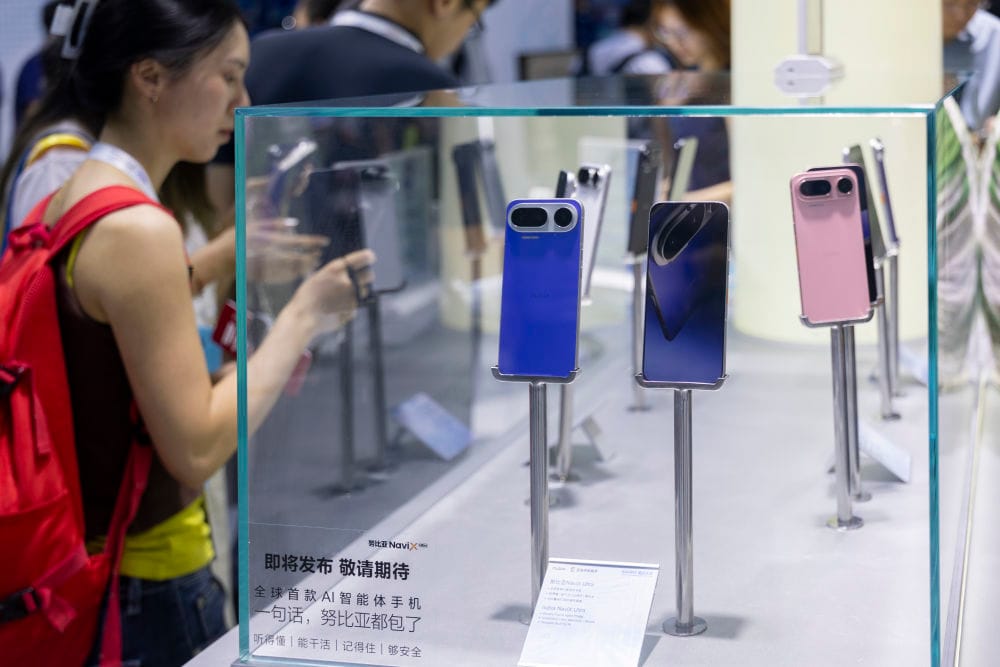
The industry is placing a parallel bet on AI-native hardware to stimulate replacement demand. On September 1 — the same day as the price increase announcements — ZTE Corporation's Nubia brand confirmed that the Doubao Phone NaviX Ultra, co-developed with ByteDance, has received MIIT network access certification and will go on sale in September. The device is positioned as the world's first AI agent smartphone. A second AI agent device, the STEPX Neo from Stepfun, is also expected to launch in H2 2026; both devices were displayed at the World Artificial Intelligence Conference in July.
The strategic calculus is straightforward: AI features offer a narrative justification for premium pricing at a moment when hardware performance improvements have largely exceeded the requirements of everyday use cases. However, industry observers note a structural irony — the same memory cost surge that is driving up handset prices is also constraining R&D budgets for on-device AI development at traditional OEMs, leaving AI-native momentum primarily with software-first entrants such as ByteDance and Stepfun.
Whether "Tao chips" and AI agent software can together persuade a consumer base already absorbing 21% higher prices to accelerate upgrade cycles will be the defining commercial question for China's smartphone sector through the remainder of 2026.
Related Coverage:
Huawei Launches World's First Wide-Ratio Bar Phone, Betting on HarmonyOS
CXMT's Fastest LPDDR5X Chip Enters Mass Production, Debuts in Nubia NaviX Ultra