
JD Logistics’ 3 Million Robot Commitment Signals the Next Phase of China’s AI Infrastructure Race
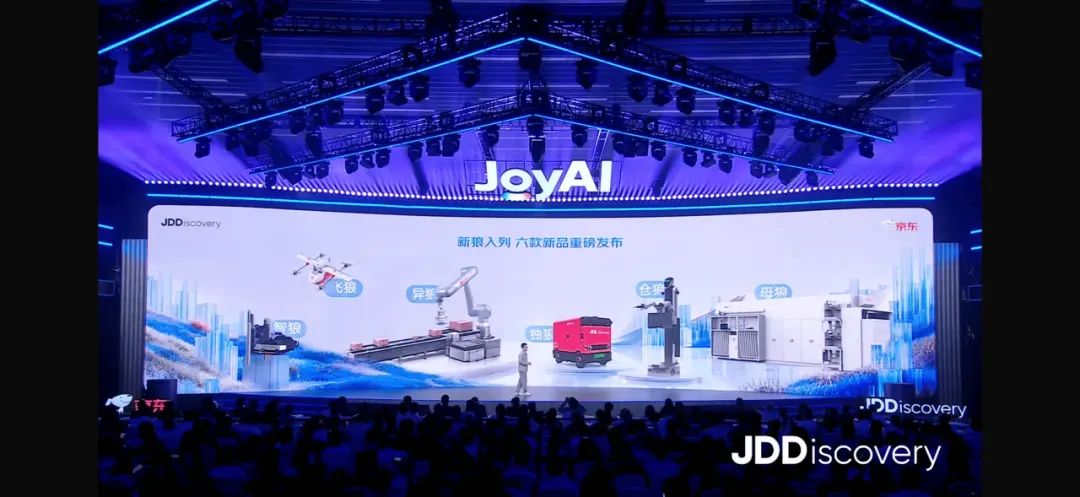
JD Logistics has pledged to procure three million robots, one million autonomous vehicles, and 100,000 drones within five years — the largest single robotics procurement commitment ever announced by a logistics operator — as it bets that coordinated physical AI, not isolated automation, is the decisive competitive moat in global supply chains.
The announcement, made September 9 at the JDD Global Tech Explorer Conference in Beijing, marks a strategic inflection point: JD Logistics is no longer positioning individual machines as efficiency tools but rather as nodes in a unified, AI-orchestrated operating system it calls "Super Brain + Langzu". The distinction matters for investors — it reframes the company's capital expenditure not as hardware spend, but as infrastructure for a proprietary physical-AI platform that competitors would require years to replicate.
Market observers noted the timing is deliberate. With China's e-commerce growth moderating and last-mile delivery margins under sustained pressure across the sector, JD Logistics is accelerating a cost-structure transformation that could redefine unit economics industry-wide.
"LangzuTech" Expands to Nine Variants, Targeting Every Link in the Chain
The LangzuTech robot family — branded internally as the "wolf pack" — now comprises 11 distinct machines across nine product lines, covering warehouse storage, picking, sorting, cold-chain handling, pharmaceutical dispensing, autonomous delivery, and drone logistics. Five new products debuted at the JDD conference.
The product architecture is deliberately comprehensive:
- LangzuTech Picker: Billed as the industry's first mobile picking robot for complex in-warehouse environments, it deploys in two weeks — versus the six-month facility shutdown typically required for conventional automation upgrades. Operating at 80 units picked per hour (UPPH) with 99.9% accuracy and over 85% SKU coverage, the system requires zero warehouse modification.
- LangzuTech Multi-shuttle — Cold Version: The industry's first goods-to-person solution rated for -20°C environments. Cold-chain warehousing has historically been the least automated segment of logistics due to equipment failure rates at low temperatures. JD Logistics claims the system — enabled by active defrost technology and 100% contactless power supply — doubles storage capacity, triples operational efficiency, and cuts per-order costs by 10%.
- LangzuTech SPP Health Edition: A fully unmanned pharmaceutical dispensary operating 24/7, achieving 99.9% dispensing accuracy, 100% compliance traceability, and a throughput of 90 orders per hour. The system is the first in the sector to handle mixed-batch, mixed-SKU pharmaceutical inventory — a regulatory and operational challenge that has long blocked pharmacy automation at scale.
- LangzuTech Mini Van 6 Plus: A sixth-generation L4 autonomous delivery vehicle with an operational lifespan exceeding eight years, 200 km range, and 1,000 kg payload capacity. Crucially, it operates across open roads with minimal mapping, closed campuses without maps, and structured parking environments with high-definition maps — reducing deployment costs significantly. Thousands of units are already running at hundreds of sites nationwide, with station-level transport costs down 21% and turnaround efficiency up 50%.
- LangzuTech L05 Drone: Described as the sector's first logistics drone supporting fully unmanned operations end-to-end — including automatic battery swapping, automated cargo loading and unloading, and autonomous flight management. Specifications: 5 kg payload, 40 km range, 72 km/h cruising speed. The elimination of human intervention at every operational touchpoint directly addresses the cost ceiling that has constrained drone logistics economics globally.
- LangzuTech Packer: An embodied robotic arm with nearly 100 distinct grip configurations, capable of handling irregular, soft, or deformable packages — floppy woven bags, inflated air-column packaging, irregular parcels — that defeat conventional industrial arms. The system has completed more than 13 million real-package operations in production environments running 24/7.
"Super Brain 3.0" Turns Isolated Machines Into a Coordinated Fleet
The hardware announcement would be incrementally significant on its own. What elevates the strategic narrative is the Super Brain large model platform, now at version 3.0, which functions as the command layer unifying all LangzuTech assets.
Super Brain 3.0 is composed of five domain-specific industrial large models: PreX (demand forecasting), OptiX (logistics decision optimization), OmniX (multimodal perception), GeoX (spatiotemporal routing), and EmbodiedX (embodied robot control). Together they form a three-tier architecture: Decision AI → Process AI → Physical AI.
In operational terms, Decision AI ingests order flow, warehouse network status, real-time traffic, and weather data to compute globally optimal routing for hundreds of millions of daily parcels — determining warehouse sequencing, vehicle dispatch, and inter-node timing simultaneously. Process AI translates those decisions into device-level instructions. Physical AI, via the CyberX control engine, pushes commands directly to LangzuTech robots and closes the feedback loop in real time.
The system's practical impact is most visible in inter-stage synchronization. Without centralized orchestration, picking, sorting, and loading operations run on independent rhythms, generating idle time at handoff points. Super Brain 3.0 calculates optimal cadence across all stages simultaneously, triggering downstream readiness the moment upstream tasks complete. JD Logistics reports the system is now deployed across more than 1,000 operational scenarios, with frontline efficiency gains of approximately 20%.
The "LangzuTech" is currently active in more than 20 Chinese provinces and over 10 countries — a geographic footprint that gives the platform real-world training data at a scale no pure-play robotics startup can match.
Scale Procurement Signals a Supplier Ecosystem Shift
The five-year procurement target — three million robots, one million autonomous vehicles, 100,000 drones — carries implications that extend well beyond JD Logistics' own balance sheet.
For China's robotics supply chain, a buyer of this scale and technical specificity functions as a market-shaping anchor customer. Suppliers capable of meeting JD Logistics' reliability, interoperability, and cost requirements at volume will gain a defensible reference case; those that cannot will find themselves structurally disadvantaged as the industry consolidates around proven platforms.
For JD Logistics itself, the procurement commitment is simultaneously a cost play and a barrier-to-entry signal. Autonomous delivery vehicles already demonstrate a 21% reduction in station transport costs. Cold-chain automation delivers a 10% per-order cost reduction. At the volumes implied by this procurement cycle, the cumulative labor cost displacement will be material — and the operational data generated will further widen the performance gap between JD Logistics' AI platform and competitors relying on conventional automation.
The broader logistics sector is watching closely. Rivals including SF Holding and Cainiao Network have made their own automation investments, but none has publicly committed to a comparable procurement scale or disclosed a comparably integrated AI orchestration architecture. JD Logistics' announcement effectively raises the benchmark for what "serious" logistics automation looks like in 2026.
Related Coverage:
JD.com Returns to Operating Profit, But Revenue Decline Exposes Structural Growth Gap