
Li Auto Enters AI Glasses Market as Automakers Join Tech Hardware Race
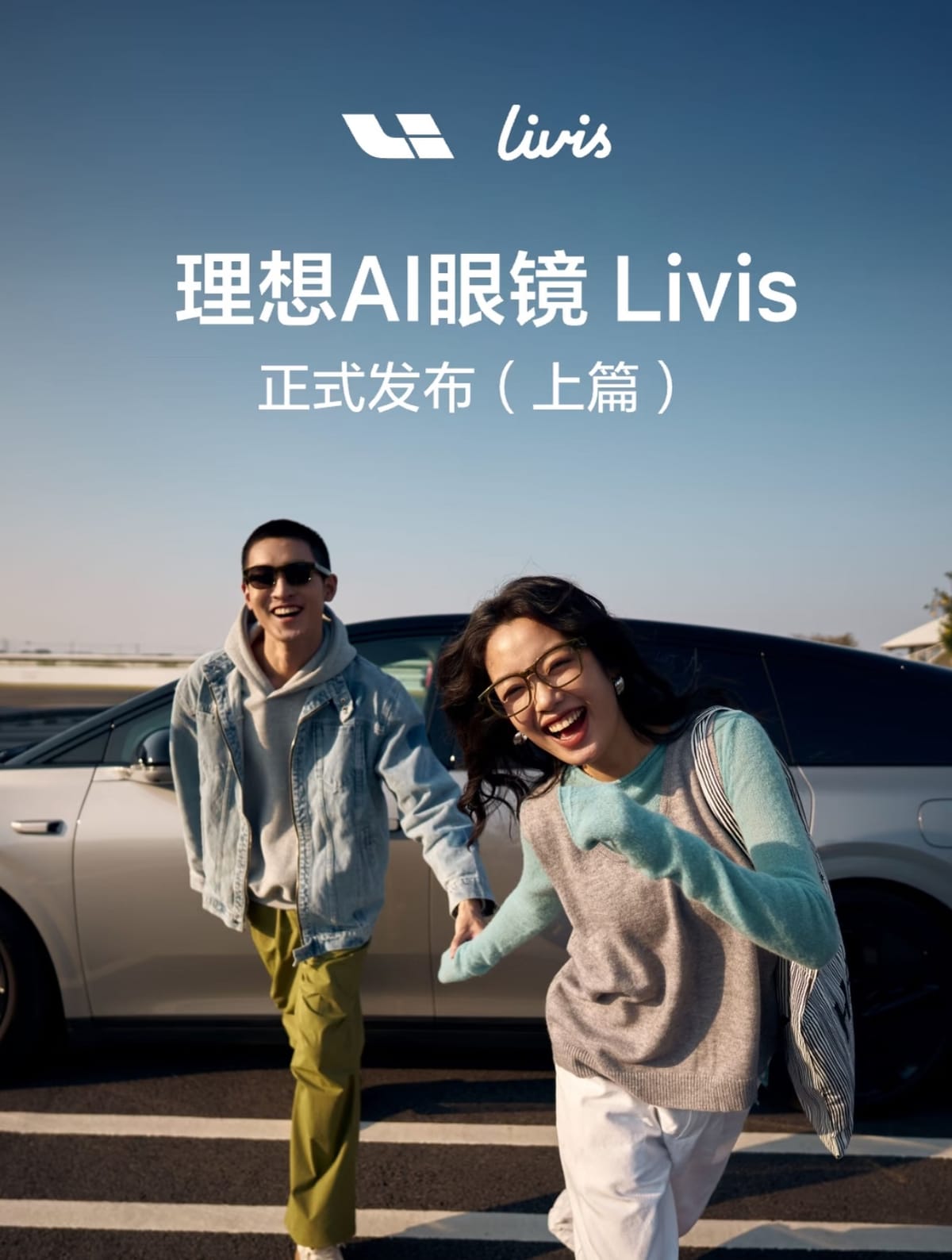
Li Auto launched its first AI-powered smart glasses on December 3, marking an unprecedented move by an automotive manufacturer into the rapidly expanding artificial intelligence eyewear sector.
The Li Auto AI Glasses Livis, priced at 1,999 yuan (US$282)with a subsidized price of 1,699 yuan(US$238), represents the first AI glasses product from a car manufacturer. While BMW previously released smart glasses for motorcycle riders in 2023, those lacked large language model integration and focused primarily on vehicle information display.
According to incomplete statistics, at least 32 AI glasses models have launched in China's domestic market through November 2025, including products from tech giants Alibaba and Baidu, as well as startups like Inmo and Rokid.
Li Auto's entry into this crowded market reflects a strategic positioning of AI glasses as "wearable robots" within its broader embodied intelligence strategy, according to Fan Haoyu, senior vice president at Li Auto. The company places the product on equal footing with its vehicle lineup rather than positioning it as a car accessory.
The Livis glasses weigh 36 grams and offer 18 hours of typical battery life, supporting 1,000 photos, 41 minutes of video recording, 7.6 hours of music playback, or six hours of calls. The device lacks optical display modules, focusing instead on image recording and voice interaction powered by Li Auto's proprietary Mind GPT large language model.
Li Auto's WearLink Realtime Audio communication system enables 300-millisecond wake-up speeds and 800-millisecond end-to-end response times when paired with the Mind GPT-4o model. The glasses integrate with Li Auto vehicles for voice-controlled functions including door opening and temperature adjustment, though more advanced features like vehicle summoning face regulatory restrictions.
The automotive manufacturer confronts distinct challenges compared to internet companies entering the AI glasses market. While tech platforms can leverage user bases numbering in the tens or hundreds of millions from smartphone app ecosystems, car manufacturers operate with customer bases two orders of magnitude smaller.
Li Auto's vehicles offer potential computational advantages, with models like the L6 Max equipped with dual Orin X chips providing 508 TOPS of computing power. This architecture could enable the glasses to offload complex processing tasks including map navigation and augmented reality interactions to vehicle platforms.
The company must navigate potential conflicts in interaction logic as functionality expands. Current systems automatically suppress glasses activation when users enter vehicles, routing voice commands beginning with "Li Auto" to the vehicle system and redirecting camera requests back to the glasses. Maintaining this seamless handoff with expanded feature sets presents technical challenges.
Li Auto's positioning of the Livis as an all-day wearable device rather than a vehicle-specific accessory places it in direct competition with established consumer electronics manufacturers and internet platforms, testing whether automotive brands can establish credibility in the wearables market.Li Auto has become the first Chinese automaker to launch AI-powered smart glasses, marking an unexpected expansion of the competitive landscape in a sector that has already seen 32 product launches in China this year alone. The Beijing-based electric vehicle manufacturer unveiled the Livis AI glasses on December 3, priced at 1,999 yuan (US$282) with subsidized pricing at 1,699 yuan(US$238) with subsidized pricing at 1,699 yuan(US$238).
The move represents a strategic shift for automakers seeking to establish themselves as players in the next generation of consumer hardware, positioning AI glasses as a potential gateway to control multiple smart devices rather than merely vehicle accessories. Unlike traditional tech companies entering the space, Li Auto lacks the established consumer electronics brand recognition and massive user base that internet giants bring to the market.
The company's senior vice president Fan Haoyu characterized the device as a "wearable robot" and part of Li Auto's embodied intelligence strategy, placing it on par with the company's vehicle lineup rather than as a peripheral product. This positioning reflects broader competition among automakers and tech firms to secure market share in what many view as the next major computing platform.
However, the practical integration between vehicles and smart glasses faces regulatory constraints, with features like vehicle summoning via glasses technically ready but not yet permitted under current rules. This limitation may constrain the immediate differentiation advantage automakers might otherwise enjoy over traditional tech competitors.
Breaking New Ground in Automotive Hardware
Li Auto's entry into AI glasses represents the first time a mainstream automaker has launched a true AI-powered eyewear product, distinguishing it from BMW's 2023 smart glasses designed specifically for motorcyclists, which lacked large language model capabilities and focused primarily on displaying vehicle metrics like speed and engine RPM.
The Livis glasses weigh 36 grams and offer 18 hours of typical use, positioning them competitively on battery life. The device can capture 1,000 photos, record 41 minutes of video, play 7.6 hours of music, or handle 6 hours of calls on a single charge. The emphasis on lightweight design and extended battery life indicates Li Auto's intention for the product to function as an all-day wearable rather than a vehicle-specific accessory.
Notably, Li Auto opted against including an optical display module, instead focusing on image recording and voice interaction—mainstream features in current AI glasses offerings. The device integrates Li Auto's self-developed WearLink Realtime Audio communication system and Mind GPT-4o model, achieving 300-millisecond wake-up speeds and 800-millisecond end-to-end execution responses.
Competitive Pressures in Crowded Market
The Chinese AI glasses market has seen explosive growth in 2025, with at least 32 models launched through November from companies ranging from internet giants Alibaba and Baidu to startups like Inmo and Rokid. This saturation presents immediate challenges for Li Auto's market entry.
Internet companies enter the AI glasses space with significant advantages: existing apps with tens of millions or even hundreds of millions of users, providing ready-made content ecosystems that can migrate to the new form factor. In contrast, automakers like Li Auto must rely on vehicle integration features to differentiate their offerings, despite their automotive user bases being two orders of magnitude smaller than major tech platforms.
The brand perception gap poses additional hurdles. While Li Auto positions the Livis as capable of independent use beyond vehicle integration, consumers may view traditional consumer electronics manufacturers as more credible players in the wearables space, regardless of the product's actual capabilities.
Vehicle Integration Opportunities and Constraints
Li Auto's automotive background offers unique technical advantages that pure tech players cannot easily replicate. Modern smart vehicles like the Li Auto L6 Max come equipped with dual Orin X chips providing 508 TOPS of computing power, far exceeding what can be embedded in lightweight glasses.
This architecture enables a distributed computing model where glasses handle lightweight interactions while offloading complex data processing—such as map navigation and augmented reality scene interactions—to the vehicle's computing platform. This approach circumvents the performance limitations inherent in compact wearable devices.
Currently, the Livis glasses support command-based vehicle functions including door unlocking and climate control adjustments. However, more advanced features face regulatory barriers. Vehicle summoning via glasses, while technically feasible according to Fan, remains prohibited under current regulations, limiting near-term differentiation opportunities.
As functionality expands, interaction logic conflicts may emerge. Currently, when a user wearing Livis enters a Li Auto vehicle, the system automatically suppresses glasses wake functions, routing voice commands to the car. When users request video recording—a capability the vehicle lacks—the system activates the glasses. This seamless handoff works with limited functionality, but scaling to comprehensive features like navigation could introduce conflicts in cross-device function calls and concurrent multi-tasking scenarios, presenting significant engineering challenges ahead.Li Auto has become the first Chinese automaker to launch AI-powered smart glasses, marking an unexpected expansion of the competitive landscape in a sector that has already seen 32 product launches in China this year alone. The Beijing-based electric vehicle manufacturer unveiled the Livis AI glasses on December 3, priced at 1,999 yuan (US$282)with subsidized pricing at 1,699 yuan(US$238)with subsidized pricing at 1,699 yuan(US$238).
The move represents a strategic shift for automakers seeking to establish themselves as players in the next generation of consumer hardware, positioning AI glasses as a potential gateway to control multiple smart devices rather than merely vehicle accessories. Unlike traditional tech companies entering the space, Li Auto lacks the established consumer electronics brand recognition and massive user base that internet giants bring to the market.
The company's senior vice president Fan Haoyu characterized the device as a "wearable robot" and part of Li Auto's embodied intelligence strategy, placing it on par with the company's vehicle lineup rather than as a peripheral product. This positioning reflects broader competition among automakers and tech firms to secure market share in what many view as the next major computing platform.
However, the practical integration between vehicles and smart glasses faces regulatory constraints, with features like vehicle summoning via glasses technically ready but not yet permitted under current rules. This limitation may constrain the immediate differentiation advantage automakers might otherwise enjoy over traditional tech competitors.