
Midea's Eight-Year Robot Gambit: From Home Appliances to Global Top-Four Industrial Robotics Player
Midea has emerged as one of the world's four largest industrial robot manufacturers after nearly a decade of strategic investments, marking a significant shift from its traditional home appliances business to advanced manufacturing technology. The transformation reflects China's broader industrial upgrade ambitions, with the company achieving over 85% localization of core robot components and robot-related revenue exceeding RMB 30 billion yuan ($4.2 billion) in 2024.
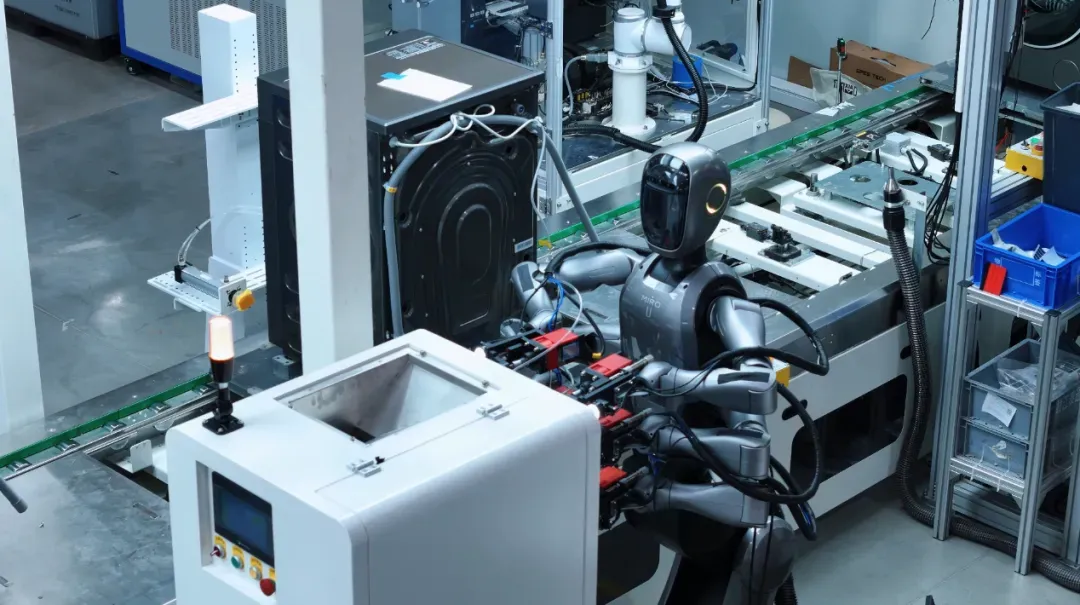
At Midea's high-end washing machine facility in Wuxi, the company's self-developed "Mero U" hyper-humanoid robot featuring six arms and wheeled legs autonomously navigates production lines, completing multi-arm coordinated assembly tasks with 360-degree rotation capability that has boosted production changeover efficiency by 30%. Meanwhile, at the Jingzhou washing machine plant, robots enable one washing machine to roll off the line every 10 seconds. The company plans to deploy "Mera," its service robot, in retail stores throughout 2026 for customer interaction and product demonstrations.
The milestone comes after Midea's controversial 2017 acquisition of German robotics manufacturer KUKA, which sparked skepticism about potential integration challenges. The eight-year integration period has now yielded tangible results, with KUKA's China business revenue contribution rising to 30% and Midea's industrial robot market share in China reaching 9.4% according to MIR DATABANK. In 2025, Midea renamed its wholly-owned subsidiary Guangdong Midea Electric to KUKA Robotics Automation (Guangdong) Co., Ltd., positioning robotics as its primary business scope.
The robotics push forms a cornerstone of Midea's broader transformation from a product-focused appliance maker into a technology conglomerate. The company's To-B business segment, which includes robotics, grew from 18.5% of total revenue in 2020 to 25.7% in the first half of 2025, establishing industrial automation as a critical growth engine alongside its consumer electronics operations.
Technical Capabilities and Manufacturing Scale
Midea has built formidable technical and production capabilities that underpin its global robotics ambitions. The company now operates China's largest industrial robot production base at the Midea KUKA Intelligent Manufacturing Technology Park in Shunde, Guangdong, which became fully operational in 2023 and delivered over 30,000 robots in 2025.
The facility features Guangdong's first fully automated "robots building robots" production line, capable of completing one robot every 30 minutes with 24-hour continuous operation. In 2024, Midea secured the National Key Laboratory for High-End Heavy-Duty Robots (Blue Orange Laboratory), the only enterprise-dependent facility in China's robotics sector, focusing on core components, complete machine design, and three other critical research areas.
The company's flagship "Mero U" represents a departure from conventional humanoid robot design. Rather than mimicking human bipedal locomotion, the six-armed, wheeled-leg configuration enables parallel task execution—with lower arms handling 15kg heavy-duty transport while upper arms perform 5kg precision operations, completing transport, assembly, and fastening simultaneously. The Mecanum wheel chassis delivers twice the movement speed of traditional bipedal robots with 360-degree on-the-spot rotation, optimized for narrow factory corridors. Magnetic quick-change end effectors allow three-second tool switching, reducing production line changeover from hours to seconds.
Deployed at the Wuxi facility, Mero U has generated annual cost savings exceeding RMB 8 million yuan ($1.1 million) from changeover efficiency improvements alone, delivering an 18-month investment payback period. The robot represents the third generation of Midea's self-developed "Mero" series, which has progressed from quality inspection and patrol duties at the Jingzhou plant to sub-millimeter precision assembly at Wuxi, with Midea's appliance factories serving as real-world testing grounds for technology iteration.
Sustained R&D investment supports these technical advances. Midea has allocated over RMB 43 billion yuan (6 billion) to research and development over the past three years, with first-half 2025 R&D spending reaching RMB 8.8 billion yuan (1.2 billion), up 14.4% year-over-year and outpacing overall revenue growth. The company maintains 38 global R&D centers and 16 national-level innovation platforms, employing a 1,600-person robotics research team with nearly 50% holding master's or doctoral degrees.
Midea's self-developed harmonic reducers exceed Japanese competitors' precision by 15%, while its hollow-cup motors reduce energy consumption by 27%. The company has achieved over 70% self-sufficiency in core component development, breaking foreign technology monopolies across the robotics value chain from components to complete systems.
Strategic Integration and Measured Expansion
Midea's robotics strategy stands out for its pragmatic, long-term approach rather than pursuit of short-term gains. The company has followed a deliberate "industrial-first, commercial-second" pathway, maintaining strategic patience despite years of integration challenges following the KUKA acquisition.
The 2017 KUKA purchase initially triggered concerns about organizational mismatches between Midea's rapid "T+3" supply chain model and KUKA's long-cycle, customized project-based business. Rather than forcing administrative integration, Midea granted KUKA operational independence while establishing joint R&D teams focused on specific application scenarios. This eight-year integration process has gradually aligned KUKA's technical expertise with Chinese market demands.
According to Midea's 2025 public disclosures, KUKA's China business now represents 30% of its revenue. Leveraging KUKA's five decades of robotics manufacturing experience, Midea has achieved comprehensive coverage from core components to complete solutions and from hardware to intelligent systems. Joint development efforts have enabled Midea's industrial robots to capture 9.4% of the Chinese market, with new products successfully passing European certifications for technology export. The 2025 subsidiary renaming formally elevated robotics to the forefront of corporate operations, signaling deepened collaboration.
On the self-developed robotics track, Midea's "industrial-before-commercial" approach has proceeded methodically. The company first deployed robots in its own appliance factories, using industrial scenarios as technology iteration proving grounds. The large-scale Mero series applications at Jingzhou and Wuxi facilities validated both practical utility and economic viability while accumulating vast industrial scenario data to refine algorithms.
Only after maturing industrial robot technology has Midea extended into commercial and residential applications. The "Mera" series for commercial and home use has completed final testing, with 2026 deployment planned for Midea experience stores in major cities nationwide. These wheeled-leg hybrid robots will handle product navigation, function demonstrations, and interactive services, integrating deeply with Midea's smart home ecosystem through environmental perception and voice interaction capabilities. This represents Midea's pivotal step from industrial to consumer-grade robotics.
From industrial scenario scale deployment to commercial scenario pilot programs, Midea has resisted rushing into home robotics for publicity, instead advancing incrementally by validating technology through applications and adapting technology to requirements. This measured pace has helped the company avoid many detours in the humanoid robotics race.
Growth Dynamics and Ecosystem Advantages
Within Midea's technology conglomerate transformation, robotics has become the core growth driver of its To-B segment, supported by a three-pillar framework of technology, scenarios, and ecosystem integration that sustains steady growth amid industry fluctuations.
In the first three quarters of 2025, Midea's robotics and automation business generated RMB 22.6 billion yuan ($3.1 billion) in revenue, up 9% year-over-year—a solid performance given the sector's technical barriers and investment cycles. Midea's To-B business share has expanded from 18.5% in 2020 to 25.7% in first-half 2025, establishing itself as a vital corporate growth engine. As the To-B segment's core component, robotics business holds substantial future growth potential.
Critically, Midea has created unique "scenario synergy advantages" for its robotics operations. As a manufacturing giant, Midea's appliance production processes—from injection molding and assembly to quality inspection and packaging—provide ideal robotics application scenarios. This "build robots, use robots" model enables technology validation and cost optimization without external scenario dependence, while appliance production's "small batch, high variety" requirements continuously enhance robot flexibility and intelligence.
Simultaneously, Midea is cultivating a robotics industry ecosystem cluster. The Midea KUKA Intelligent Manufacturing Technology Park has attracted numerous upstream and downstream enterprises covering servo motors, drivers, controllers, and other core components, achieving 85% supply chain integration within the park. As chain leader of Guangdong Province's key robotics industry chain, Midea has fostered a comprehensive ecosystem of "chain leader plus specialized and innovative SMEs," enabling cluster enterprises to reduce costs and increase efficiency through collaborative effects while strengthening its own robotics business with more complete industrial chain support.
Midea's robotics have evolved beyond appliance industry "proprietary tools" into universal solutions applicable across automotive, aerospace, electronics, medical, logistics, and other sectors. From internal appliance manufacturing scenarios to external cross-industry expansion, Midea's robotics business boundaries continue widening, opening new revenue growth dimensions.
Strategic Logic: Robotics as Core Answer to Technology Transformation
Midea's eight-year robotics commitment stems from its broader corporate transformation logic. In 2020, Midea initiated strategic restructuring, upgrading from "product leadership, efficiency-driven, global operations" to four pillars of "technology leadership, direct user access, intelligence-driven, global breakthrough." This transformation's core involves evolving from a single appliance track toward a cross-boundary, ecosystem-oriented technology conglomerate.
Robotics serves as the connective tissue linking all Midea businesses: robots manufacture appliances, improving production efficiency and achieving "appliance robotization"; appliance scenarios provide massive training data for robots, accelerating "robot appliance integration"; robots coordinate with smart home ecosystems to deliver intelligent household services, enabling the leap from "hardware" to "ecosystem."
Midea's robotics strategy never existed in isolation but integrates deeply with To-B businesses including new energy, medical care, and intelligent buildings. At the Hefei zero-carbon park, robots collaborate with photovoltaic and energy storage systems for intelligent park management. In healthcare, Midea's acquisition-built medical system can potentially synergize with medical robotics. Technical breakthroughs in the StarFlash laboratory and AI frequency conversion chips provide underlying technical support for robots, enabling technology reuse.
Midea is transitioning from "technology applier" to "standard setter." The AI frequency conversion chip jointly developed with HiSilicon achieves fundamental advancement from fixed algorithm execution to local real-time decision-making. Through the Shanghai StarFlash Open Laboratory, Midea drives smart home connectivity standard innovation. Robotics business serves as a crucial vehicle for Midea's technology standard export. Future Midea robots will not merely complete tasks but become core entry points for its intelligent ecosystem.
In global expansion, Midea positions robotics as a key lever. By 2026, Midea's overseas local manufacturing rate will exceed 70%, with parallel overseas supply chains established in the first half. Leveraging KUKA's global channels and Midea's overseas footprint, Midea robotics can potentially achieve worldwide deployment, taking Chinese-made robots to international markets.
Industry Implications
Midea's robotics trajectory offers a mirror for China's broader robotics industry development. It demonstrates that robotics success requires sustained R&D investment and scenario validation rather than overnight breakthroughs, along with identifying suitable tracks aligned with inherent strengths. The case proves Chinese enterprises can achieve technical breakthroughs in industrial and humanoid robotics high-end manufacturing, breaking foreign monopolies beyond consumer products like appliances and electronics.
Most significantly, Midea illustrates that manufacturing transformation involves not simple "robot-for-human substitution" but deep integration of technology, scenarios, and ecosystems. In 2026, Midea's Mero U hyper-humanoid robots will deploy across more factories, Mera will enter retail stores, and robotics capacity and revenue will continue expanding. From appliance giant to global top-four robotics player, Midea's eight-year journey proves that Chinese enterprises can forge their own robotics pathways through dedicated technical development and scenario-based implementation.
Midea's story marks merely the beginning of China's robotics industry evolution.