
miHoYo Commits RMB 100 Billion to AI, Repatriates Silicon Valley LLM Team
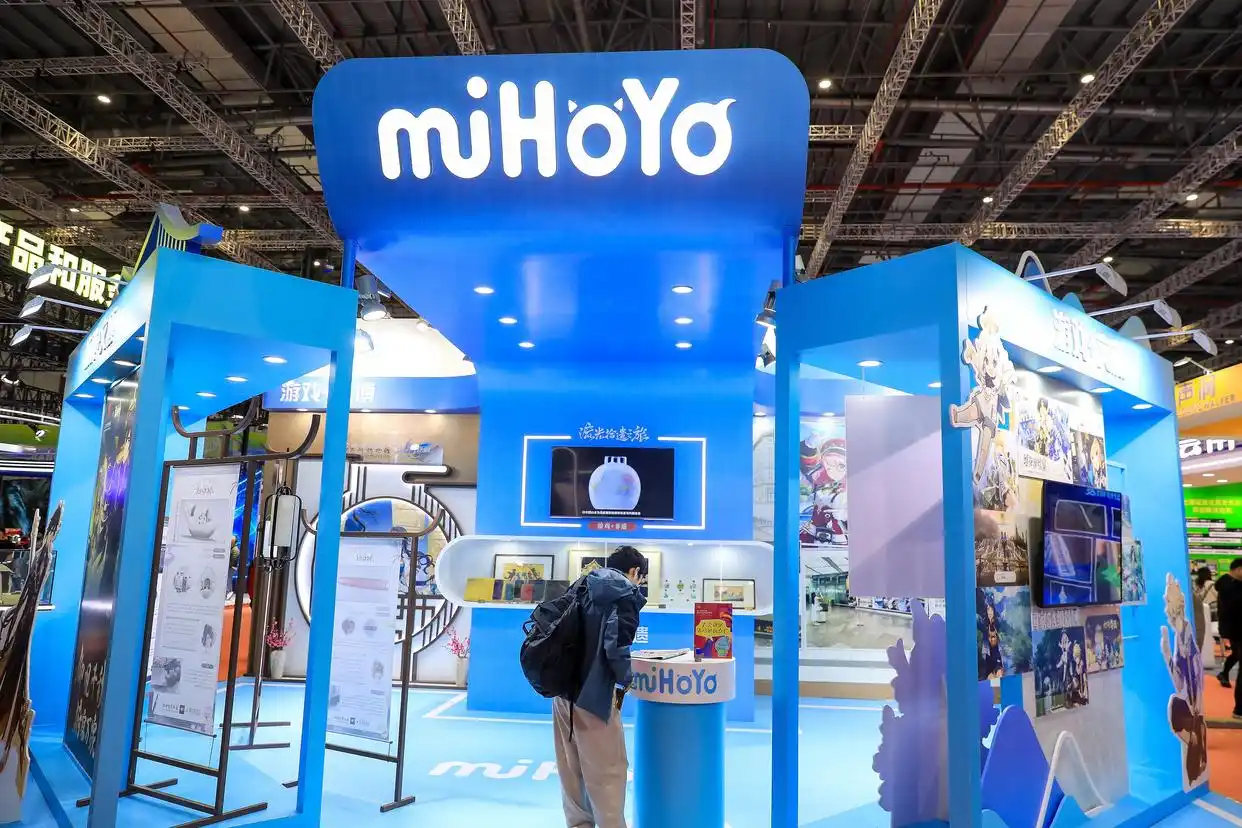
The maker of Genshin Impact is staking up to RMB 100 billion (US$13.9 billion) on artificial intelligence over three years — a capital commitment that repositions the privately held gaming giant as a technology infrastructure company competing directly in China's crowded large language model race.
At a closed-door AI technology forum and elite campus recruitment event held in Beijing on May 15, 2026, miHoYo co-founder Liu Wei, widely known in the industry as "Dawei Ge," disclosed the headline figure and outlined a full-stack, self-developed AI architecture as the company's core strategic axis. The event, restricted to top university talent and technical insiders, marked the most explicit public articulation yet of miHoYo's transformation ambitions. Crucially, the announcement coincides with a near-simultaneous operational pivot: the LLM team at Anuttacon — the Silicon Valley AI startup founded by miHoYo co-founder Cai Haoyu — has been recalled to China and consolidated into a centralized R&D offensive, with Cai himself relocating his primary research base back to the mainland.
The dual signal — a multi-billion-dollar capital pledge paired with a geographic consolidation of talent — suggests miHoYo is accelerating a strategic clock that most analysts had expected to run longer. For investors tracking China's AI compute and model ecosystem, the move injects a well-capitalized, technically credible new entrant into a field already contested by Baidu, ByteDance, Alibaba, and Zhipu AI.
Co-Founder Bets the House, Signals Tolerance for Total Loss
Liu Wei's framing of the RMB 100 billion (US$13.9 billion) commitment was deliberately unhedged. "Even if we ultimately fail and produce nothing, we accept that — consider it one grand fireworks display," he said at the May 15 event, according to a detailed account published by industry outlet Game Daily on May 16.
The rhetorical choice is strategically significant. By pre-emptively absorbing the possibility of failure into the public narrative, Liu is insulating the company's internal culture from short-term pressure while simultaneously signaling to the talent market — particularly elite graduate recruits — that miHoYo is operating on a decade-long horizon, not a quarterly earnings cycle.
miHoYo remains privately held, which means the RMB 100 billion figure carries no external accountability mechanism. However, the company's balance sheet has historically been robust: the global commercial success of Genshin Impact and Honkai: Star Rail since 2020 and 2023 respectively has generated substantial free cash flow, giving the founders genuine capacity to self-fund at this scale without dilutive external financing.
Anuttacon's Pivot Reveals Where the Real Bet Lies
The strategic reorientation at Anuttacon deserves particular scrutiny. The startup had originally targeted the development of "human-like" interactive systems combining LLMs, voice, and video — a thesis validated in part by the release of Whispers from the Star, an experimental AI dialogue game on Steam that achieved an 82% positive rating. However, player feedback consistently flagged the underlying AI as insufficiently intelligent to fully realize the game's design ambitions.
In response, Anuttacon has discontinued development on earlier multimodal interaction-model projects and redirected substantially all compute and core personnel toward general-purpose LLM and Agent construction. The decision to repatriate the LLM team to China rather than double down in Silicon Valley carries operational logic: proximity to miHoYo's existing infrastructure, data assets, and the regulatory environment governing Chinese user data all favor a domestic concentration of capability.
The move also reflects a broader pattern visible across Chinese AI developers in 2026: the marginal cost of hiring frontier AI talent in the San Francisco Bay Area has risen sharply, while China's domestic talent pool — particularly from institutions like Shanghai Jiao Tong University, which both Liu and Cai attended — has deepened considerably.
"No Star Researchers" Doctrine Challenges Conventional Hiring Logic
Liu's talent philosophy, articulated at the Beijing event, represents a direct challenge to the dominant hiring playbook at Chinese AI labs. He explicitly cautioned against recruiting what he termed "star researchers" — senior figures with strong individual reputations, defined scopes of responsibility, and high ego — arguing that such profiles create organizational friction that slows iteration velocity in the LLM era.
"Only a young, like-minded team has any real chance of achieving a leapfrog breakthrough," Liu said, according to Game Daily's account. The argument is technically grounded: in the pre-transformer era, specialized expertise in narrow subfields (computer vision, speech recognition, reinforcement learning) was a genuine competitive moat. In the current paradigm, where architectural decisions cascade across the entire stack and training runs must be debugged end-to-end, siloed ownership structures impose coordination costs that compound at scale.
miHoYo is pairing this flat-team doctrine with what Liu described as an "AI for AI, Model with Model" efficiency framework — using trained models to autonomously analyze training bottlenecks, write GPU kernel code, and identify software bugs, thereby creating a self-reinforcing R&D loop. The company frames this as a prerequisite for competing at the frontier: teams that cannot automate their own optimization pipeline will be outpaced by those that can.
Infrastructure at 10,000-GPU Scale Redefines the Capability Ceiling
On the technical architecture side, Liu's remarks at the May 15 event drew a sharp distinction between AI infrastructure as a commodity layer and as a primary determinant of model capability. At clusters of 10,000 GPUs or more, he argued, the co-design of communication, compute, and data pipelines directly constrains the maximum parameter scale a model can sustain and the context length it can sustain — making infrastructure engineering inseparable from model research.
This framing aligns with the operational reality facing any Chinese AI lab attempting frontier-scale pre-training in 2026, particularly under continuing U.S. export controls on advanced semiconductors. miHoYo has not disclosed its current GPU inventory or its primary chip supplier, but the emphasis on full-stack self-development suggests the company is investing in software-level optimizations — including FP8 mixed-precision training, which the company has already deployed in production for its Honkai: Star Rail AI assistant — to extract maximum performance from available hardware.
On pre-training data strategy, Liu articulated a 90/10 value split: data quality and curation account for 90 points of model performance; model architecture and training tricks deliver the remaining 5-point increment from 90 to 95. He also highlighted the engineering challenge of large-scale training stability, noting that token-level anomalies or operator bugs that are negligible on a single GPU become catastrophic failure modes when amplified across a 10,000-card cluster — a phenomenon commonly referred to as a "loss spike" that can corrupt an entire training run.
In-Game AI Deployments Provide Live Validation Data
miHoYo's AI ambitions are not purely prospective. The company has already deployed production AI systems in two active titles, providing real-world performance benchmarks that most pure-play AI labs lack.
In Honkai: Star Rail, the "Pamu Helper" AI assistant — currently in beta — enables natural language interaction for gameplay queries, character build advice, and in-character roleplay with the game's mascot. The system handles tens of millions of concurrent users, a stress test that has driven specific architectural choices: a multi-module coordination system, logic reasoning embedded directly in model weights to reduce latency, and a separated knowledge base / model capability architecture that allows independent optimization of each layer.
In Starry Valley, which entered its second beta test recently, an AI NPC system powers "Naro," a coffee shop character with persistent long-term memory, personalized emotional responses, and high-freedom dialogue. The system represents miHoYo's thesis that AI-driven NPCs can function as a primary competitive differentiator in game design — a claim that, if validated at commercial scale, would have significant implications for development cost structures across the broader games industry.
Impact Assessment: What the RMB 100 Billion Commitment Means for the Ecosystem
For China's AI talent market: A well-funded, technically credible new recruiter entering the market at scale will intensify competition for LLM engineers and ML infrastructure specialists, particularly recent graduates from top-tier Chinese universities. Compensation benchmarks set by miHoYo's recruitment drive will likely exert upward pressure on offers from incumbent labs.
For the GPU and compute supply chain: A 10,000-GPU-scale build-out by a single private company represents meaningful incremental demand in a market already constrained by export controls. Domestic chip suppliers including Huawei HiSilicon and Cambricon stand to benefit if miHoYo's procurement skews toward China-made alternatives.
For the games industry: If miHoYo's "Context × Permission" Agent framework — which requires models to read real-world context such as codebases and chat histories and execute modifications with genuine permissions — matures into a deployable product, it would represent a qualitative shift in how game AI systems are designed, moving from scripted behavior trees to genuinely adaptive agents. The two- to three-year timeline Liu cited for personalized, dynamically generated gameplay experiences would, if achieved, compress the development roadmap that most competitors have publicly projected.
For investors in listed Chinese gaming peers: Tencent and NetEase, both publicly traded, will face a privately held competitor with no earnings pressure and a declared willingness to absorb losses at scale. The strategic asymmetry — miHoYo can invest without quarterly disclosure obligations — is a structural advantage that listed peers cannot easily replicate.
Related Coverage: