
Momenta Nears Breakeven as Revenue Jumps 76% in H1, but AI Spending Accelerates
Momenta, China's top third-party urban NOA supplier, posted its first interim results as a listed company on Aug. 31, delivering 75.9% revenue growth and a near-breakeven adjusted loss — yet management explicitly ruled out a near-term profit target, signaling that the company's spending clock is running faster than its earnings clock.
The headline numbers drew immediate market attention: adjusted net loss for the six months ended June 30, 2026, compressed to RMB 14.1 million (US$1.96 million) from RMB 416 million a year earlier — a 96.6% contraction. Under IFRS, however, the statutory net loss ballooned to RMB 16.54 billion (US$2.30 billion), driven almost entirely by a RMB 16.31 billion non-cash fair-value loss on preferred shares that converted to ordinary shares upon listing. Investors largely looked through the accounting distortion; the operative question is whether the RMB 420 million gap between gross profit and total operating expenses can close before the next capital cycle.
On the earnings call, CEO and founder Cao Xudong and Senior Vice President Sun Huan declined to provide a profitability timeline, instead committing to accelerate R&D, expand GPU capacity from 20,000 to as many as 60,000 units, and push global commercialization in the second half — a posture that prioritizes market share over margin in a competitive window that management believes remains open.
Revenue Architecture Reveals a Dual-Speed Engine
Total first-half revenue reached RMB 1.602 billion (US$222.5 million), split between technology development services at RMB 995 million (US$138.2 million), up 81.5% and representing 62.1% of the top line, and software licensing at RMB 607 million (US$84.3 million), up 67.5% and accounting for the remaining 37.9%.
The two streams are sequentially linked: an OEM design win first generates development revenue during the engineering and validation phase; once the vehicle enters mass production and generates sales volume, it converts to per-unit software license fees. This pipeline dynamic means Momenta's 114 undelivered design wins — out of a cumulative 219 nominations — represent a substantial but time-uncertain revenue backlog. The speed at which those nominations convert, and at what unit delivery cost, will determine how quickly the operating deficit narrows.
Gross margin expanded 140 basis points year-over-year to 73.2%, as cost of revenue grew 67.0%, below the 75.9% revenue growth rate. Management attributed the improvement to platform reuse across vehicle programs — specifically its "three core tools": Momenta Adaptor, Momenta Framework, and Momenta Box — which allow engineering teams to amortize development investment across multiple OEM clients rather than rebuilding from scratch for each program.
Delivery Efficiency Gains Compress Per-Program Costs, But Scale Brings New Risks
The most operationally significant disclosure in the results was the collapse in per-vehicle-program delivery resources: from approximately 400 engineers over two years to "tens of engineers over roughly three months." In the first half of 2026 alone, Momenta delivered 37 vehicle models — nearly matching the approximately 40 delivered in all of 2025.
This efficiency gain is the structural argument for why more volume should eventually mean more margin. But the arithmetic is not automatic. Momenta now holds 114 undelivered nominations. Each nomination that enters production adds licensing revenue, but also incremental delivery cost. If model and toolchain reuse scales as management claims, the marginal cost per new program falls. If OEMs require bespoke customization, the cost base rises in lockstep with the order book.
Cash discipline improved alongside delivery metrics. Net operating cash outflow narrowed 46.8% year-over-year to RMB 381 million (US$52.9 million), and accounts receivable days were held to approximately 105 days — a meaningful signal for a company whose customers are automakers navigating their own cash cycles.
Price War Pressure Forces a Tiered Licensing Rethink
Momenta acknowledged that China's automotive price war is transmitting upstream into the supplier chain, and that per-vehicle average software license prices may be adjusted downward as production volumes scale. Management framed this as a volume-sharing arrangement — tiered pricing and bulk discounts — rather than a capitulation on pricing power.
The distinction matters for the margin model. If Momenta's cost per installed unit falls faster than the license price, gross margin is protected or expands. If OEM price pressure outpaces cost reduction, the 73.2% gross margin ceiling could erode even as unit volumes rise. Momenta stated it would not engage in "bottomless price cuts," citing the safety-critical nature of autonomous driving systems and brand risk to OEM partners.
A potential offset is the subscription monetization model under discussion with automakers. Management disclosed that on select cooperating vehicle models, premium ADAS option packages priced above RMB 10,000 (US$1,389) are achieving take rates above 80%. Momenta is exploring consumer-facing subscription revenue as a complement to one-time license fees, with L3-capable vehicles targeted for mass production in 2027. That revenue stream carries no current disclosure, but represents the most significant potential upside to the long-term unit economics.
R7 World Model Enters Production Vehicles, Raising the Stakes on GPU Investment
Momenta's R7 world model — the successor to the R6 that underpins current production deployments — is entering final delivery stages and will begin rolling out to production vehicles in Q3 2026. Scheduled recipients include Mercedes-Benz GLC and GLE models, BMW neue Klasse iX3, and multiple Volkswagen and Cadillac programs.
The commercial significance of R7 is partly technical and partly financial. Technically, it delivers 3x to 5x performance improvements over R6 across multiple scenarios, with internal tests showing up to 25x improvement in specific safety scenarios. Financially, R7 reuses R6's existing sensor and chip configurations, meaning OEMs absorb no additional hardware bill-of-materials cost — a critical selling point in a cost-sensitive market.
To train R7, Momenta drew on over 13 billion kilometers of real-world driving data accumulated from more than one million production vehicles, with over 100 million high-value "golden data" segments curated from that corpus. The company plans to expand its real-world data target to 24 billion kilometers by year-end, requiring the GPU expansion from 20,000 to up to 60,000 units. R&D expenditure in H1 already reached RMB 1.163 billion (US$161.5 million), up 18.6% year-over-year, representing 72.6% of revenue — a ratio that underscores why the company's cost structure more closely resembles an AI lab than a traditional automotive supplier.
Robotaxi and RoboVan Commercialization Accelerates, But Regulatory Timelines Remain the Binding Constraint
Momenta's L4 ambitions moved from roadmap to operational reality in H1 2026. The company holds autonomous driving test or operational licenses in Shanghai, Suzhou, Wuxi, and Shenzhen, and has established commercial partnerships with Uber (for Munich), Grab (Southeast Asia), Lumo and Mercedes-Benz (Abu Dhabi), and SAIC Mobility for Pudong, Shanghai.
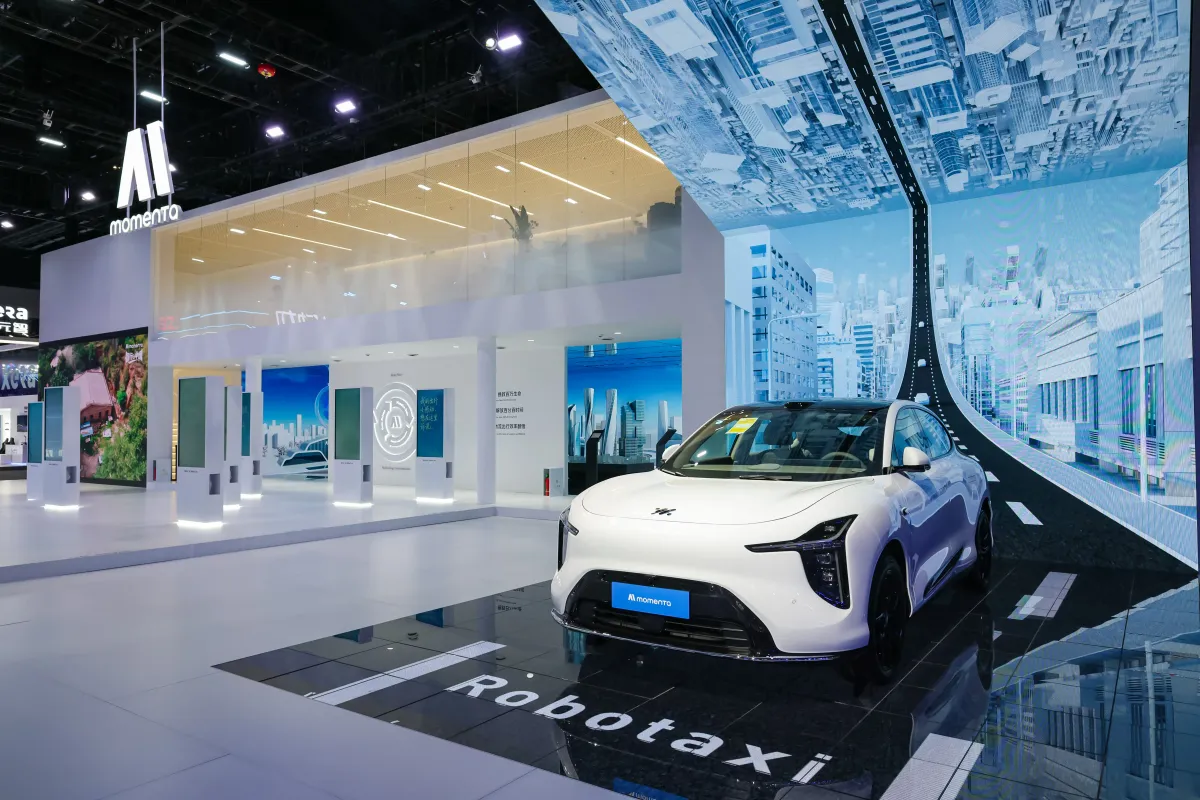
The first production-spec Robotaxi vehicle, equipped with R7, is scheduled for Q4 2026 deployment, with a fleet of "hundreds" of units targeted domestically and internationally by year-end. Momenta projects the global Robotaxi and RoboVan addressable market could exceed US$20 billion (approximately RMB 134.4 billion) within five years, based on a fleet of 1 million to 1.5 million vehicles each generating roughly US$10,000 in annual gross profit.
The binding constraint is regulatory, not technological. European urban NOA regulations are not expected to open further until 2027, and Momenta's overseas deployments currently generate development revenue rather than scalable license fees. The company's safety threshold — achieving a system at least 10 times safer than a human driver — sets a high internal bar before it will seek broad regulatory approval.
In parallel, Momenta's autonomous freight vehicle (RoboVan) began small-scale trial operations in Suzhou in H1 2026, targeting last-mile logistics including parcel relay and nighttime delivery. Scale deployment within Suzhou and expansion to additional cities is planned for H2 2026, with multi-city domestic and international rollout targeted for 2027.
Impact Assessment: The Structural Tension Every Investor Must Price
Momenta operates under two simultaneous cost regimes that pull in opposite directions. On the revenue side, it is embedded in the automotive supply chain, subject to OEM price pressure, tiered discounts, and model-cycle risk. On the cost side, it runs like an AI infrastructure company, with continuous expenditure on model training, GPU capacity, and engineering delivery that cannot be paused without falling behind on both technology and customer commitments.
The RMB 420 million gap between gross profit and total operating expenses in H1 2026 is the clearest expression of this tension. Closing it requires either revenue to outgrow operating costs — which the 76% top-line growth versus 18.6% R&D growth suggests is possible — or a deliberate decision to slow investment, which management has explicitly rejected.
The 114 pending design wins are the most immediate variable. At current delivery efficiency, Momenta could theoretically process them in under two years. The unit economics of that conversion — how much gross profit each program generates relative to its delivery cost — will determine whether Momenta's first full-year adjusted profit arrives in 2027 or slips further out.
Related Coverage:
Momenta Clears Europe's Safety Bar With XHEART-QNX Stack — Now It Needs Orders