
Morgan Stanley Warns West "Dismissive And Unaware" As China's $5k Humanoids March On
In a stark warning to Western investors, Morgan Stanley has laid bare the rapidly widening chasm between China and the United States in the race for humanoid robot supremacy. A comprehensive report released on August 26, 2025, paints a picture of a West that is "dismissive" and "completely unaware" of the ferocity and scale of China's state-backed push into physical AI. While Western observers may chuckle at viral videos of clumsy robots, Beijing is executing a familiar playbook that already secured its dominance in EVs, batteries, and drones—a playbook that now includes humanoid robots for as little as $5,000.
The report's timing is critical, coming just after Beijing hosted both the 2025 World Robot Conference (WRC) and the inaugural World Humanoid Robot Games (WHRG) in quick succession. For Morgan Stanley's analysts, these were not mere tech expos; they were a powerful declaration of national intent.
A National Priority, Not A Science Fair
While the WHRG produced its share of comical "fails"—robots falling over or crashing into each other—the bank urges investors to look beyond the current spectacle and focus on the rate of change, comparing it to the early, awkward days of autonomous vehicles. The real story, they argue, is the strategic signaling from the Chinese government.
"From our perspective, the largest takeaway from both the WRC and WHRG isn't so much the displays of capabilities, but the sole fact that the events happened - both in China's capital and in short succession of each other. In our informed opinion, China has made humanoid robots a national priority with current tactics mirroring those that led to the country becoming the global leader in EVs, drones, batteries, solar, and more."
This state-led mobilization is being supercharged by a torrent of capital. Government-backed funds totaling approximately RMB 195 billion (US$27 billion) have been established to fuel the industry's growth. The report notes that while Chinese investors show "immense excitement," their US and European counterparts remain dangerously complacent.
The $5,000 Humanoid Is Here
Perhaps the most disruptive development is the aggressive pricing strategy emerging from China. While Western developers like Tesla and Figure AI focus on perfecting a single, high-end general-purpose model, Chinese startups are flooding the market with a diverse range of robots at shockingly low prices.
The Unitree G1 is highly likely the most used humanoid globally given its low $16k starting price point (even used by US universities and startups for AI research). Now, within the past month, both Unitree and EngineAI have both unveiled new humanoids priced at slightly above $5k- the Unitree R1 and EngineAI SA02. These cheaper humanoids may not be the most advanced, but they are still 1) probes collecting the critical data needed to train the next generation of robot models; 2) some of the only few robots being truly mass produced today. Remember the key hurdles to AI robots at scale is data and manufacturing (interlinked).
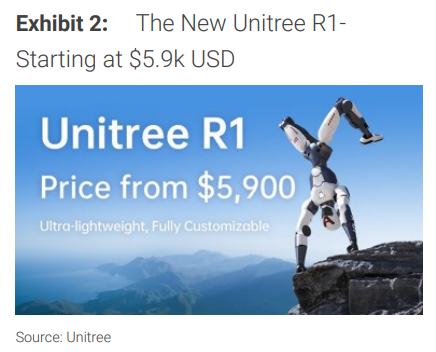
This strategy aims to solve the twin hurdles of AI robotics at scale: data and manufacturing. By deploying thousands of cheap robots, Chinese firms can rapidly accumulate real-world data and master mass production, creating a formidable, self-reinforcing cycle of improvement. This approach has already borne fruit, with the China Humanoid Value Chain stock index surging 16.3% month-to-date, dramatically outperforming the broader MSCI China index.
A Chasm In Public Opinion
The divergence extends beyond boardrooms and factory floors into the realm of public perception. A recent Morgan Stanley AlphaWise consumer survey reveals a staggering gap in sentiment between the two superpowers.
"For the question, 'Will humanoids have a positive overall impact on society?', [there was] a net positive 5% across US respondents compared to a net positive 61% across Chinese respondents... In our view, the wide gap in US/China optimism is materially influenced by the degree of media coverage and government support in each country."
When asked if humanoids will see wide-scale adoption in the next five years, 66% of Chinese consumers agreed, double the 32% in the US. This cultural acceptance creates fertile ground for talent development and rapid adoption, a critical advantage in what Morgan Stanley calls a "battle for human education and creativity."
As China fosters a culture celebrating physical sciences and mobilizes its industrial base, the report leaves professional investors with an unsettling question that demands their attention: "What is America's answer?" Given the current trajectory, the West may wake up to find the race is already over.