
NIO’s Battery Swapping Has Reached Scale. The Next Question Is Whether the Business Model Works
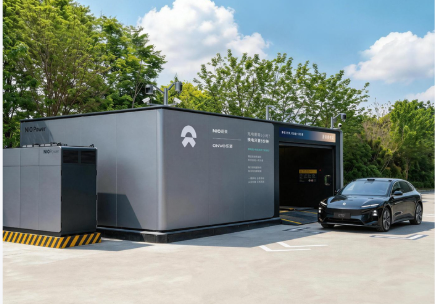
NIO’s battery swapping business has reached operational scale, surpassing 100 million cumulative battery swaps (company disclosure, February 2026).
As the network matures, the core investor question is shifting from "Is battery swapping popular?" to "Is battery swapping an economically efficient infrastructure model?"
Public financial results show NIO's profitability improving. In Q1 2026, the company reported:
- Vehicle gross margin: 18.8%
- Overall gross margin: 19.0%
- "Other sales" gross margin: 20.6%
However, these figures do not directly reveal whether battery swapping itself is profitable.
The key analytical challenge lies in asset ownership and cost allocation. Swap stations and battery packs are both capital-intensive assets, but they are not necessarily owned by the same entity.
This article examines:
- How station assets and battery assets are separated.
- How the BaaS model changes reported economics.
- What public disclosures reveal about Wuhan Weineng and battery financing.
- Which metrics investors should monitor going forward.
Sources: This article is based solely on publicly available information, including NIO's disclosures (such as the 2025 Form 20-F), Q1 2026 financial results cited in the source materials, and China Securities Journal / Cnstock reporting regarding Wuhan Weineng's RMB 550 million ABS issuance in 2025. No non-public information is included.
Why "Swap Gross Margin" Is the Wrong Starting Point
A common shortcut is to look at NIO's improving gross margin and conclude that battery swapping has become profitable. Public disclosures do not support that conclusion.
The company's reported 20.6% gross margin for "other sales" combines multiple businesses, including:
- Parts
- Aftersales services
- Energy services
- Auto finance
- Technology and R&D services
- Used-car business
- Other activities
Because battery swapping revenue and costs are not separately disclosed within this category, the figure cannot be interpreted as a standalone "swap gross margin."
As battery swapping increasingly resembles infrastructure, a more relevant question is whether recurring service cash flow can cover the full life-cycle cost of the underlying assets, including:
- Depreciation
- Financing costs
- Residual value risk
- Operating expenses
Two Heavy-Asset Categories: Stations vs. Batteries
Evaluating NIO's battery swapping economics requires separating two distinct pools of capital-intensive assets.
A. Swap Station Assets (Primarily Within NIO)
Station-related assets include:
- Swap station equipment
- Construction and installation
- Site leasing and land costs
- Operations and maintenance
- Depreciation of station assets
These investments are generally reflected within NIO's own financial statements as part of its charging and battery swapping infrastructure.
Key operating metrics include:
- Swaps per station
- Depreciation per swap
- Operating cost per swap
- Time required for new stations to reach mature utilization
B. Battery Pack Assets (Primarily Held by Wuhan Weineng)
Battery packs represent a different asset class with a different economic profile.
Major cost components include:
- Initial procurement cost
- Depreciation
- Residual or second-life value
- Financing and refinancing costs
- Asset utilization
Under the Battery-as-a-Service (BaaS) model:
- Customers purchase vehicles without batteries.
- Customers subscribe to battery usage through Wuhan Weineng.
- NIO sells battery packs to Wuhan Weineng.
- NIO China holds approximately 16.5% of Wuhan Weineng, giving it significant influence but not control.
Important performance indicators include:
- Subscription cash-flow stability
- Customer churn
- Delinquency rates
- Battery utilization
- Residual value realization
- Cost of capital
How BaaS Changes the Financial Picture
BaaS is more than a pricing strategy. It separates three businesses:
- Vehicle sales
- Energy service operations
- Battery ownership and financing
This structure creates two major analytical challenges.
1. Profit Is Distributed Across Multiple Entities
Even if the battery swapping ecosystem is economically attractive, profitability may be divided between:
- NIO
- Wuhan Weineng
- Other participating entities
As a result, NIO's reported earnings alone may not reflect the economics of the complete system.
2. Transfer Pricing Matters
The economics also depend on the pricing arrangements between NIO and Wuhan Weineng.
These include:
- Battery sales
- Service agreements
- Related-party transactions
Public source materials indicate that investors are increasingly looking for greater disclosure around battery pricing and cost allocation.
The Financing Signal: Wuhan Weineng's ABS Issuance
According to public reporting cited in the source materials, Wuhan Weineng issued RMB 550 million of green technology asset-backed securities (ABS) in 2025, with proceeds primarily supporting battery asset deployment.
This suggests that:
- Battery assets are increasingly financed using infrastructure-style capital-market instruments.
- Long-term sustainability depends on whether battery-generated cash flows are sufficiently stable to support securitized financing.
Securitization itself is not the central issue.
The more important questions are whether:
- Cash flows remain stable.
- Asset structures are transparent.
- Returns are sustainable over the long term.
Industry Cooperation Could Improve Utilization
The source materials also describe cooperation with automakers including:
- Changan
- Geely
- GAC
Areas of collaboration include:
- Technical standards
- Vehicle development
- Network construction
- Battery asset management
This matters because battery swapping infrastructure is characterized by:
- High fixed costs
- Strong dependence on utilization
If additional manufacturers introduce compatible vehicles:
- Station utilization could improve.
- Depreciation per swap could decline.
- Battery turnover could increase.
- Financing costs could fall as cash flows become more predictable.
Conversely, slow progress in standards, vehicle rollout, or operational integration could leave the network facing long payback periods and continued capital intensity.
What Investors Should Watch Next
Rather than focusing on headline gross margins, investors should monitor operational evidence across three dimensions.
Station Operations
- Swaps per station per day (preferably distribution rather than averages)
- Capital expenditure per station
- Payback assumptions
- Station depreciation
- Operating cost structure
- Expansion pace versus utilization ramp
Battery Assets (Wuhan Weineng / BaaS)
- Size of the battery asset pool
- Growth rate
- Subscription ARPU
- Customer churn
- Depreciation methodology
- Residual value realization
- Financing mix
- Cost of capital
- Refinancing sensitivity
- Transparency of related-party pricing
System-Level Economics
- Whether incremental swaps become cheaper over time
- How economics evolve as more brands join the network
- Which participants capture incremental profitability as utilization increases
What This Means for Different Stakeholders
Equity Investors
The central issue is no longer whether battery swapping is popular.
Instead, investors need to understand:
- Who bears depreciation
- Who assumes financing risk
- Who captures recurring service revenue
Credit and ABS Investors
The priority is the quality of the underlying asset pool, including:
- Subscription cash-flow performance
- Structural transparency
- Long-term asset quality
Partner Automakers
The value proposition depends on:
- Speed of standardization
- Access to the network
- Whether battery swapping delivers lower total cost of ownership than fast charging under real-world operating conditions
Consumers
BaaS reduces the upfront purchase price of a vehicle while shortening charging time.
Its long-term attractiveness, however, depends on:
- Stable subscription pricing
- Broad network coverage
- Continued service quality
Conclusion
NIO's battery swapping network has entered the infrastructure stage.
At this point, the decisive question is no longer a single gross margin figure.
The more important questions are:
- Who owns the heavy assets?
- Who bears depreciation and residual value risk?
- How are returns distributed between NIO and Wuhan Weineng?
Greater transparency around utilization, asset turnover, and inter-entity economics would make the battery swapping business easier for investors to evaluate—and easier to underwrite on its own economic merits.