
NIO's Five-Year Survival Battle Amid China's EV Shakeout
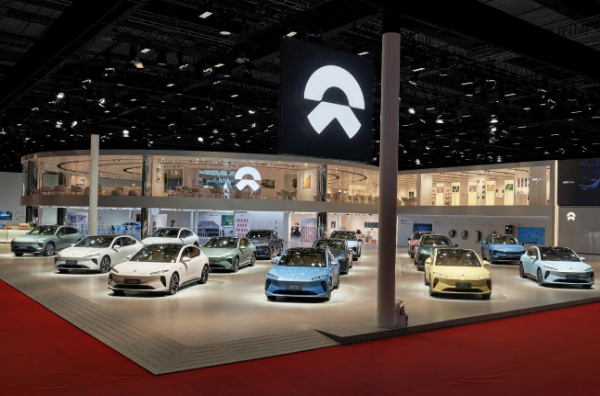
NIO Inc. founder William Li delivered a stark warning at the 2026 Beijing Auto Show: Chinese electric vehicle makers face a brutal consolidation window of just five years, after which the industry's winners and losers will be determined.
"Five years from now, the industry landscape will be clear," Li told reporters following NIO's multi-brand showcase. "I hope NIO will still be on this stage." The comment underscores mounting pressure on EV startups as China's once-booming market shows signs of saturation. First-quarter new energy vehicle sales plunged 24% year-on-year, according to the China Passenger Car Association, while industry executives openly acknowledge the market may contract in 2026 for the first time.
NIO's response to the crisis was visible even in its booth strategy. The company merged exhibition spaces for its three brands—NIO, ONVO, and Firefly—into a single supersized pavilion, which staff described as more "cost-effective" than separate displays. The move reflects CEO Li's January pledge to achieve full-year profitability through relentless cost discipline, even as competition forces unprecedented marketing spend.
Market Saturation Triggers Industry 'Convergence'
Li characterized the current phase as an industry "convergence period," marked by homogenizing products and thinning margins. "The window is maybe five years—we're already in the finals," he said, drawing parallels to China's smartphone market collapse a decade earlier. However, he argued the automotive shakeout will unfold more gradually due to longer purchase cycles and higher capital intensity.
NIO President Qin Lihong reinforced the urgency, noting that automakers flooded organizers with requests for additional booth space ahead of the show. "This is humanity's largest-ever auto exhibition," Qin said, "but it may also mark the peak before decline." Deep Blue Automotive CEO Deng Chenghao separately warned that domestic sales growth could flip negative this year, forcing brands to "accept this reality."
The consolidation threat is forcing faster product cycles. Li admitted that NIO's front trunk technology—touted as having a two-to-three-year lead when the L90 SUV launched—now holds barely a one-year advantage. Rival automakers have compressed development timelines, with "large six-seat SUVs" flooding the market in late 2025 and "large five-seat SUVs" arriving en masse in early 2026.
Supply Chain Muscle Becomes Deciding Factor
Li believes "systemic capability" will separate survivors from casualties. NIO's battery-swap network and proprietary Shenji NX9031 chip represent the type of vertical integration he sees as essential. Last month, the company's pure-electric large three-row SUVs (ES8 and L90) outsold extended-range rivals 2.5:1, validating Li's technology bets.
Yet even supply chain leadership is under assault. Qin highlighted Contemporary Amperex Technology Co. Ltd. (CATL) and Horizon Robotics as stealing the show with major press conferences—a scenario "impossible in the internal combustion era." The shift reflects how battery and semiconductor suppliers now command greater industry influence than automakers themselves, fundamentally rewriting value chain economics.
The upcoming ONVO L80—scheduled for pre-sale launch on April 28—will test NIO's execution. The five-seat SUV targets the same blue-ocean segment as a refreshed ES8 variant, though the models are positioned RMB 100,000+ ($13,900) apart to avoid cannibalization. CTO William Fei promised "unlimited production capacity," while Li teased "imaginative" interior packaging that delivers "qualitative change" over quantitative improvements.
Profitability Push Collides With Arms Race
NIO's austerity drive faces an inherent contradiction: cutting costs while competitors escalate R&D spending. Li acknowledged that maintaining technological edges now requires fighting over "three-to-five percentage points" of market share. "The gap between leaders and eliminated players is just that thin," he wrote in an internal memo earlier this year.
The company's consolidated booth strategy exemplifies this tension. By combining NIO, ONVO, and Firefly into one pavilion, management maximized "bang for buck" in visibility while trimming rental costs. Staff overheard discussing the layout praised its "cost-effectiveness"—a far cry from the cash-burning growth era when EV startups competed for the flashiest displays.
Whether belt-tightening can coexist with the innovation required to survive Li's five-year "finals" remains an open question. Qin argued that China's EV supply chain—from CATL's battery breakthroughs to Horizon's AI chips—has reached a "leap moment" of global competitiveness. "Years from now, people will remember March-April 2026 as inseparable from China becoming an automotive powerhouse," he predicted.
For now, NIO's bet is that its charging infrastructure (over 2,000 swap stations nationwide), proprietary silicon, and brand portfolio provide enough differentiation to outlast weaker competitors. Li's five-year timeline suggests he expects half or more of today's 30+ Chinese EV brands to disappear by 2031. The question is whether NIO's cost discipline and technology lead can keep it off that casualty list.
Related Coverage:
NIO’s First Profit Is a Milestone—But the Strategy Behind It Matters More