
NIO’s H1 Revenue Jumps 86% as Investors Question the Cost of Profitability
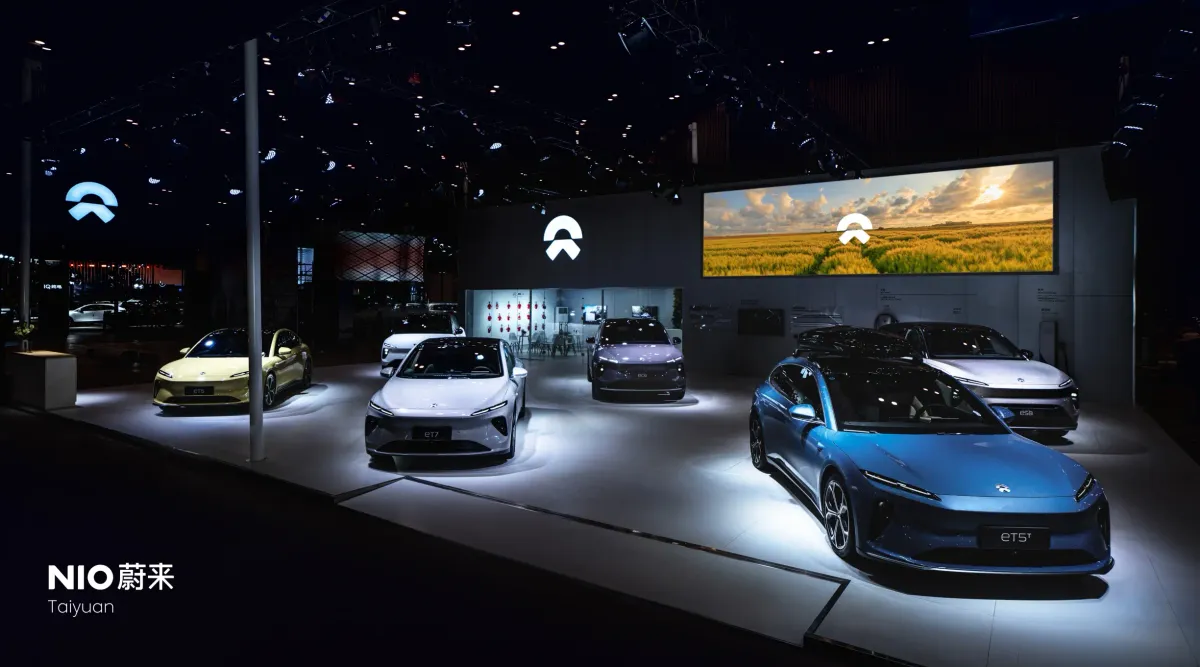
Shares of the Chinese EV maker tumbled to a 52-week low on earnings day, exposing a market verdict that strong headline numbers alone cannot paper over eroding R&D investment, rising per-unit costs, and an unproven three-brand expansion.
NIO reported first-half 2026 results on September 1 that superficially read as a breakthrough: total revenue of approximately RMB 57.6 billion (US$8.0 billion), up 86% year-on-year, gross margin expanding more than 8 percentage points, and net losses narrowing nearly 90% to reach adjusted profitability. Yet Hong Kong-listed shares closed at HK$31.06 on the day of the release — down 6.39%, with an intraday low of HK$29.44 that marked a fresh 52-week trough. U.S.-listed ADRs followed suit, settling near US$4.06, off approximately 4%. The divergence between reported numbers and market reaction signals that investors are pricing in structural risks that the income statement does not yet fully reflect.
The core concern is straightforward: NIO's profitability improvement is being manufactured primarily through expense compression rather than genuine operating leverage. Research and development spending fell 34.9% year-on-year in the first half to RMB 4.03 billion (US$560 million), with the R&D-to-revenue ratio collapsing from 19.9% to 7.0%. Meanwhile, selling, general and administrative expenses of RMB 7.92 billion (US$1.1 billion) ran at nearly twice the R&D budget — a ratio unmatched among the "NIO-Xpeng-Li Auto" peer group. That asymmetry, combined with a per-vehicle cost trajectory that management itself acknowledges will worsen in the second half, frames a sustainability question that the capital market is unwilling to defer.
Revenue Surges as Three-Brand Matrix Delivers Uneven Volume
NIO delivered 191,123 vehicles in H1 2026, up 67% year-on-year, spread across its three distinct brand tiers. The flagship NIO brand (targeting the RMB 400,000–600,000 segment) contributed 119,488 units, a 60.5% increase, and remains the financial backbone of the group, accounting for roughly 56.6% of consolidated revenue. The ES9 — the brand's new halo SUV priced at an average transaction value of RMB 556,700 (US$77,320) — delivered over 10,000 units within its first 30 days from late May and held a three-to-four month waitlist as of August. The ES8, now 11 months into its lifecycle, crossed 140,000 cumulative deliveries and is tracking toward 150,000 by September. CEO Li Bin cited China Automobile Dealers Association insurance data showing NIO brand average transaction price reached RMB 406,000 (US$56,400) in Q2 — surpassing Mercedes-Benz, BMW, and Audi — and climbed further to above RMB 430,000 in July.
Onvo, the mid-market family brand targeting RMB 200,000–300,000, delivered 42,463 units in H1, a 33.3% gain, with cumulative L60 deliveries exceeding 100,000 and L90 approaching 60,000 since launch. However, the brand's trajectory is volatile: L60 monthly sales swung from above 10,000 in December 2025 to below 3,000 in May 2026. More critically, the L90 underwent a significant mid-cycle refresh just eight months after launch — adding LiDAR and the in-house Shenqi chip — triggering a tenfold surge in owner complaints as early adopters faced immediate depreciation. Li Bin acknowledged the brand's awareness currently equates to "NIO circa late 2019 or early 2020," a candid admission of the brand-building gap that remains. In the RMB 200,000–300,000 segment, Onvo faces dual pressure: Tesla Model Y's pricing discipline from below and Li Auto i6's surgical positioning, with the latter sustaining monthly sales above 20,000 units.
Firefly, the entry-premium compact brand at RMB 100,000–150,000, delivered 29,172 units, up 271.9%, maintaining 14–15 consecutive months of segment-leading market share. The brand's addressable market, however, is constrained: at this price point, consumers can choose larger A-segment sedans, and Firefly's highway range efficiency and NVH performance trail class benchmarks. The brand-premium gap versus MINI (宝马MINI) remains meaningful.
Gross Margin Holds, but Cost Arithmetic Turns Hostile
CFO Stanley Qu disclosed that per-vehicle average cost in Q2 was already approximately RMB 14,000 (US$1,944) higher than at end-2025, driven by memory chip, battery, and commodity inflation. Management guided that costs will rise a further RMB 2,000–3,000 (US$278–417) in H2, bringing the full-year increment to RMB 16,000–17,000 (US$2,222–2,361) versus the 2025 year-end baseline. NIO has explicitly ruled out price reductions to defend volume — a strategically defensible position given its premium positioning — but the commitment compresses the path to margin expansion.
Q2 vehicle gross margin held at 18.5%, consistent with Q1's 17.6% and sharply above the prior-year 12.2%. Consolidated gross margin was 18.4% in Q2, a 60-basis-point sequential decline from Q1's 16.3% on a blended basis. Management guided vehicle gross margin to remain near 18.5% in Q3 and Q4, supported by ES8 and ES9 — both carrying margins above 20% — and by ongoing supply-chain renegotiations. Whether that target holds as the cost headwind compounds through Q4 will be the single most-watched metric for the remainder of the year.
Non-GAAP operating profit reached RMB 200 million (US$27.8 million) in Q2, marking three consecutive quarters of adjusted operating profitability. GAAP net loss was RMB 500 million (US$69.4 million), down 89.4% year-on-year but up 59% sequentially. Adjusted net income was RMB 26.1 million (US$3.6 million). Cash and liquid assets ended Q2 at RMB 56.7 billion (US$7.875 billion), providing a meaningful buffer.
R&D Compression Raises Long-Term Competitiveness Questions
The most contested element of NIO's H1 report is its research and development trajectory. At RMB 4.03 billion for the half, NIO's R&D spend was less than 70% of Xpeng's RMB 5.821 billion and below Li Auto's (理想汽车) RMB 5.498 billion. More structurally concerning, NIO is the only member of the three-way peer group that is cutting R&D in absolute terms while the others are expanding. The R&D expense ratio of 7.0% compares to Xpeng's 17.8% and Li Auto's 11.3%.
Management's counter-narrative centers on efficiency gains: NIO focuses exclusively on battery-electric architecture, avoiding the resource dilution of developing parallel EREV or PHEV platforms; an internal CPU (Cost per Unit) measurement system has improved per-engineer productivity; and quarterly R&D spend is expected to stabilize at approximately RMB 2.5 billion on a non-GAAP basis. Li Bin also noted that the company is supporting the spin-off of an embodied AI startup led by NIO's head of intelligent driving, Ren Shaoqing, in which NIO holds a strategic stake — a structure designed to track physical AI development and attract talent without burdening NIO's own P&L.
Nevertheless, investment bank CMB International — which maintained a Hold rating in a note dated August 28 — expressed skepticism about the sustainability of the current model. The bank projected a GAAP net loss of approximately RMB 7.8 billion (US$1.083 billion) for full-year 2026 even under a 500,000-unit scenario, and questioned whether Onvo's L90 could realistically achieve a 20% vehicle gross margin target. The broader concern articulated by multiple sell-side analysts is that a profit model anchored to two high-margin SKUs — the ES8 and ES9 — is inherently fragile: any intensification of competition in the RMB 400,000-plus segment would force either margin-dilutive promotions or accelerated new model spending, both of which undermine the current financial construct.
Delivery Cadence Must Accelerate Sharply to Hit Full-Year Targets
NIO's full-year 2026 delivery guidance of 456,000–489,000 units implies a significant back-half loading. H1 deliveries of 191,123 units represent only 39%–42% of the midpoint range. Q3 guidance of 108,000–111,000 units is consistent with July and August actuals of approximately 35,900 and 35,800 units respectively, suggesting no material acceleration in the current quarter. Reaching the annual target therefore requires Q4 monthly deliveries averaging above 44,000 units — a level NIO has never sustained. Li Bin set a Q4 monthly target of "above 40,000 units," implying the upper end of the guidance range may be aspirational.
The competitive landscape adds context. Leapmotor led the new-energy-vehicle startup cohort with 356,500 H1 deliveries, though on a value-for-money positioning that is structurally distinct from NIO's premium strategy. Zeekr delivered 178,400 units in H1, up 97%, the only major new-energy startup to complete more than half its annual target by midyear. Li Auto delivered 193,500 units, a 5.1% decline as extended-range electric vehicle demand normalizes. Xpeng delivered 166,000 units, down 15.8%, in a product-cycle trough. NIO's brand premium in the above-RMB-300,000 segment is well-established, but the volume math for the full year depends heavily on Onvo recovering its momentum in a segment where competition is most acute.
Battery-Swap Network Pivots Toward Monetization
NIO's battery-swap infrastructure — a capital-intensive differentiator that has historically weighed on free cash flow — is beginning to generate a commercial return. The company now operates 4,123 swap stations globally, with the fifth-generation station, launched August 7, capable of serving all three brands across vehicle sizes from compact to full-size SUV. Hardware cost per fifth-generation station (excluding batteries and high-voltage supply infrastructure) is approximately RMB 1.4 million (US$194,444), down roughly RMB 100,000 from the fourth generation. Swap success rates have improved approximately 50% year-on-year.
Critically, NIO has shifted the capital burden for new station construction to its "Power-Up Partners" program, which now includes more than 40 state-owned enterprises and financial institutions across 25 provinces. Management confirmed that all new swap infrastructure in 2026 will be funded by partners rather than NIO's balance sheet — a structural change that eliminates a significant source of capital expenditure drag. Full-year capex guidance of RMB 6–7 billion (US$833 million–US$972 million) is expected to be roughly flat with 2025. The company is also exploring swap station deployment as infrastructure for Robotaxi operators, with access fees under negotiation.
Intelligent driving subscriptions represent an emerging revenue line. Approximately 58% of ET7 users on the third-generation NX9031 chip platform used the autonomous driving feature for more than half of their trips. Secondary-market owners and users whose five-year free subscription has lapsed pay RMB 380 per month; penetration in this cohort is approximately 20%, generating tens of millions of renminbi annually — modest today but scalable as the installed base ages.
Three Hurdles Define the H2 Narrative
Investors evaluating NIO's second-half trajectory face three discrete risk factors that the headline numbers obscure.
First, cost inflation is not transitory. Per-vehicle cost is now structurally RMB 16,000–17,000 higher than at end-2025. Memory chip and battery prices show no near-term reversal. Maintaining an 18.5% vehicle gross margin under this pressure requires either product-mix enrichment — sustained ES8 and ES9 dominance — or supply-chain offsets that management has yet to quantify in detail.
Second, the R&D gap compounds over time. A 7.0% R&D intensity ratio may be defensible in the near term given NIO's EV-only focus, but the company's 2027 pipeline — new 5-series and 6-series NIO models, a major Onvo strategic product, and Firefly special editions — requires design and validation spending that the current quarterly RMB 2.5 billion envelope may struggle to accommodate without a reset.
Third, three-brand operating efficiency remains unproven at scale. SG&A as a percentage of revenue was 13.7% in H1, above Li Auto's 8.9% and Leapmotor's approximately 10.4%. The "Sky Store" co-location strategy — housing NIO, Onvo, and Firefly under one roof — is designed to improve asset utilization, but execution risk is material as the network expands into lower-tier cities where brand awareness for Onvo and Firefly is weakest.
The capital market's verdict on September 1 was unambiguous: a near-90% loss reduction and RMB 56.7 billion in liquidity are insufficient to offset concerns about whether NIO's improved financials reflect a structural inflection or a cost-optimization window that closes once the competitive environment in the RMB 400,000-plus segment intensifies. The answer will likely be determined by Q4 delivery volumes, H2 gross margin resilience, and whether Onvo can rebuild order momentum without sacrificing the pricing discipline that Li Bin has publicly committed to maintain.
Related Coverage: