
Pony.ai Outlines Path to Profitability with Global Fleet Expansion Targets
Pony.ai has achieved positive unit economics for its robotaxi fleet in Guangzhou, proving the commercial viability of autonomous ride-hailing services. The company is now pivoting toward an "asset-light" business model to accelerate its global footprint, leveraging a validated cost structure to compete with international rivals.
Lawrence Wang, co-founder and CFO of the autonomous driving technology firm, announced that the company aims to expand its fleet from approximately 1,000 vehicles at the end of 2024 to at least 3,000 by the end of 2025. This aggressive scaling is underpinned by the company's "Gen 7" vehicle platform, which has successfully balanced revenue against operating costs and hardware depreciation in key markets.
The strategic shift marks a transition from technical verification to commercial scaling, with a long-term target of managing a fleet of 100,000 vehicles by 2030. Wang projects that reaching this scale will allow the company to achieve overall corporate break-even. The roadmap relies heavily on significant cost advantages over U.S. competitors, positioning the Chinese firm to capture market share in regions including the Middle East and Europe.
This development highlights the intensifying bifurcation of the global autonomous driving sector into U.S. and China-led camps. By establishing a profitable operating loop, Pony.ai seeks to secure a leading position in the industry’s "marathon," emphasizing that financial sustainability is now as critical as technical safety in the race for mass adoption.
Achieving Positive Unit Economics
The core of Pony.ai’s recent financial progress lies in the dramatic reduction of hardware costs and the optimization of operational efficiency. In Guangzhou, the company’s robotaxis now generate an average daily revenue of RMB 299 yuan (US$41), which covers the costs of hardware depreciation, safety drivers, and insurance, resulting in a positive gross profit per vehicle.
Cost reductions were driven by the introduction of the company’s seventh-generation autonomous driving kit. Developed in collaboration with automakers such as Toyota Motor, GAC, and BAIC, the new system reduced the bill of materials (BOM) cost by 70% compared to the previous generation. Specifically, computing unit costs fell by 80% and LiDAR costs by 68%. The company replaced traditional industrial PCs with four automotive-grade Nvidia Orin X system-on-chips, marking an industry-first scale application that lowered costs while improving reliability.
Operational efficiency has also improved significantly. The ratio of remote assistance staff to vehicles has moved from 1:20 to a projected 1:30 by year-end. Furthermore, commercial insurance costs for the robotaxis are at least 50% lower than those for traditional taxis. These efficiencies, combined with a high service usage rate of 23 orders per day in Guangzhou, have created a reproducible profitability model.
The Asset-Light Pivot
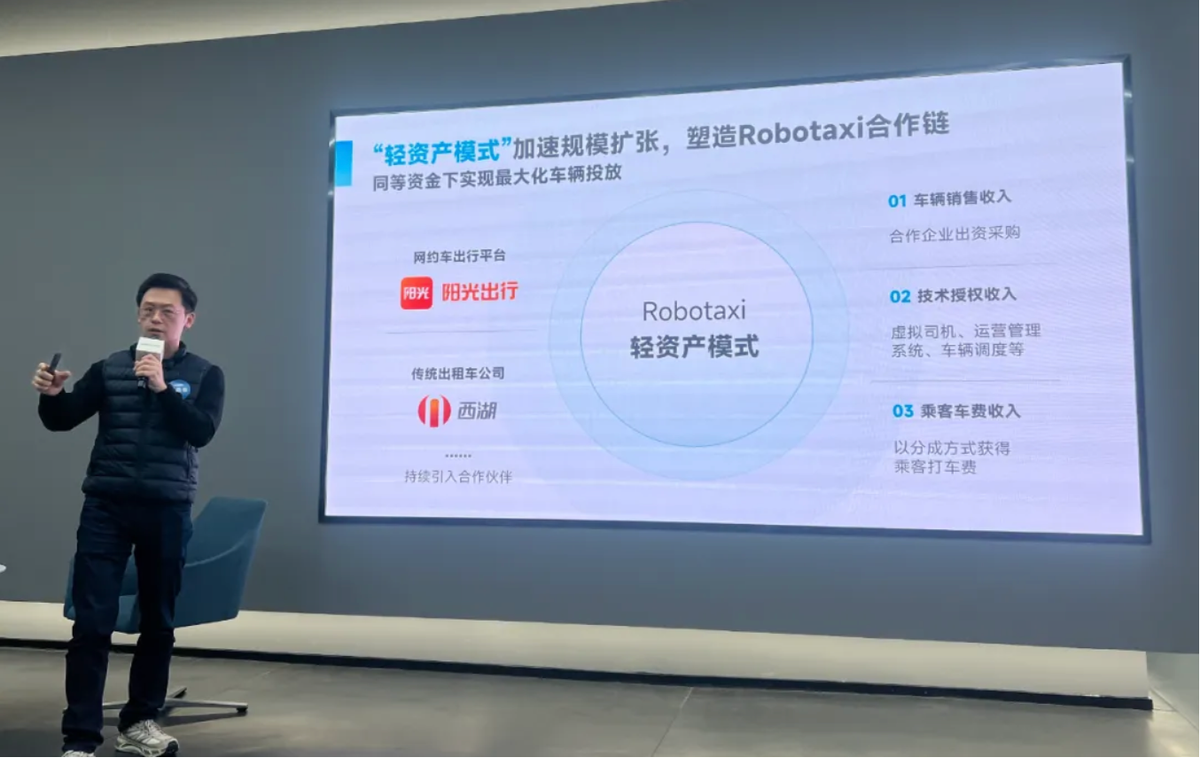
With a proven profit model, Pony.ai is restructuring its expansion strategy to favor an "asset-light" approach. Rather than acting as a heavy-asset operator owning thousands of vehicles, the company will transition into a technology and business model enabler.
Under this new value chain, automakers produce the vehicles, asset companies or fleet operators hold the inventory, and ride-hailing platforms manage dispatching. Pony.ai’s role focuses on providing the "AI Driver" capabilities. The company’s revenue streams will diversify to include vehicle sales to operators, technology licensing fees, and revenue sharing from ride orders. Partnerships have already been established with entities like Sunshine Mobility and Shenzhen Xihu to integrate into this ecosystem.
This model allows for rapid scaling without the heavy capital expenditure associated with fleet ownership. "The goal of our sample operation in Guangzhou was to prove to partners that the workflow is viable and profitable," Wang stated. The projected growth to 3,000 vehicles in 2025 takes into account production capacity, market capacity in new domestic and overseas cities, and purchase commitments from asset-light partners.
Global Competition and 2030 Outlook
The global robotaxi market is currently defined by a dual-pole competition between the U.S. and China. While U.S. firms like Waymo and Tesla Inc. dominate their home market, Wang argues that Chinese companies hold a distinct competitive edge in international markets due to cost structures.
Wang noted that vehicles deployed by Waymo—collaborating with brands like Zeekr and Hyundai—cost four to five times more than Pony.ai’s seventh-generation vehicles. This cost disparity provides a significant advantage for Chinese firms expanding into neutral territories. Pony.ai has already initiated partnerships in Qatar with Mowasalat, in Luxembourg with Emile Weber, and in Singapore with ComfortDelGro Corp.
Despite the optimism, Wang acknowledged that the industry remains a long-term challenge involving safety, policy, and manufacturing capabilities. He cited the operational setbacks faced by GM’s Cruise as a cautionary tale against unbalanced expansion. However, the company remains confident in its trajectory, forecasting that once robotaxis capture 5% to 10% of China’s mobility market, the network effect will be substantial. The ultimate target is a fleet of 100,000 vehicles by 2030, a scale at which the company expects to achieve full profitability.