
The DJI Way: Frank Wang's Philosophy, Strategy, and the Drone Giant's Path to Dominance
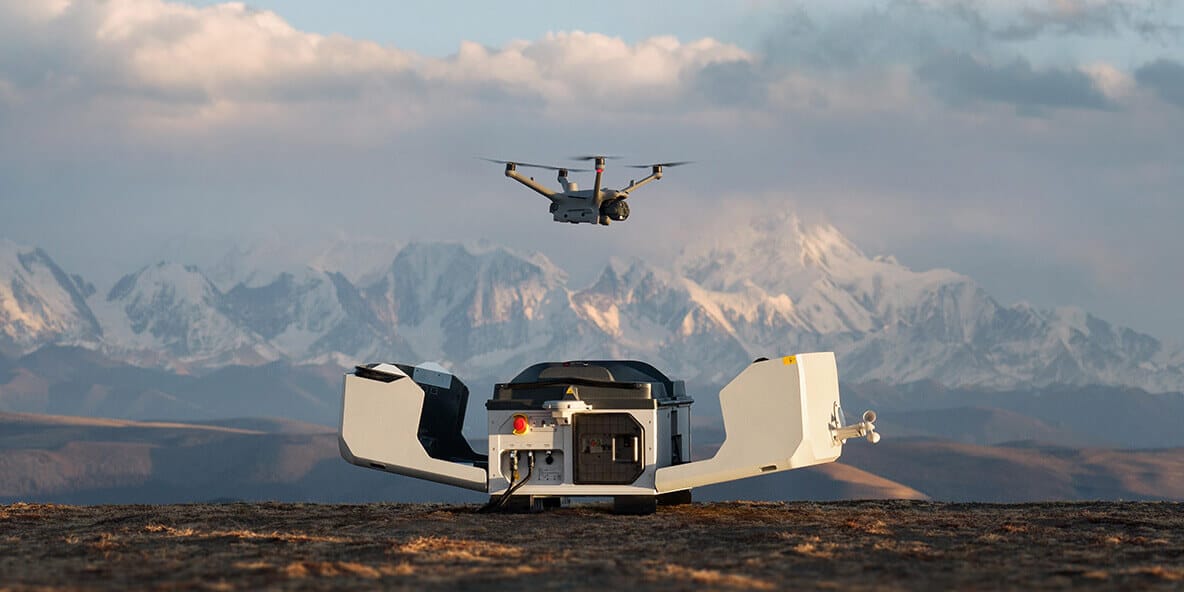
The following is a full translation of an in-depth report published on August 28, 2025, by LatePost, a prominent Chinese-language media outlet focusing on business and technology. The report provides a comprehensive analysis of the world's leading drone manufacturer, SZ DJI Technology Co., Ltd., from its founding to its current strategic crossroads.
This report is noteworthy for its rare look into the operational and financial details of one of China's most successful, yet famously private, technology firms. It examines the foundational principles of its enigmatic founder, Frank Wang, details its aggressive competitive tactics that led to market dominance, and explores its strategic expansion into new sectors. For a global audience, this piece offers crucial insights into how DJI has maintained over 70% of the consumer drone market for a decade, even amidst significant international political and economic pressures.
The DJI Way: Frank Wang's Core Principles, Methodology, Competitive Strategy, Expansion, and Boundaries
Original by the LatePost Team, LatePost, August 28, 2025, 14:06, Beijing
A net profit margin approaching 40%, nearly double that of Apple, and surpassing Hermès and Pop Mart.
By He Qianming
In May 2025, DJI released its Mavic 4 Pro drone, just as the United States imposed additional tariffs on Chinese goods. For the first time, DJI did not debut a new aircraft in the US. Nevertheless, some retailers managed to procure it through special channels, pricing it 30% higher than in Canada, and it sold out rapidly. This is just one illustration of DJI's dominance in the drone market.
We have learned that last year, DJI's revenue surpassed RMB 50 billion yuan (US$6.94 billion), with a net profit margin approaching 40%—nearly double that of Apple and exceeding that of both Hermès and Pop Mart International Group Ltd.
Over the past decade, DJI's market share in consumer drones has never dipped below 70%. During this period, DJI has expanded into handheld gimbals, gimbal cameras, action cameras, and robotic vacuums. Its biggest breakthrough has been the handheld gimbal camera, the Pocket 3, with projected sales for 2025 expected to exceed ten million units. The profit from each unit is equivalent to that of a dozen domestically produced Android phones.
According to our sources, several Chinese mobile phone companies have already assembled teams to develop products to compete with the Pocket 3.
What is exceptionally rare is that DJI achieved all this without imitation. Before DJI launched the Pocket, there was no product with a similar form factor on the market. When DJI entered the action camera market, a category defined by GoPro for over a decade, it consistently sought innovation, such as adding a front-facing screen and implementing a magnetic modular design.
Today, its competitors are heavily reliant on talent cultivated by DJI. For instance, when DJI entered the portable power station market in 2023, one of its rivals, EcoFlow , was founded by a former head of DJI's battery R&D and is known as the "Little DJI of Xili." In August 2025, when DJI launched its robotic vacuum, competitors like Narwal had long been recruiting former DJI employees near DJI's headquarters.
Insta360 , which went public on the STAR Market in June with a market capitalization exceeding one hundred billion yuan, recently released a drone product to compete with DJI. Its founder, Liu Jingkang, views DJI as a "demonic coach," stating, "DJI is far, far, far, far, far more powerful than it appears and than most people understand."
Starting with the formative years of DJI founder Frank Wang, we attempt to answer:
How did DJI sweep away its competitors in the drone industry to achieve its current market position? What are DJI's core principles and methodology? As DJI expands beyond drones, do these methodologies remain effective?
Dropping Out of a Top University in His Junior Year, a "Desperate" Grade on His Second Undergraduate Thesis
Frank Wang was born in 1980 in Hangzhou to a teacher mother and an engineer father. For that era, his family was well-off. A few years after the Reform and Opening-Up, his parents went into business in Shenzhen, and Wang moved there to live. When Wang was 10, around the third grade, his parents were too busy with work and sent him back to Hangzhou to live with a teacher's family, making him a "left-behind child."
In a 2015 speech to freshmen at Shenzhen University, Wang said he was fortunate to have read a comic book about helicopters in elementary school. He then became obsessed with the sky, spending most of his time on books related to model aircraft.
The comic book that inspired Wang was the eighth volume in the first series of Grandpa Brainstorm. The section on helicopters was only two and a half pages, less than 500 words, primarily describing helicopters used for seeding, fertilizing, and pesticide spraying; laying power cables; and performing maritime reconnaissance, fish spotting, and military tasks.

This was the starting point of Wang's dream. His parents catered to his interest, buying him model aircraft literature and using his passion to motivate him to study hard in middle school: if he got high scores, they would buy him a remote-controlled helicopter.
Wang accepted this pact, and his grades improved. His parents spent over RMB 10,000 yuan to buy him a remote-controlled helicopter from Hong Kong. At the time, over ten thousand yuan was equivalent to the average annual income of two urban residents.
The remote-controlled helicopter was quickly broken. Wang later said he still has a scar on his elbow from it. His parents didn't restrict him from playing with helicopters due to the injury; instead, they gave him the manufacturer's phone number and had him independently arrange for parts to be sent for repairs.
Perhaps it was this encouragement that led Wang to enroll in the electronics department at East China Normal University. In his junior year at this "Project 985" university, Wang chose to drop out. He didn't start a business but applied to top global universities like Stanford and MIT. Unsurprisingly, all his applications were rejected.
This extraordinary decision revealed a stubborn side to Wang's personality. He was unwilling to wait another year to apply for graduate studies abroad. Some reports mention that Wang even considered returning to his final year of high school to retake the college entrance exam.
Wang was lucky. He caught the opportunity when The Hong Kong University of Science and Technology (HKUST) began independent admissions in mainland China, which did not require a joint examination. Submitting materials and attending an interview could lead to an undergraduate spot. He impressed HKUST. The fruits of his studies at HKUST were directly reflected in his final year project: an autonomous hovering control system for a helicopter.
The helicopter Wang was studying was not the large transport type from the Grandpa Brainstorm comic, but a model helicopter larger than a toy, capable of performing some tasks.
His ambition lay in "autonomous hovering." At the time, other teams were also researching flight control systems for model helicopters, but they could only manage takeoff and landing. Keeping the helicopter hovering at a specific altitude still required a skilled pilot with a remote control performing precise maneuvers.
Although it was only a small helicopter flight control system, it was difficult for an undergraduate like Wang to build it alone in a short time. He needed funds to purchase the model helicopter and components for the flight control system, and he needed help with the hardware and control algorithms.
Wang's entrepreneurial potential became apparent: he persuaded his professor to secure HK$18,000 in research funding, part of which would have originally gone to other students. He also convinced two classmates to join him, often working late into the night.
On the day of the presentation, Wang was dealt a blow. Many reports claim that when Wang controlled the helicopter for the demonstration, it failed to hover properly and crashed. He received a final grade of C—HKUST's grading system is A+, A, A-, B+, B, B-, C, D, F.
In a 2019 blog post, the professor who gave Wang the C, Wang Lixin, wrote: "Frank fiddled with it for half an hour but couldn't get the helicopter to fly. Frank's project was a flight control system with little theoretical work. Not flying meant it wasn't done well. There were other students watching, so giving him a high grade would have been unfair. If he had managed to get it to fly, even if it crashed, he wouldn't have received such a low grade."
"Over a decade has passed, and my memory of Frank's appearance that day is very blurry. But I can't forget the beads of sweat on his forehead, and as I turned to leave, the look of despair in his eyes," Wang Lixin wrote in the final part of his article.
At the time, Wang had always wanted to study abroad. A low grade on his final project meant he would have a hard time applying to top universities in Europe and America. Wang's project advisor, Li Zexiang, supported him, allowing him to continue his graduate studies at HKUST.
Wang's life trajectory changed from that point. Li Zexiang, a proponent of the "New Engineering" education philosophy, aimed "not to train a batch of students to go to Silicon Valley and Wall Street, but to hope they can use technology to create something new." He supported Wang in starting a business.
In 2006, while Wang was a graduate student, DJI was born. Wang's master's program was two years, but it took him more than four years to graduate.

One Year into the Venture, Only Wang and a Cashier Remained
Wang's startup focused on the flight control system from his graduation project. After the project ended, he spent several months in his university dorm troubleshooting and figuring out why it had failed to fly. However, he still couldn't achieve a better effect with the autonomous hovering he cared so much about.
Subsequently, Wang moved to Shenzhen. His first office was in a warehouse of his uncle's magazine office in the Sunshine Golf Building in Chegongmiao. Later, he moved to a three-bedroom apartment near Lianhuashan Park. With a third-place finish in the Asia-Pacific robot competition, Wang attracted a few employees. The initial capital was mainly RMB 200,000 yuan (US$27,800) from his parents.
Unlike the "hard tech startup" trend that would emerge later, Wang didn't think flight control would become a hundred-billion-yuan market, nor did he have venture capital. He just felt he had the technology and could create something cool. He later said in an interview that his initial goal was to build a company that could support 10-20 people.
At that time, in the field of aircraft control, the more mature area was fixed-wing aircraft—smaller versions of large passenger planes and fighter jets. The control systems on these planes, known as AutoPilot, had been used in aviation since the 1930s to keep the aircraft stable when the pilot let go of the controls.
Helicopters can fly without a runway, making them very suitable for consumer drones. The difficulty lies in the fact that takeoff, landing, and turning rely mainly on a single rotor, and any change in motion affects flight stability.
Before computer control matured, helicopters were mainly controlled by pilots using levers and hydraulics, similar to pulling brake lines, which tilted the "swashplate" under the rotor. Whichever way the plate tilted, the aircraft would fly. To prevent shaking, helicopters also needed a stabilizer bar.

At the time, the sales channels for small aircraft control systems were mainly industry trade shows. The fledgling DJI couldn't afford a booth, so it posted videos on model aircraft enthusiast websites. Its first flight control system sold for RMB 50,000 yuan, with a cost of RMB 15,000, yielding a 70% gross margin.
DJI's flight control software performance was not yet good enough, and it received few orders. Moreover, developing the flight control system required testing the equipment in the air, and any problems would lead to crashes and damage, resulting in high development costs. After about six months, Wang's funds ran out.
Wang also faced another problem: how to distribute company equity. The people who started the company with him wanted a more even split. Wang insisted on distribution based on contribution and value, which caused the team to fall apart even faster.
In an interview with us, Li Zexiang described DJI's situation at the time: in 2007, everyone left. Besides Wang, only a cashier remained. Worse, someone who left took Wang's designs and started producing and selling them elsewhere. Wang wanted to sue him, but a lawyer told him he would need to pay RMB 700,000 first.
Li Zexiang helped DJI find people. He was collaborating with the Harbin Institute of Technology Shenzhen Graduate School, recruiting 50 graduate students each year for robotics control. The first batch was about to graduate. He suggested that students intern at DJI and stay on, helping Wang rebuild the company. Financial support came from Lu Di, a friend of Wang's father, who had made money in the restaurant business and invested RMB 500,000 in DJI. He later joined DJI, handling finance and administration.
Wang also adjusted the company's business strategy. The flight control field at the time was much like the personal computer enthusiast community before Apple made computers mainstream; participants enjoyed buying parts to DIY. This trend continued for a long time, until the Phantom was released. Wang unbundled the complete flight control system to sell parts separately, which helped liquidate inventory and gave him some breathing room.
A report by Leiphone mentioned that when ZeroTech founder Yang Jianjun first met Wang in early 2008, Wang was "very modest and a bit dejected," repeatedly saying, "This industry is tough. I don't know if I should keep going."
A few years later, Wang's common refrains included, "This world is too stupid, unbelievably stupid," and "There is no one in the world worth admiring."
Achieving Autonomous Hover with Cruise Missile Technology, an Accessory That Pushed Revenue Past RMB 100 Million
In 2008, DJI released the XP 3.1 flight control system, finally solving the hovering problem with an accuracy error of 1-2 meters, which was usable. Only then was Wang's undergraduate thesis project truly complete.
In the user manual for this flight control system, DJI wrote that it used GPS/INS (Inertial Navigation System) technology, commonly found in cruise missiles, combined with advanced control algorithms to achieve autonomous, stable hovering.
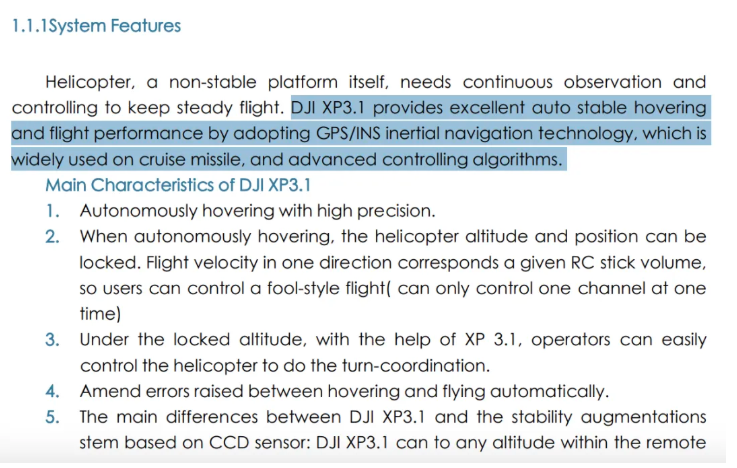
They also wrote: even a novice can learn how to operate the flight control system in minutes. This is one of the methodologies DJI has long followed.
It's not the "product-market fit" principle pursued by most entrepreneurs, but another logic for opening up a market: before a product is easy to use, the market size is limited; the degree of ease of use determines the size of the market.
Entrepreneurs who have left DJI generally follow this philosophy. For example, Bambu Lab, founded by Tao Ye, the former head of DJI's Mavic Pro series, makes easy-to-use 3D printers and has quickly become a hot consumer electronics star. When Bambu Lab was founded, there were plenty of companies making 3D printers, but they were geared toward serious hobbyists or industrial scenarios.
After DJI released the XP 3.1 flight control system, monthly revenue quickly exceeded RMB 100,000. They moved from the three-bedroom apartment to an office building in Shenzhen's Nanshan District, finally feeling like a proper company.
In the following years, DJI iterated on the XP 3.1, adding supporting equipment like a ground station—similar to an aircraft carrier's mothership—to enhance the helicopter control system's capabilities, allowing it to automatically fly over more preset points and perform more complex tasks. Wang even took the flight control system to Mount Everest to test its performance, becoming the first small aircraft to fly over Everest.

At this time, there were more and more signs around Wang that multi-rotor drones were the future. The 2009 film 3 Idiots featured a multi-rotor drone in flight; in 2010, DJI executives attended an academic conference in the US where many teams were using multi-rotor drones for experiments; DJI's overseas suppliers said that customers preferred to buy DJI's accessories for use on multi-rotor drones; and on various model aircraft forums, discussions about multi-rotor drones were increasing.
DJI subsequently invested resources in researching multi-rotor flight control systems. Theoretically, a multi-rotor drone is a variation of a single-rotor helicopter. Most of DJI's accumulated expertise in helicopters, such as algorithms and hardware, could be transferred and reused.
In August 2011, DJI released the WooKong-M multi-rotor drone flight control system, based on the WooKong-H helicopter flight control system. Similarly, the later consumer-facing Naza series had both helicopter and multi-rotor versions.
However, the popularity of open-source software weakened DJI's competitiveness, and industry competition intensified. After the release of WooKong-M, DJI's annual revenue grew to the tens of millions. Wang decided to simultaneously develop hardware to enhance competitiveness, creating the "Jindouyun" to complement the WooKong (Wukong) system and the "Fenghuolun" for the Naza (Nezha) series. These laid the technical and product groundwork for DJI's subsequent launch of the groundbreaking "Phantom" drone.

The rapid market capture of DJI's Phantom series drone was also due to a key individual and a key accessory.
In July 2011, while attending an industry trade show in the US, Wang met Colin Guinn, a reality TV actor who had participated in The Amazing Race. He was looking for a more stable drone filming solution for his aerial photography company.
Drones use multiple rotors for takeoff and turning, and the rotation of these rotors causes the camera mounted on the drone to shake. The most efficient solution is to use a gimbal to counteract the vibration. Most companies used a common brushed motor solution and then waited for a miracle solution to emerge before copying it.
DJI also initially developed gimbals this way, but brushed motors had fundamental problems: their precision and frequency were insufficient to completely counteract the drone's vibrations, and they would wear out over time, leading to poorer performance.
Wang wanted better results and decided to use brushless direct-drive motors for the gimbal. Today, such motors are common, found even in more expensive electric toothbrushes. But in 2011, they were just beginning to be widely used in industry, found in expensive CNC machines. Googol Technology, co-founded by Li Zexiang in 1999, specialized in developing CNC machines.
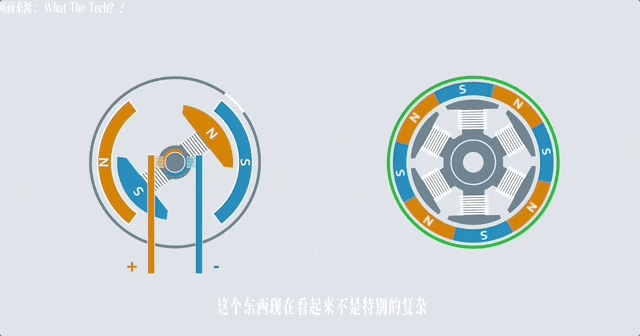
However, using brushless motors in drone gimbals required them to be small, and the control algorithms were more difficult to write. After several teams tried and failed, DJI launched the Zenmuse Z15 gimbal in 2012. Driven by the gimbal, DJI's revenue broke RMB 100 million that year.
The gimbal's development process reflects Wang's style. He pursues products that are easy to use and outstanding. Wang later said he admires things that are cool and beautiful. He believes that the pursuit of beauty translates into a combat effectiveness that ultimately leads to good products. "Coolness or beauty is a matter of taste," he said. "DJI's business decisions, product design, and technological trade-offs 'ultimately come down to taste.'"
DJI is an anomaly in China's consumer electronics industry, often called the Chinese company most like Apple. About 30 years ago, a reporter asked Apple founder Steve Jobs how to find the right direction when technology leads to countless possibilities. After a few seconds of thought, Jobs said, "In the end, it comes down to taste."
In his pursuit of taste, Wang invested enormous resources and effort. Forbes reported in 2015 that Wang worked over 80 hours a week—a "996" schedule is only 72 hours—and kept a single bed next to his desk. If a product didn't meet his expectations, he would bluntly reject it for a redo, often with the comment: "What is this garbage?"
The Phantom Filled an Industry Gap, Rejecting a Partnership with GoPro
In August 2011, one month after hearing that DJI was developing a new type of gimbal, Colin Guinn flew to Shenzhen, hoping for a deeper collaboration with DJI. At the time, most of DJI's customers were overseas. Geeks in developed regions like the United States were the most interested in drones.
Guinn was an ideal partner. He was familiar with drones, had resources in the entertainment industry, and was skilled in operations and sales. Soon, they formed DJI North America: Guinn was CEO with 48% of the shares, and DJI held 52%.
In the US, Guinn took DJI's products to various events, such as South by Southwest and the US Formula 1 Grand Prix, to raise DJI's profile. He posted drone tutorials on YouTube to educate more people on how to use them. He interacted with celebrity friends on social media to help DJI's products break into the mainstream. He helped DJI expand its sales channels to retailers like Best Buy, reaching more general consumers. Wang later commented that Guinn was an outstanding marketer whose ideas were often inspiring.
By 2012, DJI had a deep accumulation of expertise in the multi-rotor drone field: it had industry-leading flight control software, had developed two hardware models, possessed a leading gimbal, and had built up public awareness. On this foundation, DJI developed the highly integrated hardware and software of the Phantom series drone.

In January 2013, DJI released the Phantom, which sold out quickly. The Phantom's product positioning made it unique in the industry.
At the time, the drone industry was polarized. At one end were enthusiasts DIY-ing hardware, installing open-source flight control systems, and buying accessories like gimbals, with costs running into thousands or even tens of thousands of dollars, a cumbersome process. At the other end were entry-level consumer drones, like the Parrot AR.Drone, which sold for only 200−200−300 but had limited performance.
DJI's Phantom managed to capture the advantages of both ends while avoiding their shortcomings. Its performance was solid enough to meet professional needs. For example, mature hovering was a required skill, and its remote control range could reach 1,000 meters, whereas DIY devices typically only had a range of a few hundred meters. It was also beginner-friendly, ready to fly within an hour of unboxing. Equally important, it was priced under $1,000. While more expensive than the AR.Drone, it was cheaper than any product with comparable performance.
Both Wang and Guinn have summarized the Phantom's success. Wang said DJI was somewhat like Ford in the early days of the automobile. In the early 20th century, the American auto industry had hundreds of parts factories but only a few dozen assembly plants. Companies like Ford emerged and replaced many of the parts factories. He believed that by creating an integrated product, DJI could open up a larger market.
Guinn is more direct: "If a customer is buying a $100,000 product, they're willing to invest time in research. But if it's an $800 drone, they want it to work right out of the box, and it has to be perfect."
The Phantom drone continued DJI's long-held methodology. When a product becomes cheap enough to enter the mainstream, ease of use becomes a clear metric. DJI would not compromise on performance to make a product cheaper or easier to use.
However, the first-generation Phantom did not have a built-in gimbal and camera. Instead, it had a gimbal mount and a base for a quick-release GoPro action camera. GoPro's action cameras were selling 2 million units a year, having already amassed a large user base of sports and photography enthusiasts who were, to some extent, DJI's potential customers.
GoPro became the catalyst for the split between Wang and Guinn. According to reports, Guinn wanted to deepen the partnership with GoPro: GoPro would supply the cameras, DJI the drones, and they would jointly develop and sell the product, with the condition that DJI would give GoPro two-thirds of the profits. In his eagerness to sell more units, Guinn agreed on his own.
Wang disagreed. Partnering with GoPro would help open up the market, but DJI's drone would not be a complete, direct solution to user needs. It would be a tool, like a selfie stick, rather than a consumer electronics product.
By this time, Wang's goal was no longer to build a 10-20 person company. He once wrote on his WeChat Moments: "I'm tired of being a second-class citizen in culture, values, and products. I look forward to the day our products can make America bow down in admiration."
In October 2013, more than six months after the first-generation Phantom was released, DJI launched the Phantom 2 Vision, with a built-in camera and gimbal. DJI quickly iterated, releasing the Phantom 2 Vision+, which improved the gimbal structure and camera quality.
DJI's development in North America was not solely due to Guinn's efforts. Li Zexiang mentioned in an interview with us that around 2013, domestic investors viewed DJI as a toy company. In contrast, Michael Moritz, a partner at Sequoia Capital, was bullish on drones and the DJI Phantom 2 Vision, viewing it as the Apple II of its time.
He and Wang went to Silicon Valley to seek Moritz's advice on how DJI should develop, asking three questions:
First, "Can a Chinese company build a brand?" Moritz said: The product is key. As long as the product is good, it can become a brand, no matter where in the world it comes from.
Second, "Where should we start to build an international brand?" His advice was: "America, Silicon Valley, the leaders of Silicon Valley's high-tech companies."
Third, "How do we build a team?" Moritz said, "You need a talent strategy."
Through Harry Shum, then a senior executive at Microsoft, Li Zexiang sent a drone sample to Bill Gates. Through Moritz, he sent them to tech executives in Silicon Valley, expanding DJI's influence. Sequoia later became an investor in DJI.
In May 2013, Wang proposed to buy out Guinn's shares in DJI North America, offering him 0.3% of DJI's equity. Based on DJI's valuation at the time, this equity was worth $5 million. Guinn believed he was more important, as Phantom sales in the US accounted for 30% of DJI's total.
At the end of the year, DJI cut off the official email access for DJI North America employees and redirected customer payments to its Shenzhen headquarters. In early 2014, just before the Chinese New Year, DJI fired all DJI North America employees. During the same period, DJI gave away 10 Mercedes-Benz cars to its employees in China.
Guinn sued DJI, and they settled six months later. Some reports claim DJI paid nearly $10 million. Guinn, along with some members of DJI North America, joined DJI's competitor, 3D Robotics.
Employees at 3D Robotics said that in meetings, Guinn would always say, "I want to fucking kill DJI."
Sweeping Aside Rivals and "Killing" Its Own Phantom Series
3D Robotics founder Chris Anderson is almost 20 years older than Wang. A former editor-in-chief of Wired magazine, he wrote the bestseller The Long Tail. In 2007, he founded the online community DIY Drones as a side project, bringing together drone enthusiasts. Wang was a regular visitor.
DIY Drones nurtured open-source software for the drone industry, lowering the barrier to entry and incubating 3D Robotics. Anderson wrote in Wired, "I accidentally kickstarted the consumer drone boom."
Seeing the Phantom's success, many Shenzhen companies began making drones using 3D Robotics' open-source software, and 3D Robotics itself started developing drone hardware. Anderson said DJI was the Apple of the drone world, and they were the Android.
At the time, 3D Robotics had reasons to be confident: it had just raised $85 million in funding; it had an open-source community to help improve its software and hardware; it could use China's supply chain for hardware manufacturing, just like DJI; and it had Guinn, a drone marketing expert who knew DJI well.
3D Robotics' core product was the Solo drone, internally called the "Phantom Killer." The Solo had some highlights, such as deep integration with GoPro and compute chips in both the device and the remote control to enhance control capabilities.
They allowed customers a 30-day no-questions-asked return policy. If a flight malfunction caused the drone to be damaged and it was the Solo's fault, they would replace it with a new one, including the attached GoPro.
Before the Solo's launch in June 2015, Wang went to the US to meet Anderson and proposed a full acquisition of 3D Robotics. Anderson refused. Less than a year later, the Solo collapsed.
Before the product's release, The Verge gave it a very high rating, calling the Solo "possibly the smartest drone ever." An insider later revealed that the drone 3D Robotics provided to The Verge for review had been specially modified, such as having an enhanced GPS module. The version sold to customers had a standard GPS, leading to unstable control signals and an increased "crash rate."
The Solo had no gimbal, just a direct quick-release mount for a GoPro, like the first-generation Phantom. But this was 2015, and gimbals were already standard on DJI drones. Guinn said, "I didn't expect building a gimbal to be so hard, even harder than building the drone itself."
Despite this, 3D Robotics executives were very confident. They saw large orders from distributors and believed that sales would explode during the Christmas holiday season, so they had the factory produce an extra 40,000 units. A single Solo cost about 750tomake,whichamountedto750tomake,whichamountedto30 million.
But distributors were just stocking up; they weren't selling through. The units were piling up in warehouses and on shelves. By February 2016, there were 60,000 unsold Solo units, equivalent to $45 million in inventory.
Inventory is a nightmare in the consumer electronics industry, as rapidly iterating technology can quickly make a product obsolete. If 3D Robotics had had more time to iterate on its product, it might have stood a chance.
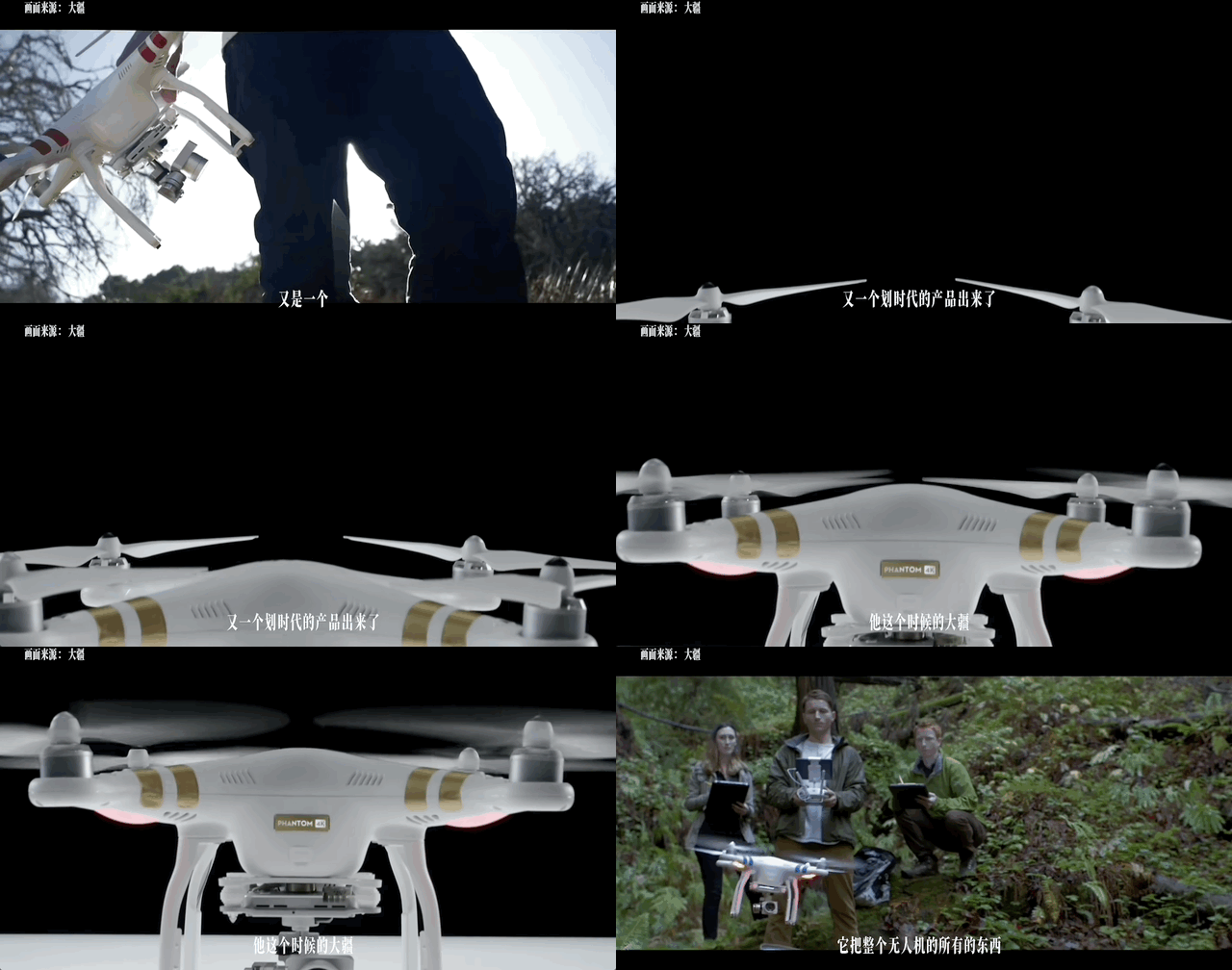
DJI's counterattack came swiftly: the Phantom 3. By this time, DJI had mastered all the technological modules for drones: flight control, hardware, gimbal, camera, and image transmission, and was a leader in each. That year, DJI invested in Hasselblad.
When the Phantom 3 Pro was released, it was priced at $1,300, while the Solo with a GoPro camera cost $1,700. The following year, DJI released the Phantom 3, which focused on different scenarios, and lowered the price to $800, with promotions offering it for just $500.
The defeated Anderson decided to exit the drone hardware market. He said they were a Silicon Valley company and should have focused on software all along, leaving hardware manufacturing to Chinese companies.
From then on, DJI became number one in the global consumer drone market, with a market share exceeding 70%, but its position was not yet unshakable.
Domestic investors no longer saw drones as toys and began to support DJI's rivals, investing in companies like XAG, Yuneec, EHang , ZeroTech, and Fimi, even helping them write their business plans.
Some companies were unwilling to confront DJI in the consumer drone market and focused on areas DJI paid less attention to, such as XAG with agricultural drones and EHang with passenger-carrying aircraft and large-scale transport drones.
But there were still companies hoping to challenge DJI, such as ZeroTech. They hoped to replicate Xiaomi's success in the smartphone market by creating a low-priced drone with a reasonably good experience.
ZeroTech focused on a small drone called Dobby. It was foldable, could fit in a pocket, weighed only 199 grams, was endorsed by celebrity Liu Yan, priced at RMB 1,800 yuan, and had an initial stock of 200,000 units. It was released in July 2016.
But the Dobby, like the Parrot AR.Drone, used a Wi-Fi signal for control, which was not very stable. To achieve a lower price and lighter weight, they also sacrificed a lot of performance.
Portability was DJI's weakness. The Phantom 3 Professional took up most of a standard suitcase. Professional users could tolerate the inconvenience, but ordinary consumers would be deterred.
But ZeroTech made its move after DJI had dealt with the challenge from 3D Robotics. DJI was able to respond quickly to new challenges. Two months after the Dobby's launch, DJI released a foldable drone: the Mavic Pro.
DJI did not sacrifice performance for portability. The Mavic Pro's price was three times that of the Dobby, but its market performance far surpassed its rival's. Like the previous "Phantom Killer," the Solo, the Dobby had massive unsold inventory, and its cash flow broke.
The Mavic Pro became the new Phantom killer. In the same year, DJI released the Phantom 4, but its sales were sluggish. DJI never released a Phantom 5.
Wang later said, "Only through self-revolution can there be innovation."
After this, there were virtually no other brands in the consumer drone market that could compete with DJI. Measures taken by the US government, such as imposing tariffs and adding DJI to the Entity List, failed to significantly dent its market share.
In 2016, DJI's revenue grew to nearly ten billion yuan, 100 times what it was four years prior, but its growth rate slowed from the previous 1000% to just over 60%. Wang judged that the consumer drone market might be approaching saturation.
Expanding Business Lines Around Drone Technology, Facing New Challenges from Talent Drain
DJI's current business landscape is a set of concentric circles. At the center is consumer drones, DJI's source of profit and foundation for expansion. DJI has expanded to seven product lines—Mavic, Air, Mini, Flip, Neo, Avata, and Inspire—covering various product forms, serving as both offense and defense.
Beyond consumer drones are DJI's drone solutions for vertical scenarios, such as agriculture and surveying. The latest product is a transport drone capable of carrying nearly 300 catties (approx. 150 kg) of cargo over 50 kilometers.
Further out are the imaging devices DJI has developed, such as handheld gimbals, handheld gimbal cameras, and action cameras. These are derivatives of DJI's drone technology and its main direction for expansion, all of which have been successful.
The most prominent is the handheld gimbal camera, the Pocket. Despite its technological foundation from drones, DJI spent two years developing the first Pocket, with three design iterations. The early version was a rectangular device with a gimbal and camera extending from it.
DJI also considered making it a mobile phone accessory but ultimately settled on a lipstick-like form factor—a product that had never appeared on the market before, capable of doing things phones couldn't and providing more value to users.

DJI pursued technological excellence for the Pocket. The handheld gimbal camera is smaller than drones and other products, which meant developing smaller brushless direct-drive motors to power a smaller gimbal.
Their engineers found that the gimbal's precision needed to be within 0.005° for users not to perceive any screen shake. Currently, almost no other company making similar products comes close to DJI's level.
However, most of these DJI products have poor heat dissipation, and their temperature rises noticeably after a period of use. This was especially true for DJI's second-generation action camera.
In 2019, DJI released its first action camera, largely following the design style defined by GoPro. The main point of differentiation was an added front-facing screen, allowing users to see themselves in the frame when taking selfies.
For its second-generation action camera, DJI redesigned the product, adopting a magnetic modular design. The front screen was made into a replaceable magnetic module. The action camera body itself was smaller, only half the size of other action cameras on the market.
DJI did not sacrifice performance for compactness, instead using smaller components that still guaranteed performance. These components typically had higher power consumption, leading to two problems: high battery drain and significant heat generation.
Because the action camera was small, its battery was not large, so it could not be used for long periods. At the same time, the action camera needed to be sealed for waterproofing, which trapped heat and caused it to become hot to the touch. DJI even advised users not to record long videos.

For its third-generation action camera, DJI reverted to the first-generation design. Leveraging its past technological accumulation and the backing of Hasselblad, its current market share is second globally, only behind GoPro.
Beyond drone-derived products, the new businesses DJI has opened up have not been as impressive. Its autonomous driving business, DJI Automotive, now renamed "Zhuoyu" , was seen as an anomaly by many former DJI employees and investors.
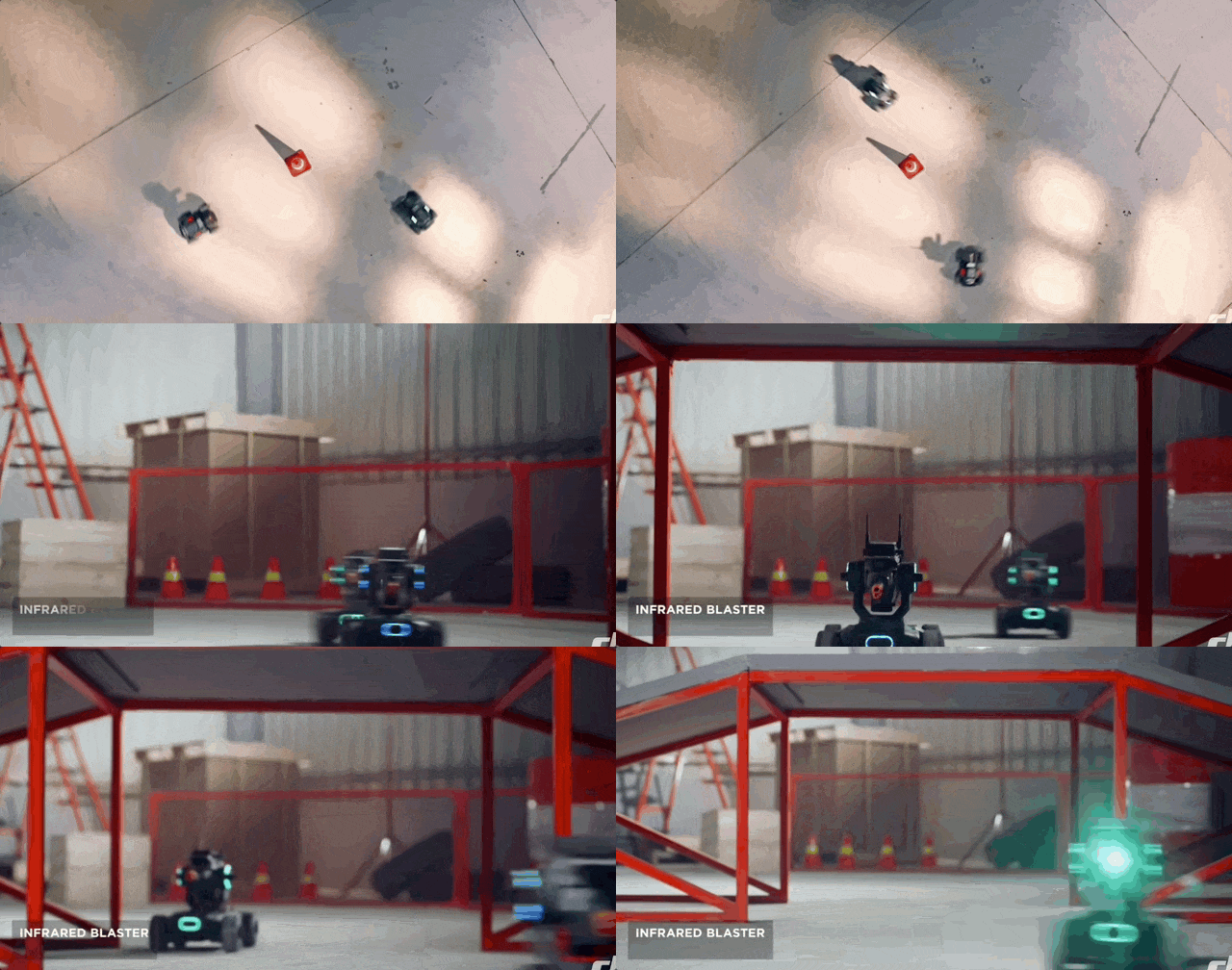
A product more in line with DJI's style was the RoboMaster S1 mecha robot, released in 2019. Similar to when DJI developed the Phantom drone, mecha robot products were a niche market at the time, frequently used in robot competitions among enthusiasts. DJI leveraged its tech and invested heavily to turn it into a consumer product for middle school students to learn robot programming, but due to factors like the "double reduction" policy, it did not develop further.
Robotic vacuums do not have these constraints but lack much of the character of a DJI product. When DJI began developing robotic vacuums in 2020, they were already a relatively mainstream product. The same applies to portable power stations.
An entrepreneur who once worked at DJI said that the company's motivation for entering these businesses is no longer as pure as when it was making drones or even the RoboMaster in its early years.
DJI hopes to use these projects with clear market prospects to retain its continually departing talent. Key engineers at DJI have been leaving in recent years, either to start their own businesses or join other consumer hardware companies, often taking a group of people with them when they leave.
In 2019, DJI systematically defined its vision: to be a pioneer in the era of spatial intelligence, making the beauty of technology exceed imagination. Wang hopes that DJI's products, equipped with various sensors and control algorithms, can operate as gracefully as a bird flying through a rainforest.
The aforementioned former DJI employee and entrepreneur said that for DJI to succeed in fields like robotic vacuums, it needs to break through its constraints. For products like robotic vacuums, where the public already has a clear understanding and the technological boundaries are relatively defined, success depends not only on DJI's traditional strengths in ultimate product design and engineering but also on marketing capabilities. For example, when Dreame promotes its floor-washing products, it will dump a bucket of instant noodles on the floor and then use the device to clean it up, which drives significant sales.
DJI's robotic vacuums, portable power stations, and its latest panoramic camera do not have a strong DJI flavor, but they are very important for the current DJI. The market performance of these products will not only affect employee morale and retention but also shape DJI's boundaries.
In an interview, Wang mentioned that DJI's greatest strength is not its products or technology, but its methodology. These highly competitive products, where DJI is a latecomer, will test whether DJI's methodology can be applied beyond drones and their derivatives, and whether DJI will become an even stronger company.