
The US-China AI Race: Chips, Models, Value Capture and Three Ways to Win
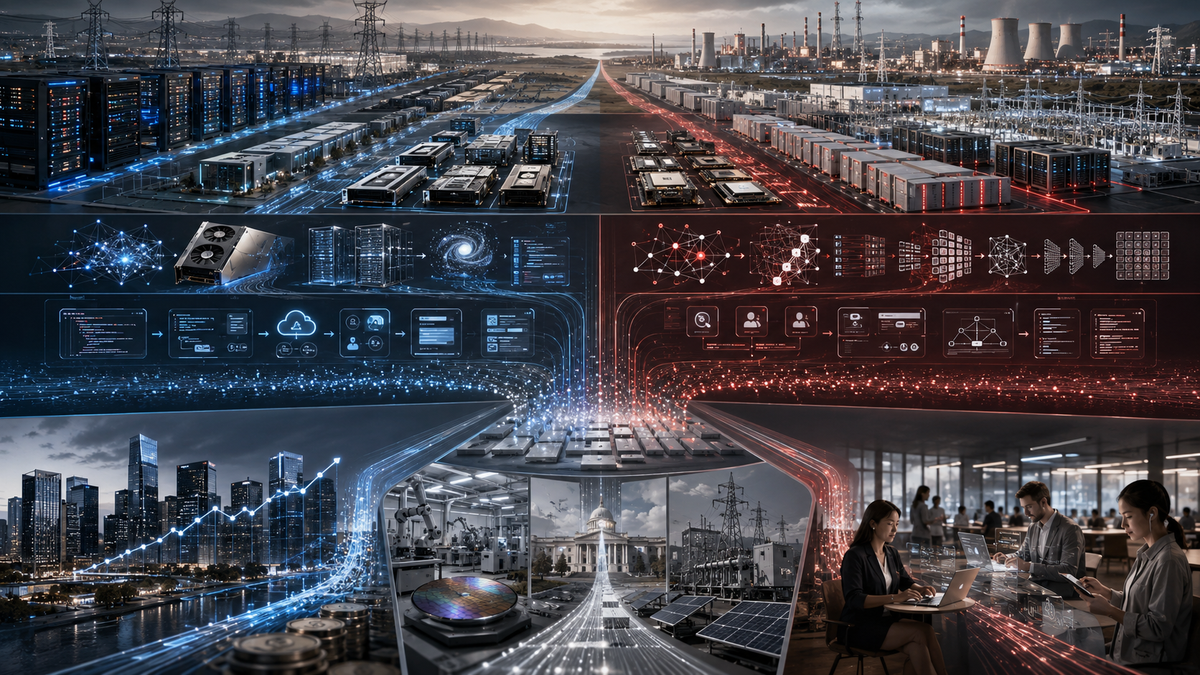
The real competition spans chips, infrastructure, data control, and applications — and the scorecard looks different depending on whether you're a company, a government, or an individual.
What Is This Really About?
Most coverage of the US-China AI rivalry focuses on benchmark scores and model releases. That framing misses the point.
The competition is better understood as a race across an entire industrial ecosystem — one that spans at least six interdependent layers: power generation, chips, infrastructure, foundation models, the "harness" layer that connects AI to real workflows, and applications. Nvidia CEO Jensen Huang has described a five-layer stack; venture capitalist Chamath Palihapitiya adds a sixth — the Harness layer, which coordinates how different models and agents actually operate inside enterprises. Think of it this way: if a model is the horse, the Harness is the bridle and reins that determine how it works.
Technological leadership and durable commercial value do not always sit on the same layer. A country or company can lead in model capability while losing the value chain to whoever controls the Harness and application layers. Understanding this structure is the prerequisite for reading any claim about who is "winning."
How Do the US and China Compare, Layer by Layer?
A layer-by-layer comparison reveals that the two countries have different strengths — and face different bottlenecks.
Where the US leads: - The most advanced AI chips (Nvidia H100/H200 and successors) - The strongest frontier closed-source models - Deep private capital markets and mature enterprise software spending habits - Established developer ecosystems (Hugging Face, OpenRouter, Vercel, major cloud platforms)
Where China leads: - Greater electricity generation capacity and faster infrastructure construction - Manufacturing and engineering execution at scale - A rapidly growing share of global open-weight model downloads and usage
The critical constraint difference:
China's primary bottleneck is advanced AI chips — both due to US export controls and the current performance, production volume, and software ecosystem gaps in domestically produced alternatives. China has more electricity; it lacks the silicon.
The US primary bottleneck is power and grid infrastructure — data center construction is constrained not by chip supply but by permitting, grid connection timelines, and electricity capacity.
These asymmetric constraints are not merely temporary inconveniences. They shape business models, engineering cultures, and long-term industrial trajectories. China's chip scarcity has pushed its engineers toward distillation, sparsification, quantization, and inference optimization. The US has pursued scale and massive cluster construction. Even if constraints are later relaxed, path dependencies may persist for a generation of engineers and companies.
On raw compute, scenario estimates based on peak FP16 FLOPS suggest that in 2025, US AI compute capacity was roughly 16 times that of China. By 2027, that gap could widen to approximately 25 times. Long-range forecasts carry significant uncertainty, but a roughly one order-of-magnitude US lead over the next three to five years is a relatively robust baseline assumption.
Why Open-Weight Models Are a Paradox, Not a Victory
Chinese AI companies — including Qwen (Alibaba), DeepSeek, Moonshot AI, and Zhipu AI — have pursued a strategy of releasing open-weight models at low or zero cost, rapidly building global developer adoption.
The numbers are significant. According to Hugging Face data, Chinese-origin models accounted for 41% of all model downloads on the platform over the past year. The Qwen family had accumulated nearly one billion cumulative downloads as of April 2026. On OpenRouter, DeepSeek held approximately 16.3% of token share, making it the platform's largest single provider.
This represents genuine influence. But the strategy contains a structural paradox.
The infrastructure dependency problem: Chinese open-weight models reach global developers primarily through US-controlled infrastructure. Weights are distributed via Hugging Face. Inference runs through OpenRouter, Vercel, and similar platforms. The underlying compute typically runs on Nvidia hardware. The more Chinese models are used, the more revenue flows to US infrastructure companies.
The monetization gap: Download volume does not equal deployment. Deployment does not equal sustained usage. Usage does not equal revenue. Vercel data illustrates the gap sharply: Chinese open-weight models accounted for roughly one-third of token usage through its gateway, but corresponded to less than 4% of user spending.
Open-weight distribution builds developer mindshare, reputation, and ecosystem entry points. It also erodes direct pricing power and makes it easier for customers to copy, fine-tune, or replace models entirely.
The strategic summary: China has won a model distribution advantage, not a value chain advantage. Whether that translates into company revenue and complete national technological capability depends on moving from downloads to deployment, from usage to payment, and from productivity gains to revenue capture.
When Token Prices Fall 100x, What Happens to the Business Model?
One of the most consequential — and underreported — dynamics in AI is the collapse in the price of intelligence.
Over the past three years, the cost of achieving a given level of AI capability (roughly GPT-4 class performance) has fallen by more than two orders of magnitude. Industry analysis suggests inference pricing for equivalent capability drops approximately 5–10x per year. If this trajectory continues, a few months of technical lead becomes increasingly difficult to convert into durable commercial advantage.
This price collapse is not the result of any single factor. It reflects simultaneous progress across the entire stack: chip performance improvements, better cluster utilization, quantization and sparse inference techniques, speculative decoding, caching, routing optimizations, and architectural improvements that allow smaller models to match what previously required much larger ones. The rate of decline has significantly outpaced what Moore's Law alone would predict.
Competitive dynamics accelerate the trend further. As more models reach similar capability levels, vendors cannot sustain premium pricing on "smarter" alone. They compete on price, free tiers, and product bundling.
In late July 2026, OpenAI made GPT-5.6 Luna the default free model for ChatGPT users and cut API pricing to $0.20 per million input tokens and $1.20 per million output tokens — a signal that the US's leading closed-source company is now competing aggressively for mass-market users, developers, and global distribution at low price points.
Around the same time, several Chinese model companies — including DeepSeek, with new pricing effective August 17, 2026 — announced price increases. This apparent reversal reflects a convergence of pressures: subsidy reduction, rising training and serving costs, capacity constraints, and shareholder pressure for revenue and profitability.
An important distinction: Low token prices charged to customers are not the same as low underlying costs. The relevant metric for comparing AI economics is total cost of ownership (TCO) — including chip amortization, power and cooling, interconnect and storage, facility costs, software adaptation, and operations — divided by actual effective throughput. Chinese AI companies have advantages in labor costs, engineering construction, and algorithmic efficiency techniques. But at the hardware layer, domestic chip platforms still face gaps in single-card performance, chip interconnect bandwidth, cluster stability, and software maturity. The result is that completing equivalent workloads often requires more hardware, more power, and more engineering resources. In several published system comparisons, the effective unit compute cost on domestic Chinese AI stacks remains meaningfully higher than on Nvidia platforms. The low prices Chinese model companies charged were partly subsidized; the price increases reflect the stack's true economics surfacing.
Where Does Value Actually Accumulate? The Harness and Application Layer Thesis
If model capability is converging and token prices are falling, where does durable value concentrate?
The structural answer, in the absence of an AGI-level breakthrough that re-opens model differentiation, is: the Harness and application layers.
The Harness layer connects models to enterprise data, permissions, software systems, and business processes. It converts model outputs into executable business results. The application layer packages capability into products that users adopt directly, owning the specific use case, interaction design, distribution, and customer relationship.
Enterprise data and workflows are difficult to migrate. User habits, brand trust, and distribution channels are not easily replicated. Even if the underlying model can be swapped, Harness and application providers may retain stable customer lock-in.
The US market advantage: US enterprise software budgets are large, subscription purchasing habits are mature, and white-collar labor is expensive. When AI can replace software functionality or reduce hours needed from engineers, analysts, lawyers, or customer service staff, enterprises have clear payment motivation. Revenue then funds the next round of compute, R&D, and service investment — creating commercial compounding. This is the market logic behind coding agents becoming the closest thing to an AI "super-app" in the US market.
The China market challenge: China has abundant deployment scenarios and strong execution capability. But enterprise software budgets are typically lower, and the cost of white-collar labor is relatively lower. If the cost of purchasing tokens, rebuilding software, and redesigning workflows exceeds the cost of adding headcount, customers lack payment motivation. Government and state-enterprise clients can provide early revenue, but customized projects are harder to replicate at low marginal cost the way standardized software can be. This market quality gap is a significant reason Chinese model companies have prioritized international expansion.
Capital structure shapes corporate direction: US AI ecosystems are funded primarily by venture capital, public markets, and the massive capex programs of major technology companies — capital that typically favors technical frontier advancement, high growth, and globally scalable commercial revenue. Chinese AI companies draw funding from national industrial funds, internet conglomerates, local governments, and VC. Beyond commercial returns, a portion of that capital carries objectives around technological self-sufficiency, industrial localization, and national strategic capability. Government capital's influence often exceeds its direct equity stake: subsidies, procurement, market access, policy signals, and follow-on funding all amplify its effect on corporate decision-making. Different capital structures produce different corporate objectives and push companies toward different customers, products, and development paths.
Three Scenarios for Where This Goes
Scenario 1: The US Open-Weight Camp Expands, Reshuffling Global Token Share
On August 10, 2026, Meta announced the open-sourcing of its MuseSpark 1.2 flagship model weights — a clear signal that the US is responding to China's open-weight distribution advantage with its own high-quality releases.
The structural prediction: more top-tier US models will release open weights, driving a significant increase in US-origin model token share across major routing platforms, cloud providers, and AI gateways. Chinese open-weight models — Qwen, DeepSeek, Moonshot, and others — will face intensified competition from each other and from US low-cost open-weight alternatives. The most advanced frontier capabilities, particularly those with biological safety, cybersecurity, or autonomous agent risks, will likely remain behind closed, controlled APIs.
Falsification condition: If US-origin open models do not gain meaningful token share on major global platforms within 18 months, or if Chinese models demonstrably compress US model company revenues, this scenario requires revision.
Scenario 2: Two Years of Intense Competition, Then Consolidation
The next two years will see continued aggressive competition and high investment across both US and Chinese foundation model companies. By late 2028, if no AGI-level breakthrough has restructured competitive dynamics, model capability convergence combined with persistent training, inference, and iteration costs will make it difficult for companies without stable revenue, capital backing, or differentiated capability to survive. Both the US and Chinese model layers are likely to see closures, acquisitions, and consolidation.
If a decisive AGI breakthrough does occur, consolidation still happens — but it takes the form of capital, talent, and customers accelerating toward the technical leader, with laggards eliminated rapidly.
Falsification condition: If after late 2028, neither ecosystem shows multiple verifiable model-layer acquisitions, mergers, or business terminations, and independent model companies continue to grow on model revenue alone, this scenario requires revision.
Scenario 3: The AI Map Replicates the Internet Map
Today's internet roughly divides into: US platform-dominant zones, China's independent ecosystem, and mixed zones where both US and Chinese technology coexist. The AI territorial map is likely to replicate this structure. Beyond model technology, chips, cloud platforms, payment systems, app stores, data governance rules, government procurement standards, and security certifications will collectively determine technological allegiance.
This boundary will directly affect which tools individuals can access, whether data can cross borders, which skills are portable across markets, and where startup products can be sold. In the near term, the US is unlikely to ban Chinese models outright — their value as competitive pressure, through open weights, local deployment, and vendor optionality, may still exceed the market and security costs. But this tolerance is conditional. If Chinese models create visible security, industrial, media, or political problems, and geopolitical hardliners gain the upper hand in policy, restrictions could escalate to bans.
Regulatory approaches differ: the US emphasizes national security and market access; China emphasizes model licensing, content control, and social governance; Europe emphasizes risk tiering. The directions diverge, but all increase the institutional cost of cross-border deployment.
Falsification condition: If Europe, India, or other regions form a genuine third pole independent of US infrastructure, or if Chinese technology stacks become dominant in multiple large economies where Chinese internet companies previously had no foothold, this scenario requires revision.
The Three Scorecards Problem: Why "Winning" Means Different Things
Perhaps the most important analytical point in this entire discussion is one that rarely appears in technology coverage: companies, governments, and individuals keep different scorecards, and the results can point in opposite directions.
- Companies measure moats, revenue, and profit streams
- Governments measure technological leadership, industrial control, national security, social governance capacity, and global standard-setting
- Individuals measure whether AI expands or compresses their income, opportunities, choices, safety, and autonomy
A US AI company can generate extraordinary profits and market capitalization while simultaneously displacing large numbers of white-collar workers and concentrating productivity gains among shareholders. China can use AI to enhance manufacturing and governance capability while many ordinary workers see no improvement — or a deterioration — in employment security, income, and professional autonomy.
The US and China will likely both declare victory in the AI competition. Their victory structures will look fundamentally different. The US is more likely to define winning through capital returns, scientific discovery, and individual capability expansion. China is more likely to define winning through industrial scale, technology diffusion, national organizational capacity, and the ability to shape social order. The same technological revolution may reinforce each system's existing direction — and produce two distinct futures.
The question that neither scorecard captures well: Who bears the costs, and who captures the gains?
Related Coverage:
DeepSeek's V4 Pro Undercuts Grok 4.6 by 7x as Agentic AI Race Heats Up