
Unitree Debuts on STAR Market at 219x P/E as Profit Squeeze Clouds Record-Breaking IPO
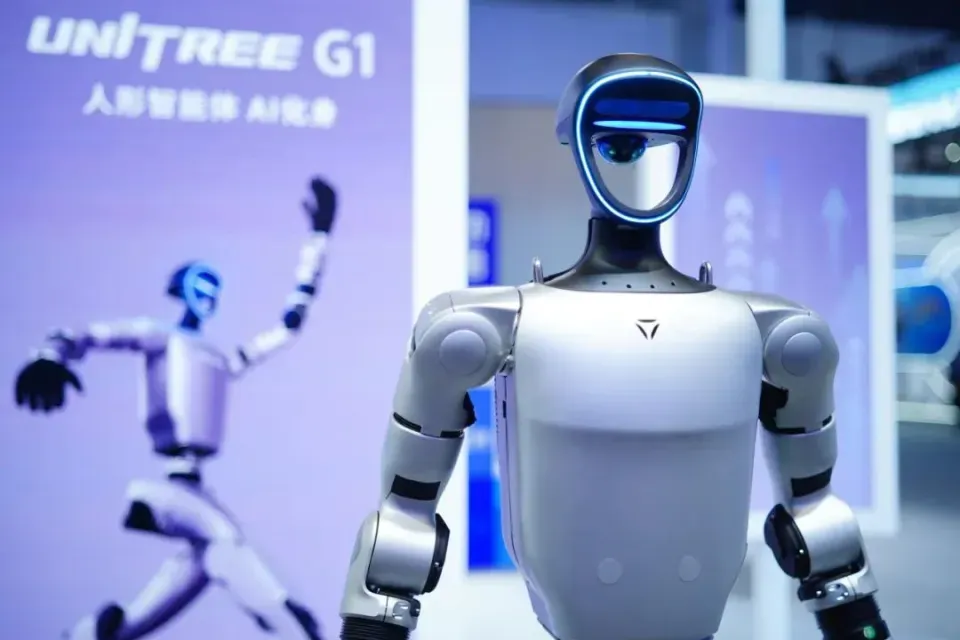
Unitree Robotics hits Shanghai's STAR Market on August 19, 2026, commanding a RMB 60.99 billion (US$8.47 billion) implied valuation at IPO — yet its own prospectus flags a sharpening profit squeeze that exposes the gap between market euphoria and operational reality.
The listing arrives one day after the Hangzhou-based humanoid and quadruped robot maker unveiled "Superhuman", a new humanoid platform that cleared a 2-meter standing high jump and hit a top speed of 12.66 meters per second — both claimed to surpass human physical records. The product drop is a textbook pre-IPO narrative catalyst, and it worked: derivatives pricing ahead of the open implied a market capitalization of approximately US$57.9 billion (RMB 416.6 billion), roughly 360% above the IPO valuation, signaling that retail and institutional demand has already priced in a scenario well beyond the company's current financials.
The subscription lottery rate of 0.0181% is the lowest in STAR Market history, a data point that captures the intensity of retail demand but also concentrates risk — only 30.09 million shares, or 7.44% of total shares outstanding, are freely tradable at listing, creating the conditions for extreme opening-day volatility.
Valuation Premium Dwarfs Every Comparable Peer
At RMB 150.80 per share, Unitree's IPO price implies a trailing price-to-earnings ratio of 219.23x and a price-to-sales ratio of 35.89x. The prospectus itself acknowledges the disconnect: comparable listed companies UBTECH Robotics and Dobot carried an average 2025 price-to-sales ratio of just 4.92x — meaning Unitree is pricing in a sales multiple more than seven times the sector peer average.
The 219x P/E also stands at roughly 5.8 times the general equipment manufacturing industry average of approximately 38x, underscoring that investors are not buying current earnings but a long-duration option on humanoid robotics commercialization. That bet carries explicit prospectus-disclosed risks, including intensifying competition, product price erosion, and uncertainty around the timeline for general-purpose robot adoption at scale.
Revenue Growth Decelerates as Cost Base Expands
Unitree's financial trajectory over 2023–2025 was exceptional by any measure. Revenue compounded at 226.78% annually over two years, rising from RMB 159 million (US$22.1 million) in 2023 to RMB 1.699 billion (US$236 million) in 2025. Gross margin expanded from 44.22% to 60.13% over the same period, and non-GAAP net profit swung from a RMB 18.02 million (US$2.5 million) loss to a RMB 591 million (US$82 million) profit.
The 2026 picture is materially different. In Q1 2026, revenue growth slowed to 68.49% year-on-year — still robust in absolute terms, but a sharp deceleration from the prior trajectory — while non-GAAP net profit fell 52.55% year-on-year. For the first half of 2026, revenue reached RMB 1.152 billion (US$160 million), up 48.54%, but non-GAAP net profit dropped 19.34% to RMB 244 million (US$33.9 million).
The company attributes the margin compression to accelerating R&D expenditure — up approximately RMB 82.04 million (US$11.4 million) in H1 2026 year-on-year — and a significant increase in selling expenses, partly linked to brand-building campaigns including a placement during China Central Television's 2026 Spring Festival Gala. The prospectus also cites cooling sector sentiment and mounting competitive pressure as structural headwinds. For investors paying 219x earnings, the direction of that cost curve matters enormously.
Founder Retains Iron Grip via Dual-Class Structure; DeepSeek and Tencent Join Cap Table
Founder, Chairman, and CTO Wang Xingxing holds approximately 31.29% of shares post-IPO through direct ownership and the employee platform Shanghai Yuyi, but his effective voting control reaches 65.31% via a Class A super-voting structure that grants 10 votes per share. The prospectus explicitly flags the risk that this mechanism could disadvantage minority shareholders in contested situations — a standard governance disclosure that nevertheless carries weight given the concentration level.
The pre-IPO institutional register includes Ningbo Sequoia at 5.59%, alongside Astrend IV, Jingwei No. 1, and Jinshi Growth each holding between 3% and 4%.
The strategic placement cohort reads as a who's-who of China's technology and state-capital ecosystem. DeepSeek received 933,399 shares with a 36-month lockup. Shanghai Qishan Investment, affiliated with Tencent Technology, received 903,290 shares under a lockup tied to the later of 36 months from Tencent's first acquisition date or 12 months from listing. National Social Security Fund, CNPC Kunlun Capital, China Southern Power Grid Financial Holdings, and Tianyi Capital Holdings each received approximately 900,000 shares with 12-month lockups.
The presence of DeepSeek — China's most prominent large language model developer — alongside state-linked energy and telecom capital suggests Unitree is positioning itself at the intersection of embodied AI and industrial deployment, a narrative that commands a premium in China's current policy environment.
IPO Mechanics: CITIC Securities Leads; Lock-Up Cliff in 12 Months
The offering comprised 40.45 million new shares, representing 10% of post-IPO total shares of approximately 404 million. Gross proceeds totaled RMB 6.099 billion (US$847 million); net proceeds after fees reached RMB 5.917 billion (US$821 million). Underwriting and sponsorship fees alone amounted to RMB 144.99 million (US$20.1 million). The lead sponsor and underwriter is CITIC Securities.
Lock-up structures create a defined risk calendar. Wang Xingxing and employee platform Shanghai Yuyi face 36-month lockups, as does DeepSeek. Most financial investors are subject to 12-month lockups, meaning a meaningful supply overhang could emerge as early as August 2027 — a date investors should mark given the expected valuation at that point.
Market Positioning: First-Mover Advantage Against a Crowded Horizon
Unitree's core product lines span quadruped robots — most visibly the Go series — and increasingly humanoid platforms. The "Superhuman" unveiling the day before listing is designed to anchor the company's technology narrative at a moment of maximum investor attention. Whether the performance metrics translate to commercial scalability remains the central question: the prospectus itself identifies the pace of general-purpose robot commercialization as a material uncertainty.
The competitive landscape is intensifying. Domestic rivals are scaling, international players including Boston Dynamics remain active, and the prospectus acknowledges downward product pricing pressure — a dynamic that directly threatens the 60%-plus gross margins that currently justify the valuation. For the 219x multiple to be sustained, Unitree will need to demonstrate that its cost discipline and product roadmap can outrun both the competitive cycle and the deceleration already visible in its H1 2026 results.
Related Coverage:
China’s First Humanoid Robot IPO: How Unitree Built a DJI-Style Cost Advantage