
Volkswagen Eyes China-Engineered CEA Platform, Up to €5B in Savings
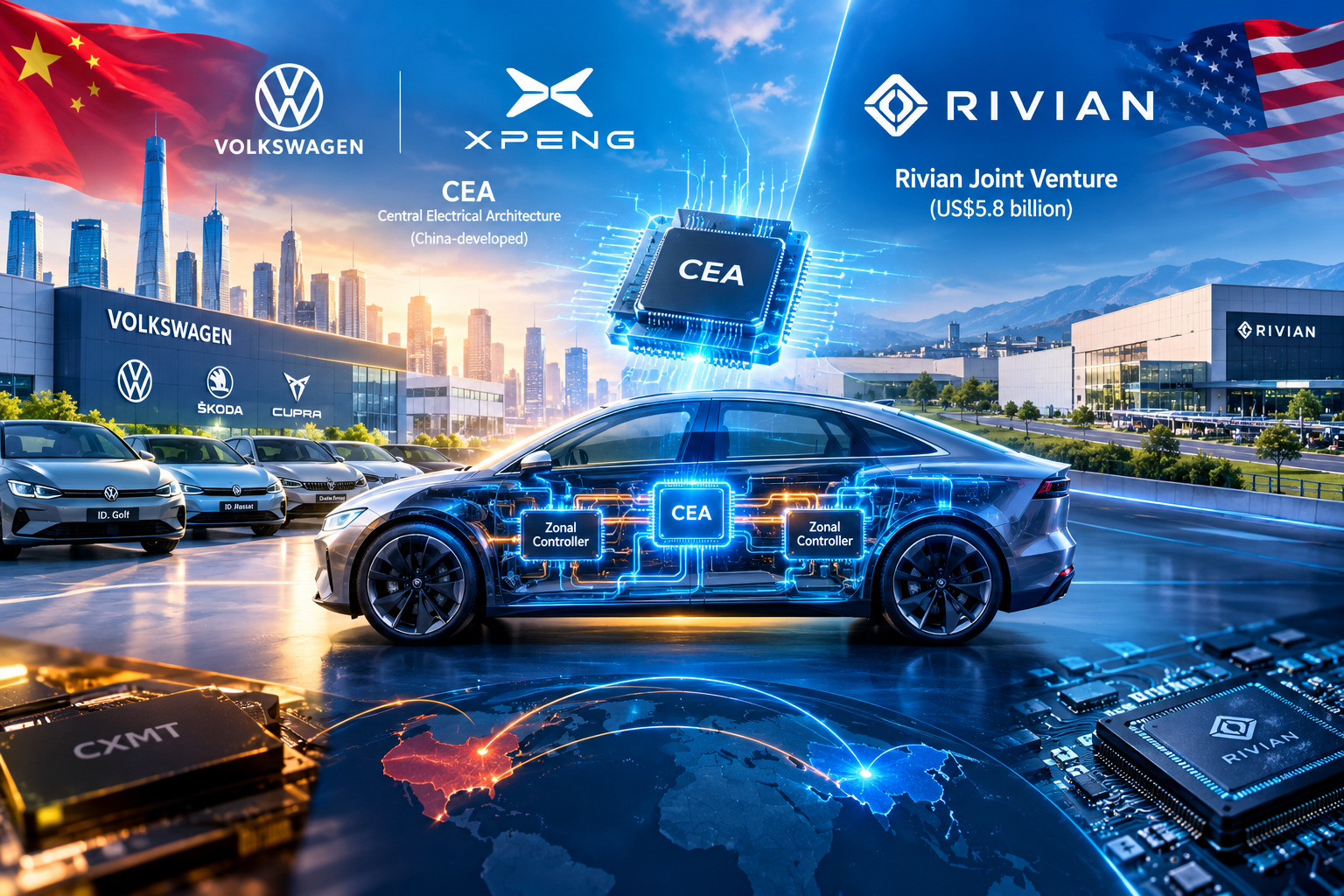
VW's Hefei-developed electrical backbone, co-built with Xpeng Motors, is now being weighed against the automaker's $5.8 billion Rivian joint venture — a rare technology reversal that could reshape how global automakers source automotive intelligence.
The proposal, first reported by Germany's Manager Magazin on October 26, 2026, would apply the China-developed CEA (Central Electrical Architecture) to roughly three-quarters of next-generation models across Volkswagen, Škoda, and Cupra — including the forthcoming ID.Golf, ID.Passat, and Škoda Enyaq. Internal estimates cited by German media put potential savings at €4–5 billion (US$556–694 million at current rates). Volkswagen Group's supervisory board has yet to formally approve the proposal.
The timing carries unmistakable urgency. Volkswagen's global deliveries for the first nine months of 2026 fell approximately 9% year-on-year to roughly 6.01 million vehicles, while China — the group's largest single market — posted a 30.2% delivery decline over the same period. A September 2026 restructuring blueprint acknowledged European manufacturing capacity exceeds demand by more than 500,000 units annually and explicitly called for reducing product and organizational complexity.
Reversing Decades of Technology Flow Between Germany and China
For the better part of three decades, the direction of automotive technology within Volkswagen's global operations was largely unambiguous: platforms, electronic architectures, and engineering standards originated in Wolfsburg and were adapted downstream by Chinese teams for local market conditions. Powertrain calibration, chassis tuning, and — critically — electronic-electrical architecture all flowed west to east.
That default is now under active scrutiny.
The CEA was not developed in Germany. It was engineered in Hefei and Guangzhou by joint teams drawn from Volkswagen China Technology Company (VCTC), CARIAD China, and Xpeng Motors, working under a strategic partnership signed in July 2024. The cooperation itself began in 2023, initially targeting faster new-model development for the Chinese domestic market, with the scope expanded specifically to electronic-electrical architecture in April 2024.
CEA reached production readiness in late 2025 — approximately 18 months from concept to volume manufacturing. In January 2026, Volkswagen announced the ID. Yu Zhong 07 (ID.与众07) as the first production model to carry the architecture. On October 16, 2026, SAIC-Volkswagen's ID. ERA 5X rolled off the line, integrating CEA with Volkswagen's China-developed CMP vehicle platform — extending the architecture's footprint into plug-in hybrid and internal combustion vehicle programs alongside battery-electric models. Volkswagen has committed to over-the-air vehicle updates for CMP-based models on a roughly 100-day cycle, completable in approximately 30 minutes.
The pace of execution is precisely what has drawn the attention of VW Brand CEO Thomas Schäfer, who is reportedly championing the European application case.
Unpacking the €4–5 Billion: Where the Savings Actually Come From
The headline savings figure demands disaggregation. CEA is not a software skin or infotainment upgrade — it represents a structural redesign of how electrical functions are organized across a vehicle.
Legacy automotive electronics resemble what engineers sometimes describe as a building with rooms added without an original plan: body control, lighting, HVAC, powertrain, and chassis functions each governed by dedicated electronic control units (ECUs), proprietary software stacks, dedicated wiring harnesses, and discrete supplier relationships. Adding a feature often requires coordinating across multiple ECUs with separate validation cycles for each vehicle variant.
CEA consolidates this through a central compute-plus-zonal-controller topology: zonal controllers manage physical sensors and actuators within defined vehicle regions, while a central compute platform handles higher-level software functions. Volkswagen disclosed in 2024 that the architecture reduces ECU count by up to approximately 30% per vehicle.
Fewer discrete controllers translate into reduced semiconductor content, fewer connector systems, simplified harness routing, and — critically for a group operating Volkswagen, Škoda, Audi, Cupra, SEAT, Porsche, and Lamborghini simultaneously — greater purchasing scale as common hardware components are ordered across higher volumes.
The software leverage is similarly structural. Shared communication protocols, diagnostic frameworks, OTA update infrastructure, and feature software can be reused across vehicle lines without full re-engineering, reducing redundant development and validation cycles while base-level safety certification remains model-specific.
Development timeline compression carries its own financial logic: a model that reaches market two or three quarters earlier avoids that duration of carrying costs and begins generating revenue sooner within increasingly compressed product cycle economics.
For context, Volkswagen has previously disclosed a 40% total cost reduction target for the CMP platform versus the MEB platform in China — a figure that encompasses battery, vehicle platform, supply chain, and CEA contributions collectively, not CEA alone.
The Rivian Equation: A $5.8 Billion Commitment in the Balance
Volkswagen's existing trajectory runs through a different set of coordinates. In November 2024, the group formalized its joint venture with Rivian, establishing RV Tech LLC with a disclosed transaction ceiling of $5.8 billion. RV Tech's mandate covers next-generation zonal electrical architecture and vehicle software for Volkswagen's European and North American electric vehicle lineup. In March 2026, reference vehicles for the ID.EVERY1, an Audi platform, and the Scout brand completed winter testing using RV Tech architecture. The ID.EVERY1 remains on schedule for a 2027 commercial launch.
The original division was strategically clean: Rivian architecture for Europe and North America; CEA for China. Schäfer's proposal requires the group to openly re-examine whether that boundary remains the most economically rational one — or whether it was drawn before CEA had demonstrated production-grade execution at scale.
That comparison is now being made explicitly at the group level. The fact that it is being made at all — given the organizational capital already committed to the Rivian path — reflects both the severity of Volkswagen's cost position and the degree to which the Hefei engineering output has exceeded initial expectations.
Industry Implications: A Template Under Construction
Should the Volkswagen board approve the CEA expansion into European mainstream models, the implications extend beyond one automaker's balance sheet.
It would mark the first documented instance of a Chinese-developed vehicle electrical architecture being adopted at scale for European mass-market vehicles by a legacy global OEM — inverting a technology transfer dynamic that has structured the automotive industry for generations.
Volkswagen's supply chain would face reconfiguration. Tier 1 suppliers currently positioned to supply components for Rivian-architecture vehicles would need to assess exposure. Equally, Xpeng Motors' engineering operation, which contributed meaningfully to CEA's architecture, would gain a form of validation that no Chinese automaker's technology has previously received at this scale within a legacy European OEM.
The knowledge-property boundaries remain an open variable. Volkswagen holds vehicle definition rights, system integration authority, and validation processes; the specific contractual perimeter governing cross-regional deployment of jointly developed IP has not been publicly disclosed. That detail will shape how quickly, and how cleanly, any board-approved expansion could proceed.
What Volkswagen's cost pressure has forced into the open is a question the broader industry will now have to answer as well: when Chinese engineering teams consistently deliver production-ready outcomes faster and at lower cost than Western counterparts, at what point does the global flow of automotive technology permanently change direction?