
Volkswagen Taps Horizon Robotics in White-Box AI Deal, Targeting L3 Autonomy by Late 2027
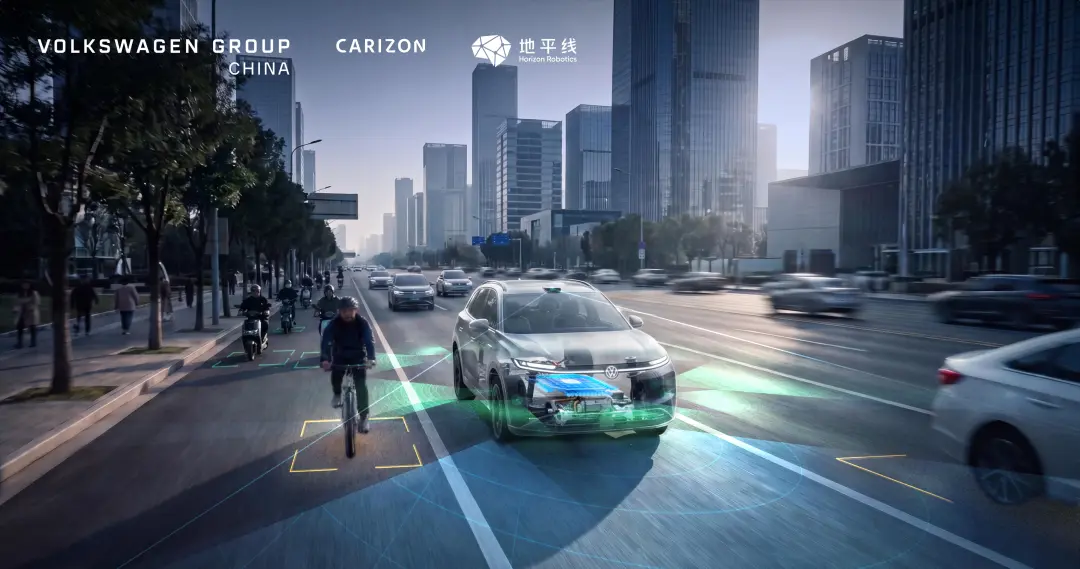
Horizon Robotics secures its first white-box AI foundation model licensing agreement with a foreign automaker, embedding its technology stack into Volkswagen's China architecture and unlocking a multi-year, billion-yuan revenue stream that analysts say reframes the company's global growth trajectory.
The partnership, announced July 22, 2026, marks a structural upgrade from conventional component supply to foundational technology co-development. Volkswagen AG and Horizon Robotics, operating through their joint venture CARIZON, have agreed that CARIZON will receive open-layer access to Horizon's HSD AI foundation model under a white-box licensing framework — granting Volkswagen the right to independently develop and iterate a unified AI driving solution tailored to China's complex traffic environment. The first L3-capable autonomous driving system built on this stack is scheduled to begin customer deliveries in the second half of 2027.
Market reaction was swift. The announcement arrived one day after Horizon Robotics disclosed a stronger-than-expected H1 2026 earnings preview, with continuing-operations revenue projected at RMB 1.93 billion to RMB 2.08 billion (US$268 million–US$289 million), representing year-on-year growth of up to 34.5% — materially above the institutional consensus range of 25%–30%. Gross margin held in the 60%–66% band, a level rare in automotive hardware supply chains and one that underscores the scalability of the company's platform licensing model.
White-Box Access Shifts the Technology Power Dynamic
The licensing structure is the deal's most consequential element for the broader industry. Traditional automotive AI supply arrangements operate as black-box integrations: the automaker buys a finished system and has limited visibility into — or control over — the underlying model. White-box authorization inverts that dynamic. CARIZON gains access to Horizon's model weights, BPU chip intellectual property, and full development toolchain, enabling Volkswagen to customize, retrain, and iterate the solution against its own vehicle platforms and safety validation standards without dependency on Horizon's release cycles.
This architecture mirrors what Horizon's management calls an "ARM + Android" platform model — a deliberate analogy to the semiconductor and mobile OS industries, where a single foundational layer generates recurring, cross-cycle licensing fees across multiple OEM customers. For Volkswagen, the arrangement preserves engineering sovereignty over vehicle-level integration; for Horizon, it converts a project-based revenue event into a durable annuity.
The new AI foundation model will operate in close coordination with CARIZON's in-development C7H system-on-chip and the GAIA world-model data platform, forming a vertically integrated autonomous driving R&D stack that Volkswagen intends to deploy across both passenger vehicle and Robotaxi applications.
Seven EV Models Anchor Near-Term Volume; CEA Architecture Extends the Runway
The commercial delivery chain is already in motion. CARIZON's full-scenario advanced driver assistance system (ADAS), featuring urban Navigate-on-Autopilot (NOA), entered mass production in Q3 2026 and will be fitted to seven new electrified models across Volkswagen Group's three China joint ventures. This follows the initial delivery milestone reached at end-2025, when CARIZON's first-generation ADAS — offering highway navigation pilot and memory parking — was deployed on the ID. Yizhong 07 and the refreshed ID. Yizhong 06.
The technology's scalability is further anchored by Volkswagen's China-developed regional-control electrical/electronic architecture, the CEA platform. Because CEA is designed as a unified backbone across multiple vehicle lines, the Horizon-derived AI stack can be ported to an expanding product matrix with limited incremental engineering cost — a structural multiplier on both unit economics and addressable volume.
Volkswagen Group CEO Oliver Blume described China as the group's most important global innovation engine, stating that the deepened collaboration would "combine world-class AI capabilities with our engineering expertise to better serve Chinese customers and support selected international markets." Volkswagen Group China Chairman and CEO Ralf Brandstätter emphasized that the on-schedule ADAS mass production validated the joint venture's technical delivery capability, and that the L3 and L4 development roadmap would now advance "faster, safer, and at scale."
Horizon's Founder Raises Long-Term Growth Target to 60% CAGR
The financial read-through is significant. Horizon Robotics founder and CEO Yu Kai told China Securities Journal that he has revised the company's projected annual revenue compound growth rate upward to 60% for the coming years, citing the Volkswagen AI foundation model agreement as the primary catalyst. The deal's total contract value is described as reaching the billion-yuan order of magnitude (approximately US$139 million+), with revenue recognition expected to extend over multiple years.
Market analysis identifies two distinct growth vectors. In the near term, seven Volkswagen models entering production in H2 2026 directly lift hardware shipment volumes and associated development service fees. In the medium term, the commencement of L3 deliveries in H2 2027 triggers a second revenue layer: high-performance compute hardware orders and incremental foundation-model licensing tied to higher SAE automation levels. The gross margin profile — structurally supported by the platform licensing model's low marginal cost — is expected to remain above 60% as this mix shift occurs.
China-Developed AI Stack Challenges Global Autonomy Incumbents
The geopolitical and competitive dimensions extend beyond bilateral financials. Horizon Robotics has, as of mid-2026, enabled 11 automakers and over 40 vehicle models to export overseas, with lifetime export design-wins totaling 2 million units. Three international OEM design-win programs carry a combined lifetime volume of 10 million units.
The Volkswagen white-box agreement now positions Horizon's HSD foundation model — which the company says requires no scene-specific retraining and generalizes across passenger, commercial, and Robotaxi use cases — as a credible alternative to the Western-dominated autonomous driving software stack in markets spanning Europe, Southeast Asia, and South America. Volkswagen's global NEV product matrix, which reached approximately 9 million annual deliveries and generated revenue of EUR 321.9 billion in 2025, provides Horizon with a distribution channel of unmatched scale.
Industry analysts note that for international automakers evaluating autonomous driving suppliers, Horizon's model addresses a structural tension: the desire for in-house development capability versus the prohibitive cost of building foundational AI infrastructure from scratch. The white-box platform resolves that tension at a fraction of the capital outlay, a value proposition with demonstrated replication potential across European and Southeast Asian OEM targets.
As China's regulatory framework for L3 commercial deployment continues to mature in 2026, the Volkswagen-Horizon partnership establishes a template — technology sovereignty for the OEM, platform economics for the supplier — that could define how the next generation of global autonomous driving supply chains is structured.
Related Coverage:
Horizon Robotics Deploys HSD V2.0 Amid Customer Chip Self-Development Risk